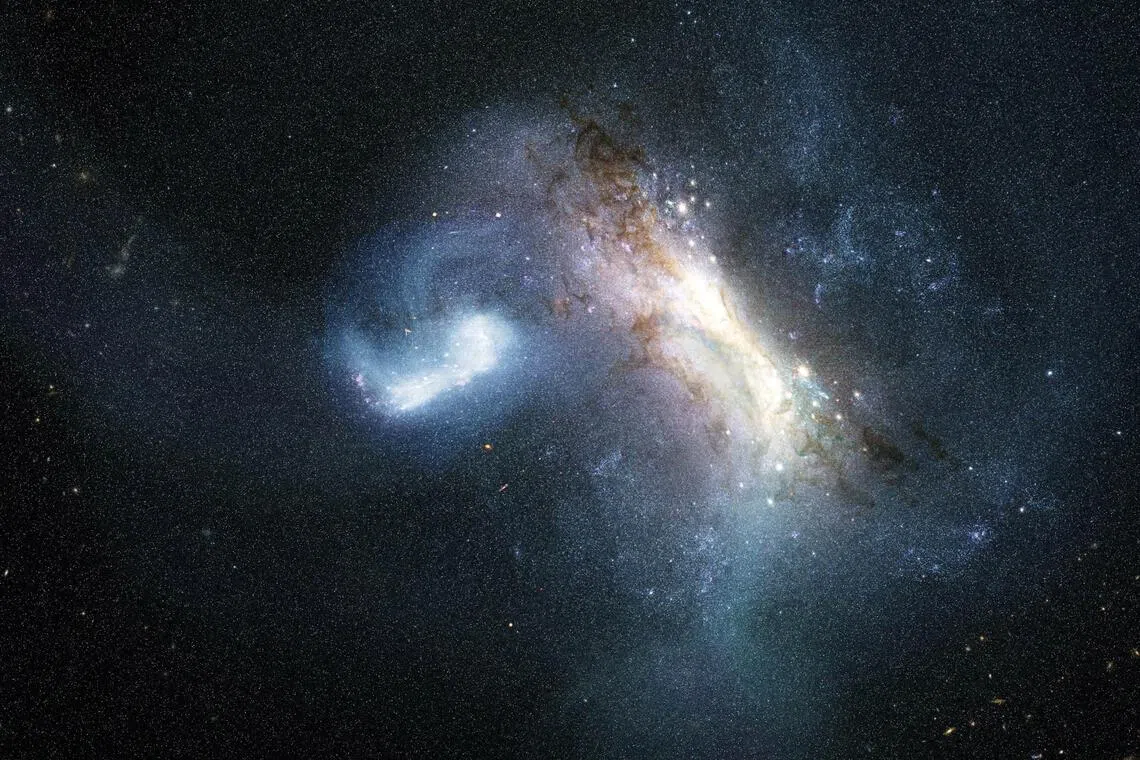
The Milky Way devoured a smaller galaxy about 11.8 billion years ago

The Straits Times World News · collected 2026-08-18
Read the original at The Straits Times World News ↗

Summary

Scientists have discovered evidence that the Milky Way devoured a smaller galaxy, known as LKH (Low-energy-Kraken-Heracles), about 11.8 billion years ago, when the universe was just 15% of its current age. The smaller galaxy is estimated to have contained stars with a mass equivalent to 500 million times that of the sun at the time of the merger. Researchers used data from the Hubble and Gaia telescopes to study stellar clusters near the Milky Way's center, revealing signs of this ancient galactic collision. This discovery suggests that the Milky Way grew not only through forming its own stars but also by merging with smaller galaxies caught in its gravitational pull.
Written by the local model on 2026-08-18, using this article's own text rather than the other coverage of the same event (that is the story summary below).

Signals How these are calculated →

Claims extracted
21
claim-shaped sentences
Uncertain
0%
0 of 21 hedged
Leaning
not scored
needs a local LLM pass
Publisher trust
94.6
red-flag proxy, not a credibility rating
Outlets on this story
2
Science
Narrative spread
1
articles carrying this framing
Analyzed 2026-08-18 · how these are computed

AI analysis (generated at analysis time, not now)

Story summary

The Milky Way galaxy devoured a smaller galaxy approximately 11.8 billion years ago, when the universe was only less than 15% of its current age. This event represents the earliest-known galactic merger in the Milky Way's history. The smaller galaxy, classified as a dwarf galaxy, contained stars with a mass equivalent to 500 million times that of the sun, which is about a quarter the size of what the Milky Way was at the time. Scientists used data from the Hubble and Gaia telescopes to study clusters of stars near the center of the Milky Way, discovering evidence of this ancient merger. This discovery shows how the Milky Way grew not only by forming new stars but also by merging with smaller galaxies caught in its gravitational pull.

Written for “Galaxy Collision” on 2026-08-31, grounded in this article and the 1 other(s) covering the same event.
Why this leaning score
This article does not take a side on a contested political question, so it has no leaning score. That is an answer rather than a gap: a match report or a rescue can be warmly or critically written without being left or right, and scoring it anyway is how approval of a subject gets recorded as a political position.
No political leaning scored for article 962 · logged 2026-08-25

Story

📰 Galaxy Collision
Science · 2 article(s) covering the same event.

How this is being covered How these are calculated →

Article leaning vs. publisher reliability
Source leaning vs. consistency

Compared with similar articles

This article reads unscored and hedges 0% of its claims. Each row says how that neighbour differs.
CBC | World News · 0.97 cosine similarity
⚖️ leaning not scored 🔴 0% hedged 0 of 21 📰 publisher trust 95
“Both articles describe the exact same incident, with identical dates and details about the Milky Way swallowing a smaller galaxy approximately 11.8 billion years ago.”

Publisher

The Straits Times World News · 95 article(s) · 0 correction(s) detected
SignalValueWeight
Correction rate 0.000 0.4
Uncertainty density 0.108 0.25
Assertive mismatch rate 0.000 0.35
No corrections detected for this publisher. That may mean careful reporting, or simply that nothing has been checked.

Who wrote this

No reporter is named on this article.

Topics

Bologna INAF Italy WASHINGTON the National Institute for Astrophysics

Subjects

Massari PERSON · 5× Bologna GPE · 1× Davide Massari PERSON · 1× INAF ORG · 1× Italy GPE · 1× Nature Astronomy ORG · 1× REUTERS ORG · 1× WASHINGTON GPE · 1× the National Institute for Astrophysics ORG · 1×

Narrative

The Milky Way devoured a smaller galaxy about 11.8 billion years ago AI generated WASHINGTON - The Milky Way, a large and spiral-shaped galaxy that is home to hundreds of billions of stars including our sun, has taken a long and complicated path to achieve its current dimensions, as illustrated by new research documenting a milestone event early in its history.
framing: assertive · carried by 1 article(s) · first seen 2026-08-18
🔮 “I would say that from the point of view of stars, the merger was rather peaceful, with no star-to-star crashes.
2026-08-18 · The Straits Times World News
The Milky Way devoured a smaller galaxy about 11.8 billion years ago · assertive framing

Claims (21 extracted, 0 hedged)

The Milky Way devoured a smaller galaxy about 11.8 billion years ago AI generated WASHINGTON - The Milky Way, a large and spiral-shaped galaxy that is home to hundreds of billions of stars including our sun, has taken a long and complicated path to achieve its current dimensions, as illustrated by new research documenting a milestone event early in its history. asserted
that → devour → history
Scientists observing clusters of stars congregated near the Milky Way’s centre have discovered evidence that our galaxy swallowed a smaller galaxy roughly 11.8 billion years ago, when the universe was less than 15 per cent of its current age. asserted
universe → observe → age
The event represents the Milky Way’s earliest-known galactic merger and shows how it grew not only by forming its own stars but by merging with smaller galaxies caught in its gravitational pull. asserted
it → represent → pull
The smaller galaxy is classified as a dwarf galaxy, differentiating it from larger galaxies like the Milky Way. asserted
galaxy → classify → Way
The researchers estimate that it contained stars with a mass equivalent to 500 million times that of the sun at the time of the merger, about a quarter the size of what the Milky Way was at the time. asserted
Way → estimate → time
The researchers used the orbiting Hubble and Gaia telescopes to study stellar clusters, each containing hundreds of thousands of stars, inhabiting a region spanning the Milky Way’s innermost 20,000 light-years, gauging their age, chemical composition and trajectory. asserted
researchers → use → age
A light-year is the distance light travels in a year, 9.5 trillion km. asserted
light → travel → year
These stars became part of the Milky Way after a galactic merger that occurred about 2 billion years after the Big Bang event that initiated the universe, they said. asserted
they → become → universe
The dwarf galaxy where they originated was given the name Low-energy-Kraken-Heracles, or LKH, in recognition of three earlier studies that examined the possibility of such a primordial merger. asserted
that → originate → merger
“The key finding of our research is the unambiguous discovery of the first merger event experienced by our galaxy in its infancy,” said astrophysicist Davide Massari of the National Institute for Astrophysics, or INAF, in Bologna, Italy, lead author of the study published in the journal Nature Astronomy. asserted
Massari → experience → journal
Whether the Milky Way’s early growth was fuelled by homegrown star formation or a galactic merger has been a matter of debate, Massari said. asserted
Massari → fuel → debate
The new study indicates that the merger infused the Milky Way early in its history with a large volume of stars and interstellar gas that feeds star formation, as well as the mysterious substance called dark matter. asserted
that → indicate → formation
“I would say that from the point of view of stars, the merger was rather peaceful, with no star-to-star crashes. asserted
merger → say → crashes
But from the point of view of the gas, the merger was more ‘explosive’ – likely, the collision between the gas from LKH and that from the Milky Way triggered the formation of many stars,” Massari said. asserted
Massari → trigger → stars
Massari said there are probably many stars that originally formed in the dwarf galaxy that still are buried in the inner regions of the Milky Way, some of them inside stellar clusters. asserted
that → say → clusters
Because of all the interstellar dust in this region, however, it is very difficult to identify individual stars, Massari said. asserted
Massari → identify → stars
The Milky Way is known to have been involved in two other massive galactic mergers. asserted
Way → know → mergers
It absorbed a dwarf galaxy called Gaia-Sausage-Enceladus about 1.8 billion years after the LKH merger. asserted
It → absorb → merger
And over the past approximately 6 billion years it has been combining with the Sagittarius dwarf galaxy. asserted
it → combine → galaxy
“Every single one of these mergers had an influence on the events that have led to the formation of our own solar system, and ultimately of Earth,” Massari said. asserted
Massari → have → Earth
“This is why I think that reconstructing the pieces of the Milky Way’s past effectively contributes to answering the big question about, ‘Where do we come from?‘“ asserted
we → think → Where

💬 Give feedback
🕘 History 🎫 Support