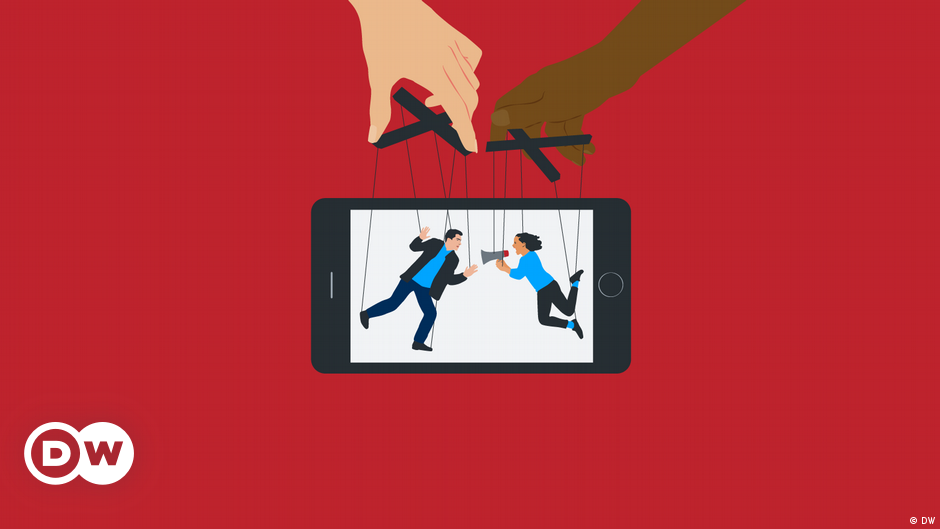
Fact check: How do I spot propaganda?

World | Deutsche Welle · collected 2026-08-18 · by Thomas Sparrow, Kathrin Wesolowski
Read the original at World | Deutsche Welle ↗

Summary

A fact-checking article from Deutsche Welle explores how to spot propaganda in the age of artificial intelligence, citing examples of AI-generated animations used to shape public opinion during the 2026 US-Iran war (note: this appears to be an error and may refer to a different conflict). According to Piers Robinson, a political scientist with the Organisation for Propaganda Studies, propaganda aims to persuade individuals to act or behave in a particular way, often through misinformation or vilification of opponents. Media outlets can inadvertently spread propaganda by amplifying false information, such as the case of RT's coverage largely reflecting the Russian government's official position.
Written by the local model on 2026-08-19, using this article's own text rather than the other coverage of the same event (that is the story summary below).

Signals How these are calculated →

Claims extracted
55
claim-shaped sentences
Uncertain
5%
3 of 55 hedged
Leaning
not scored
needs a local LLM pass
Publisher trust
94.6
red-flag proxy, not a credibility rating
Outlets on this story
1
Technology
Narrative spread
1
articles carrying this framing
Analyzed 2026-08-19 · source text last changed 2026-08-19 · how these are computed

AI analysis (generated at analysis time, not now)

Story summary

The Iranian government has created AI-generated animations to promote its military power on social media, including a video showing US Vice President JD Vance rampaging through Tehran like Godzilla, which has amassed millions of views. These animations are an example of modern propaganda, which uses technology to shape people's beliefs and attitudes. Propaganda is the deliberate use of information by governments and other actors to influence public opinion, often by selectively presenting facts or omitting important context. It can be found in countries around the world, not just authoritarian regimes like Russia, China, and North Korea**. The videos were created as part of a broader effort to promote Iranian military power and counter perceived threats from the US. This is not an isolated incident, but rather an example of how propaganda has evolved with technology to reach wider audiences.

Written for “Fact Checking Propaganda” on 2026-08-31, grounded in this article and the 0 other(s) covering the same event.
Why this leaning score
The article's own words the score was based on. Each is quoted verbatim and was checked against the article text before being stored, so you can find it in the original.
Score -0.60 Confidence high 1 quote(s) discarded as not found in the article
Leaning score -0.60 for article 956 (high confidence, 2 verified quotes) · logged 2026-08-25

Story

📰 Fact Checking Propaganda
Technology · 1 article(s) covering the same event. This is the one the site leads with.

How this is being covered How these are calculated →

Article leaning vs. publisher reliability
Source leaning vs. consistency

Compared with similar articles

This article reads unscored and hedges 5% of its claims. Each row says how that neighbour differs.
World | Deutsche Welle
⚖️ leaning not scored 🔴 17% hedged 9 of 54 📰 publisher trust 95
“Article A mentions a US-Iran war in 2026 and animated propaganda videos, while Article B refers to a Russian disinformation campaign called 'Doppelgänger' related to the invasion of Ukraine in 2022”
World | Deutsche Welle
⚖️ leaning not scored 🔴 10% hedged 5 of 50 📰 publisher trust 95
“Article A mentions the 2026 US-Iran war and a specific example of propaganda using AI-generated animations, while Article B discusses AI-generated images in general”

Publisher

World | Deutsche Welle · 73 article(s) · 0 correction(s) detected
SignalValueWeight
Correction rate 0.000 0.4
Uncertainty density 0.108 0.25
Assertive mismatch rate 0.000 0.35
No corrections detected for this publisher. That may mean careful reporting, or simply that nothing has been checked.

Who wrote this

Thomas Sparrow
4 article(s) here · 1 carrying a prediction
🔮 Some may pretend to be ordinary users; others can impersonate politicians, institutions or journalists.
🔮 As part of our verification workflow we may use AI detectors to help assess whether content has been created or manipulated with AI.
2026-08-20 · assertive framing · How DW fact-checks fake news
🔮 Look closely at the picture You may remember the story of a Syrian teenager who helped stop a knife attack in the German city of Hamburg in 2025.
2026-08-19 · assertive framing · Fact check: How do I spot AI-generated images?
🔮 The more information you can find out, the better you will be able to evaluate a source.
2026-08-18 · assertive framing · Fact check: How do I spot propaganda?
More on this subject from Thomas Sparrow
Fact check: How do I spot fake social media accounts, bots and trolls?
2026-08-20 · World | Deutsche Welle · 59% similar
Fact check: How do I spot AI-generated images?
2026-08-19 · World | Deutsche Welle · 55% similar
All 4 articles by Thomas Sparrow →
Kathrin Wesolowski
1 article(s) here · 1 carrying a prediction
🔮 The more information you can find out, the better you will be able to evaluate a source.
2026-08-18 · assertive framing · Fact check: How do I spot propaganda?
The only article under this byline in the corpus.

Topics

Iran Iraq Russia Russian Tehran

Subjects

Iraq GPE · 2× RSF ORG · 2× Russian NORP · 2× China GPE · 1× Godzilla PERSON · 1× Iran GPE · 1× JD Vance PERSON · 1× North Korea GPE · 1× Russia GPE · 1× Tehran GPE · 1×

Narrative

Ask yourself the following questions: - Is the post presenting complex issues in simple, black-or-white terms? - Is it claiming that only one viewpoint is acceptable? - Is it demonizing groups or opponents? - Is it using facts selectively and leaving out important context? - Is it using statistics in a misleading way? Finally, be skeptical of volume.
framing: assertive · carried by 1 article(s) · first seen 2026-08-18
🔮 The more information you can find out, the better you will be able to evaluate a source.
2026-08-19 · World | Deutsche Welle
Fact check: How do I spot propaganda? · assertive framing

Claims (55 extracted, 3 hedged)

The 2026 US-Iran war was not just fought on the battlefield, but also across social media. asserted
war → fight → media
AI-generated animations inspired by "The Lego Movie" showcased Iran's military power, while another animated video depicted a supersized version of US Vice President JD Vance rampaging through Tehran like Godzilla. asserted
video → generate → Godzilla
Accounts sharing this kind of content have amassed millions of views and offer a powerful example of propaganda in the age of artificial intelligence. They also illustrate how propaganda, while far from a new phenomenon, continues to evolve alongside technology. asserted
propaganda → share → technology
And how can you spot it? asserted
you → spot → it
DW Fact check offers tips to help you navigate today's information landscape. asserted
you → offer → landscape
Defining propaganda Propaganda is often described as the deliberate use of information by governments, politicians and other actors to shape people’s beliefs, attitudes or behavior. asserted
Propaganda → define → beliefs
It relies on the selective presentation of information, emphasizing certain facts while omitting or misrepresenting others. asserted
It → rely → others
Propaganda is not only deployed by authoritarian countries like Russia, China and North Korea; it can be found all over the world. asserted
it → deploy → world
A key difference between systems is that propaganda in authoritarian states is often heavily centralized and tightly controlled. asserted
propaganda → control → states
In democratic societies, propaganda is often more pluralistic, produced by a wider range of actors. asserted
propaganda → produce → actors
Moreover, freely accessing alternative media outlets and information is far more straightforward in democracies. asserted
accessing → access → democracies
Talking to DW, Piers Robinson, a political scientist with the Organisation for Propaganda Studies, said propaganda can persuade someone to act or behave in a particular way. asserted
propaganda → talk → way
He cited the example of how US politicians worked to convince the public to support the 2003 invasion of Iraq. asserted
politicians → cite → Iraq
"In that case, famously, they exaggerated intelligence about weapons of mass destruction to make Iraq appear a bigger threat than it really was," said Robinson. asserted
Robinson → exaggerate → destruction
No weapons of mass destruction were ever found in the country. asserted
weapons → find → country
Images presented by the CIA purporting to prove their existence constituted misinformation deployed for propaganda purposes. asserted
Images → present → purposes
The Iraq War demonstrates another key aim of propaganda: vilifying political opponents, rival countries, or cultures or values seen as undesirable or threatening. asserted
War → demonstrate → opponents
Researcherswho have studied his political rhetoric point to his frequent use of name-calling as a technique for discrediting political opponents and to his use of exaggerated claims to portray undocumented immigrants disparagingly. uncertain
studied → study → immigrants
What role do media outlets play in spreading propaganda? asserted
outlets → play → propaganda
Media organizations can spread and amplify propaganda messages either knowingly or by mistake, Christian Mihr of Reporters Without Borders (RSF) told DW. asserted
Mihr → spread → DW
Russian state-funded broadcaster RT, for instance, is often accused of serving as a Kremlin mouthpiece. asserted
broadcaster → fund → mouthpiece
Its coverage largely reflects the Russian government's official position. asserted
coverage → reflect → position
Ideally, media organizations play the opposite role: as watchdogs to sniff out and debunk propaganda. asserted
organizations → play → propaganda
Indeed, media researchers say this is one of the most important tasks expected of journalists. asserted
this → say → journalists
RSF's Mihr said journalists are in an ideal position to help contextualize political propaganda by asking lawmakers tough questions and interviewing independent experts. asserted
journalists → say → experts
Artificial intelligence is dramatically changing the way propaganda is created and distributed. asserted
propaganda → change → way
While producing propaganda once required hours or days of work, AI tools can now generate images, videos and audios in minutes. asserted
tools → produce → minutes
This allows governments and other actors to adapt messages quickly and tailor them to different audiences, platforms and languages. asserted
governments → allow → audiences
That's where the term "slopaganda" comes in. asserted
slopaganda → come → ?
It combines propaganda and slop, a term often used for low-quality, AI-generated material. asserted
It → combine → material
Consider the AI-generated images mentioned above that circulated during the 2026 US-Iran war. asserted
that → consider → war
Their widespread use has led some observers to describe the conflict as a "slopaganda war", highlighting the emergence of a new form of online information warfare. asserted
use → lead → warfare
So, with all this in mind, how can you tell whether you’re looking at propaganda? asserted
you → tell → propaganda
Tips to detect propaganda Although propaganda is often subtle, there are, nevertheless, ways of identifying it. asserted
propaganda → detect → it
One of the most effective ways is to look closely at where the information comes from. asserted
information → look → where
Did a government official or agency publish the message? asserted
official → publish → message
Does it come from a state-funded media outlet? asserted
it → come → outlet
Who runs the source? asserted
Who → run → source
Can I find information about how it is funded? asserted
it → find → information
The more information you can find out, the better you will be able to evaluate a source. asserted
you → find → source
…and 15 more, not listed.

💬 Give feedback
🕘 History 🎫 Support