Mystery of Roman sarcophagus unearthed at Westminster Abbey solved at last, expert says

Read the original at The Guardian ↗
Cite

correspondent, N. D. S. (2026, October 21). Mystery of Roman sarcophagus unearthed at Westminster Abbey solved at last, expert says. The Guardian. https://www.theguardian.com/uk-news/2026/oct/21/mystery-roman-sarcophagus-westminster-abbey-solved-at-last-expert-says

Dated from the outlet's own feed. Check the original for its byline.

The Guardian · collected 2026-10-21 · by Nicola Davis Science correspondent

Quick Summary

A Roman sarcophagus discovered in 1869 within Westminster Abbey grounds has long puzzled archaeologists due to its contents not matching the period suggested by the artifact itself. Consultant archaeologist Warwick Rodwell recently published findings suggesting the remains inside belonged to a medieval abbot, likely Ælfwig who died around 1020, based on radiocarbon dating and historical context. The sarcophagus, originally intended for Roman dignitary Valerius Amandinus but later repurposed, was modified with a large cross, indicating its use in the late Anglo-Saxon period.
Written locally by qwen2.5:14b on 2026-10-21, using this article's own text rather than the other coverage of the same event (that is the story summary below).

AI analysis runs on qwen2.5:14b, locally

Story summary

An 1869 excavation at Westminster Abbey uncovered a Roman sarcophagus containing human remains, which has puzzled archaeologists for decades. Prof Warwick Rodwell, a consultant archaeologist at Westminster Abbey, now claims he has solved the mystery: the remains likely belong to a medieval abbot. The limestone sarcophagus, first discovered in 1820 and dated to the late Roman period, features a Latin inscription honoring Valerius Amandinus and was originally part of a mausoleum wall recess. Prof Rodwell notes that Valerius Amandinus must have been wealthy due to the sarcophagus's grandeur; however, no other Roman artifacts were found nearby, suggesting it was not its original burial site. The lid's large carved cross is believed to be a later addition, supporting the theory that the sarcophagus was repurposed for a medieval abbot's remains.

Written for “Roman Sarcophagus Mystery Solved” on 2026-10-21, grounded in this article and the 0 other(s) covering the same event.

Story

📰 Roman Sarcophagus Mystery Solved
Other · 1 article(s) covering the same event.

Compared with similar articles

Nothing to compare against. No article is close enough to this one for the pipeline to have linked or judged the pair.
How this article was measured signals, leaning charts, publisher record, byline, topics and claims

Signals How these are calculated →

Claims extracted
23
sentences that state something as happening or true
Uncertain
26%
6 of 23 hedged ("reportedly", "may", "according to")
Leaning
not political
takes no side on a contested political question
Publisher signals
66/100
The Guardian's corrections and hedging, across everything collected from it. Not a measure of accuracy.
Outlets on this story
1
Other
Same framing elsewhere
1
articles that frame the event the way this one does
Analyzed 2026-10-21 · how these are computed

How this is being covered How these are calculated →

Article leaning vs. publisher reliability
Source leaning vs. consistency

Publisher

The Guardian · 2190 article(s) · 6 correction(s) detected
Running correction rate · 6 correction(s)

Who wrote this

Nicola Davis Science correspondent
8 article(s) here · 1 carrying a prediction
🔮 “Nobody of lower rank would have been buried in anything like that,” he said, adding that the lid was another clue.
🔮 Livestreaming an execution could cause post-traumatic stress disorder in the viewing public, mental health experts have said after the US confirmed plans to broadcast the death by firing squad of a man who shot dead 13 unarmed soldiers.
🔮 They will share a prize of 12m Swedish kronor (about £901,500).
🔮 Court officials and craftspeople serving early Egyptian kings may have been sacrificed when their ruler died, according to research that found fractures in several ancient skulls.
🔮 But such woes could soon be a thing of the past, with gene-edited bananas that keep their freshly peeled colour now one step closer to reaching British shoppers.
🔮 Drones could help cut the time it takes to get a defibrillator to people experiencing cardiac arrests when not in hospital, researchers have suggested.
🔮 Now experts are hoping a database of canine DNA could offer vital leads.
🔮 Prof Jim Al-Khalili, who will be giving this year’s Royal Institution Christmas lectures on the topic of time, has said people expending their energy on trying to live for ever may be missing out on the here and now.
Also by Nicola Davis Science correspondent
Nothing else under this byline is closely related to this article, so these are simply their most recent.
All 8 articles by Nicola Davis Science correspondent →

Topics

Latin Roman Westminster Abbey the Journal of the British Archaeological Association

Subjects

Rodwell PERSON · 10× Roman NORP · 3× Henry III PERSON · 2× Valerius Amandinus PERSON · 2× Ælfwig PERSON · 2× Latin NORP · 1× Warwick Rodwell PERSON · 1× Westminster Abbey ORG · 1× Wulfnoth PERSON · 1× the Journal of the British Archaeological Association ORG · 1×

Narrative

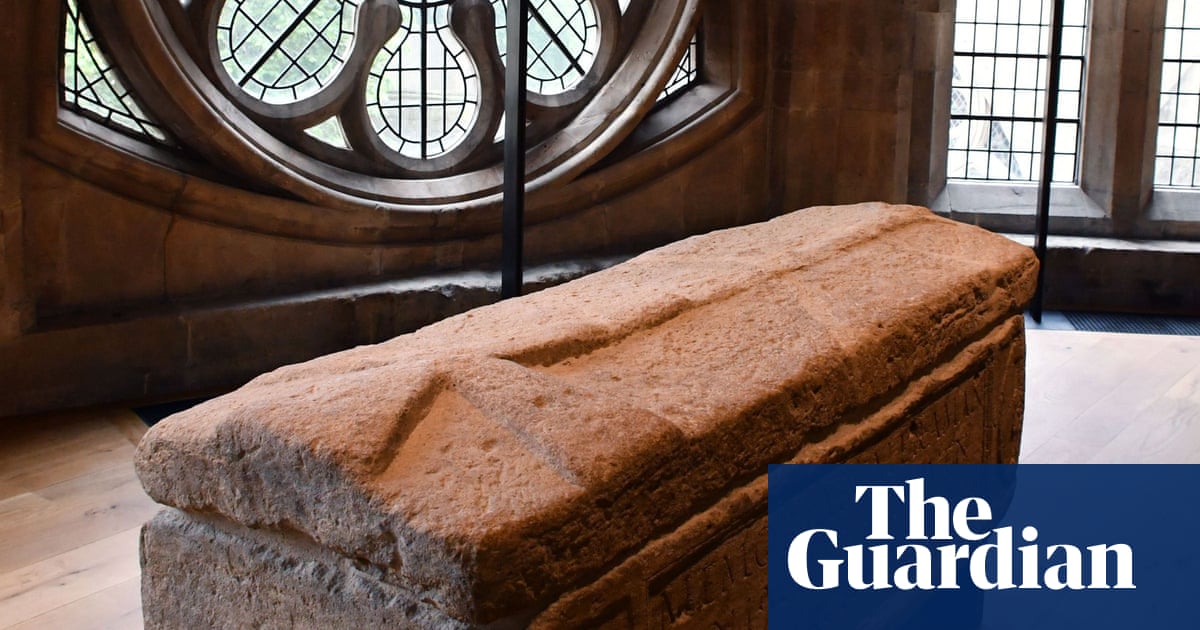
While the sarcophagus itself was from the late Roman period, with a Latin inscription to one Valerius Amandinus and Roman decoration on one side, no Roman artefacts were found in subsequent excavations of the area. “That was not its original place of burial,” said Prof Warwick Rodwell, a consultant archaeologist at Westminster Abbey, noting it was likely the sarcophagus was originally housed in the wall recess of a mausoleum, and that Valerius Amandinus was a wealthy individual. What’s more, the lid of the fourth-century sarcophagus was decorated with a large, carved cross that was later shown to be a modification of the original lid.
framing: mixed · carried by 1 article(s) · first seen 2026-10-21
🔮 “Nobody of lower rank would have been buried in anything like that,” he said, adding that the lid was another clue.

Claims (23 extracted, 6 hedged)

It has all the ingredients of a chilling mystery: the skeleton of an unknown man discovered within a Roman sarcophagus unearthed in the grounds of Westminster Abbey. asserted
It → have → Abbey
Now an expert has said he has solved the longstanding “who-is-it”, suggesting the remains belonged to a medieval abbot. asserted
remains → say → abbot
First discovered in 1820, the limestone sarcophagus was officially excavated in 1869 from what is now an area of grass along the north side of the nave, but was once the yard of a sacristy built by Henry III. asserted
what → discover → III
But the discovery spawned a mystery: whose remains were inside? asserted
remains → spawn → mystery
While the sarcophagus itself was from the late Roman period, with a Latin inscription to one Valerius Amandinus and Roman decoration on one side, no Roman artefacts were found in subsequent excavations of the area. “That was not its original place of burial,” said Prof Warwick Rodwell, a consultant archaeologist at Westminster Abbey, noting it was likely the sarcophagus was originally housed in the wall recess of a mausoleum, and that Valerius Amandinus was a wealthy individual. What’s more, the lid of the fourth-century sarcophagus was decorated with a large, carved cross that was later shown to be a modification of the original lid. asserted
that → find → lid
It runs the full length and the width of the lid, and it’s a very specific late Anglo-Saxon cross type,” Rodwell said. asserted
Rodwell → run → lid
Writing in the Journal of the British Archaeological Association, Rodwell not only describes what was previously known about the sarcophagus but sets out the findings of a more recent investigation in 2018 as part of plans to display the sarcophagus in the Queen’s Diamond Jubilee Galleries. asserted
what → write → Galleries
As part of that work the sarcophagus was taken to a laboratory and its lid removed. asserted
lid → take → laboratory
“And there, inside it, was the skeleton,” Rodwell said. asserted
Rodwell → say → it
The discovery was something of a surprise given written records had suggested the skeleton had been lost. uncertain
skeleton → give → surprise
However, Rodwell said the bones tallied with those depicted in 19th-century drawings. asserted
bones → say → drawings
A subsequent analysis suggested the remains belonged to a man who was 5ft 9in tall and aged between 35 and 49. uncertain
who → suggest → 35
In another twist, when the inside of the sarcophagus was cleaned, experts found a rectangular outline in a white substance in the bottom of the sarcophagus. asserted
experts → clean → sarcophagus
Rodwell said this suggests the body had been covered in powdered lime before being placed into a wooden coffin that sat inside the sarcophagus. uncertain
that → say → sarcophagus
Crucially, radiocarbon dating of the bones suggested they were from the late 10th or early 11th century. uncertain
they → suggest → century
Now Rodwell said he had the answer to the identity of the dead man, suggesting it was most likely a medieval abbott. asserted
it → say → man
“Nobody of lower rank would have been buried in anything like that,” he said, adding that the lid was another clue. asserted
lid → bury → that
“The Latin cross again points to a major ecclesiastic.” asserted
cross → point → ecclesiastic
According to Rodwell, there are two possible abbots who fit the bill: Ælfwig, who died in about 1020, and Wulfnoth who died in about 1049. uncertain
who → accord → 1049
Rodwell believes Ælfwig is the most likely candidate, noting he was already a monk at Westminster when the previous abbot died, and spent about 27 years in the role. asserted
abbot → believe → role
Rodwell suggested the re-used sarcophagus was most likely interred in the eastern arm of the abbey church, with the lid as a floor slab, before being dug up and reburied during the construction work of Henry III. uncertain
sarcophagus → suggest → III
“It’s like so much in archaeology,” said Rodwell. asserted
Rodwell → ’ → archaeology
“There’s a lot more complication than one initially sees.” asserted
one → ’ → ?

💬Give feedback
🕘History 🎫Support