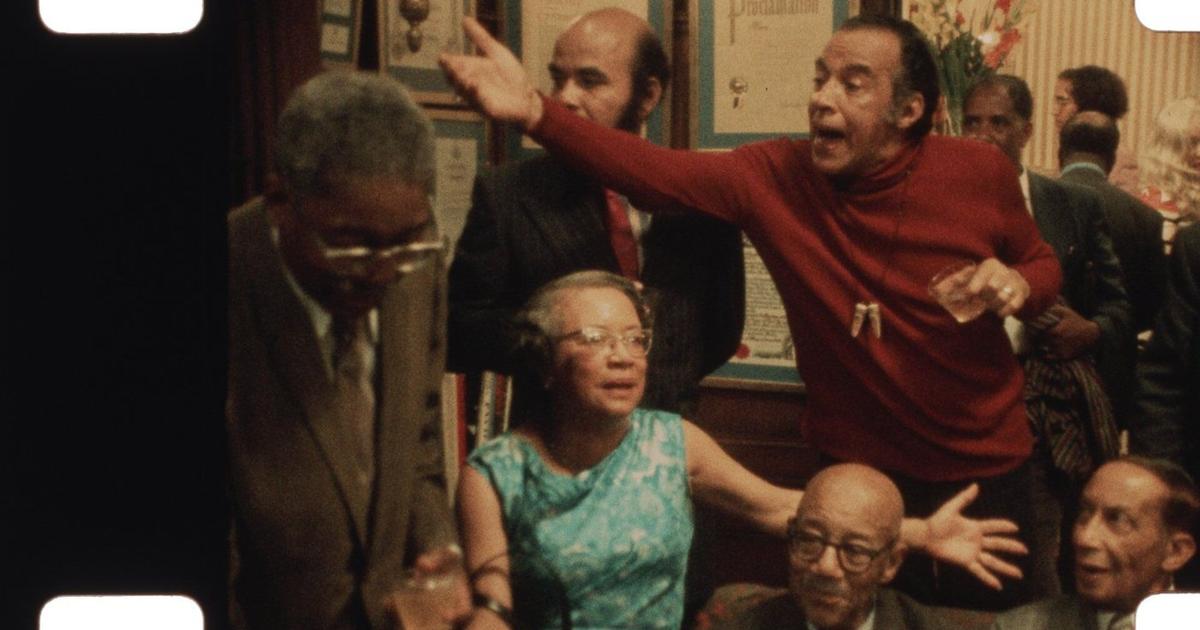
Movie Review: 'Once Upon a Time in Harlem' is more than a staggering time capsule

Read the original at Toronto Star ↗
Cite

Coyle, J. (2026, October 20). Movie Review: 'Once Upon a Time in Harlem' is more than a staggering time capsule. Toronto Star. https://www.thestar.com/entertainment/movies/movie-review-once-upon-a-time-in-harlem-is-more-than-a-staggering-time-capsule/article_82589283-812b-5122-a67c-136efdd8157a.html

Dated from the outlet's own feed. Check the original for its byline.

Toronto Star · collected 2026-10-20 · by Jake Coyle analysis

Quick Summary

"Once Upon a Time in Harlem" is a documentary filmed in August 1972 by William Greaves, who invited notable figures from the Harlem Renaissance era to Duke Ellington’s townhouse to discuss its legacy. After Greaves' death in 2014, his widow and son restored the footage, resulting in a film that explores the complex nature of remembering historical events like the Harlem Renaissance. The documentary captures lively debates among attendees about the essence and significance of this cultural movement, reflecting on both individual achievements and communal experiences.
Written locally by qwen2.5:14b on 2026-10-20, using this article's own text rather than the other coverage of the same event (that is the story summary below).

AI analysis runs on qwen2.5:14b, locally

Story summary

In August 1972, filmmaker William Greaves organized a reunion of key figures from the Harlem Renaissance at Duke Ellington’s apartment in Harlem. The gathering included notable artists like Aaron Douglas, Arna Bontemps, and Eubie Blake, among others. Greaves aimed to film this event for a documentary titled "From These Roots," which would eventually be renamed "Once Upon a Time in Harlem." The film captures the reconnection of these influential figures who had not seen each other in over 50 years, providing a rare glimpse into their lives and contributions during one of America’s most culturally significant eras.

Written for “Once Upon A Time In Harlem Review” on 2026-10-20, grounded in this article and the 1 other(s) covering the same event.
Why this leaning score
This article does not take a side on a contested political question, so it has no leaning score. That is an answer rather than a gap: a match report or a rescue can be warmly or critically written without being left or right, and scoring it anyway is how approval of a subject gets recorded as a political position.
No political leaning scored for article 94673 · logged 2026-10-20

Story

📰 Once Upon A Time In Harlem Review
Entertainment · 2 article(s) covering the same event. See how they differ ↓

Compared with similar articles

This article reads unscored and hedges 3% of its claims. Each row says how that neighbour differs.
TIME
⚖️ leaning not scored 🔴 3% hedged 1 of 32 📰 publisher trust 59
“Both articles describe the same documentary film event from 1972 in Harlem, featuring reconnections of key figures from the Harlem Renaissance.”
How this article was measured signals, leaning charts, publisher record, byline, topics and claims

Signals How these are calculated →

Claims extracted
35
sentences that state something as happening or true
Uncertain
3%
1 of 35 hedged ("reportedly", "may", "according to")
Leaning
not political
takes no side on a contested political question
Publisher signals
63/100
Toronto Star's corrections and hedging, across everything collected from it. Not a measure of accuracy.
Outlets on this story
2
Entertainment
Same framing elsewhere
1
articles that frame the event the way this one does
Analyzed 2026-10-20 · how these are computed

How this is being covered How these are calculated →

Article leaning vs. publisher reliability
Source leaning vs. consistency

Publisher

Toronto Star · 8658 article(s) · 23 correction(s) detected
Running correction rate · 23 correction(s)
2026-10-07
Correction
2026-09-24
Correction

Who wrote this

Jake Coyle
8 article(s) here · 1 carrying a prediction
🔮 In August 1972, the filmmaker William Greaves invited luminaries of the Harlem Renaissance to gather at Duke Ellington’s townhouse and reflect on its legacy.
🔮 Lamentable though that imbalance may be — you may have your own Kurosawa favorite — it’s not hard to see the contemporary appeal of 1963’s “High and Low.”
🔮 LOS ANGELES (AP) — Eva Marie Saint, the pale, willowy actor who won an Academy Award for her first movie, “On the Waterfront,” and starred opposite Cary Grant in the Alfred Hitchcock thriller “North by Northwest,” has died.
🔮 He recently met a reporter for coffee in Toronto to talk about “Wild Horse Nine” and why he’s so eager for the conversation it might generate.
🔮 The good news: Eleazar is, and anyone who sees “Misty Green” will be immediately convinced of that fact.
🔮 Sony is forecasting $23.3 million for the four-day holiday weekend.
Also by Jake Coyle
Nothing else under this byline is closely related to this article, so these are simply their most recent.
All 8 articles by Jake Coyle →

Topics

America Black Hollywood the Harlem Renaissance

Subjects

Greaves PERSON · 4× Black NORP · 2× America GPE · 1× David PERSON · 1× David Greaves PERSON · 1× Duke Ellington’s PERSON · 1× George Schuyler PERSON · 1× Hollywood GPE · 1× Louise Aarchambault Greaves PERSON · 1× William Greaves PERSON · 1×

Narrative

“Once Upon a Time In Harlem” is most moving when the swirl of the party momentarily retreats and the excerpted words of the poets and the writers including Langston Hughes, Zora Neale Hurston and Cullen speak with a depth of meaning that the free-flowing conversation of the gathering — for all its thoughtfulness — can’t match.
framing: assertive · carried by 1 article(s) · first seen 2026-10-20
🔮 In August 1972, the filmmaker William Greaves invited luminaries of the Harlem Renaissance to gather at Duke Ellington’s townhouse and reflect on its legacy.

Claims (35 extracted, 1 hedged)

We’ve had “Once Upon a Time” in the West, in America, in Hollywood. asserted
We → have → Hollywood
It’s a classic kind of movie title phrase, and a good way to start a fairytale or burnish a myth. asserted
It → ’ → myth
But “Once Upon a Time in Harlem” is a staggering documentary event, and has a different relationship with the past. asserted
Time → have → past
It takes place over one day about half a century ago, in 1972. asserted
It → take → 1972
It’s about remembering the Harlem Renaissance of the 1920s, yet another half-century leap in time. asserted
It → ’ → time
In that way, “Once Upon a Time in Harlem” stretches over more than a century of time. asserted
Once → stretch → time
It doesn’t merely resurrect the Harlem Renaissance. asserted
It → resurrect → Renaissance
It’s more about the act of resurrecting the Harlem Renaissance: the need to remember it, to argue over it and to cherish it. asserted
It → ’ → it
The film is less an act of preservation than a lively and dynamic reminder that history is an ever-unfolding continuum. asserted
history → unfold → reminder
It’s also just a cocktail party — a really, really amazing cocktail party. asserted
It → ’ → ?
In August 1972, the filmmaker William Greaves invited luminaries of the Harlem Renaissance to gather at Duke Ellington’s townhouse and reflect on its legacy. asserted
filmmaker → invite → legacy
Greaves, with a small camera crew including his son, David, planned to shoot the event on 16 mm for a film called “From These Roots.” asserted
Greaves → include → Roots
But Greaves ultimately made that 1974 documentary largely with archival photographs. asserted
Greaves → make → photographs
He spent years debating what to do with the footage from the townhouse in 1972, but never found a home for it. asserted
He → spend → it
After Greaves’ death in 2014 at the age of 87, his widow, Louise Aarchambault Greaves, resolved to have the footage restored. asserted
footage → resolve → 87
David Greaves stepped forward to direct the project to the finish line. asserted
Greaves → step → line
“Once Upon a Time in Harlem,” a miracle of a movie, thus has an intoxicating time-capsule feel, like a ‘70s documentary classic that time somehow forgot. asserted
time → have → that
We occasionally hear Greaves’ voice from behind the camera or catch him in a mirror. asserted
We → hear → mirror
But the film is largely observational, floating between conversations as the attendees discuss the meaning and nature of the intellectual, artistic and cultural movement known as the Harlem Renaissance. asserted
attendees → float → Renaissance
Remembering it requires arguing over where to place the most emphasis. asserted
Remembering → remember → emphasis
Is it a matter of recalling certain individuals, and if so, who? asserted
it → recall → individuals
Or was it a flourishing brought on by something more communal and harder to define? asserted
it → bring → something
The writer George Schuyler terms it “an awakening of people who wrote and thought.” asserted
who → term → people
The poet Arna Bontemps calls it “a prism reflecting all of the Black experience from the beginnings to the present.” asserted
poet → call → present
Bontemps’ definition is shared by the spirit of “Once Upon a Time in Harlem.” asserted
definition → share → Harlem
The movie could hardly be more specifically set, on a single day. uncertain
movie → set → day
In dialogue and breadth, the documentary stretches across the years that lead up to the Harlem Renaissance and reverberates across both its contemporary ’70s time and today, when Black history is under considerable threat. asserted
history → stretch → threat
The film’s final images are of children outside in the street, a parting glance that propels “Once Upon a Time in Harlem” into the future. asserted
that → propel → future
Some of those in attendance include Ida Mae Cullen, widow of the poet Countee Cullen; the writer-artist Richard Bruce Nugent; the painter Aaron Douglas; the socialist and bookstore owner Richard B. Moore; Lee Whipper, actor and founder of the Negro Actors Guild; pianist Eubie Blake; and the scholar John Henrik Clarke. asserted
Some → include → Guild
(Ellington was sick and absent, though his presence is felt all around.) asserted
presence → feel → ?
“Once Upon a Time In Harlem” is most moving when the swirl of the party momentarily retreats and the excerpted words of the poets and the writers including Langston Hughes, Zora Neale Hurston and Cullen speak with a depth of meaning that the free-flowing conversation of the gathering — for all its thoughtfulness — can’t match. asserted
conversation → retreat → thoughtfulness
This is also dazzlingly true of Whipper, a grand and eloquent presence then in his mid-90s who eagerly recites, from memory, his speech from the 1943 film “Mission to Moscow.” asserted
who → recite → Moscow
It’s in these moments when any definition between past and present slips away. asserted
definition → ’ → past
In “Once Upon a Time in Harlem,” a documentary shared by father and son, the collective spirit and enduring sound of the Harlem Renaissance come thundering into now. asserted
spirit → share → Renaissance
“Once Upon a Time in Harlem,” a Neon release in select theaters Friday, is rated PG-13 by the Motion Picture Association for some disturbing images, strong racial language, smoking and brief partial nudity. asserted
Once → rat → images

💬Give feedback
🕘History 🎫Support