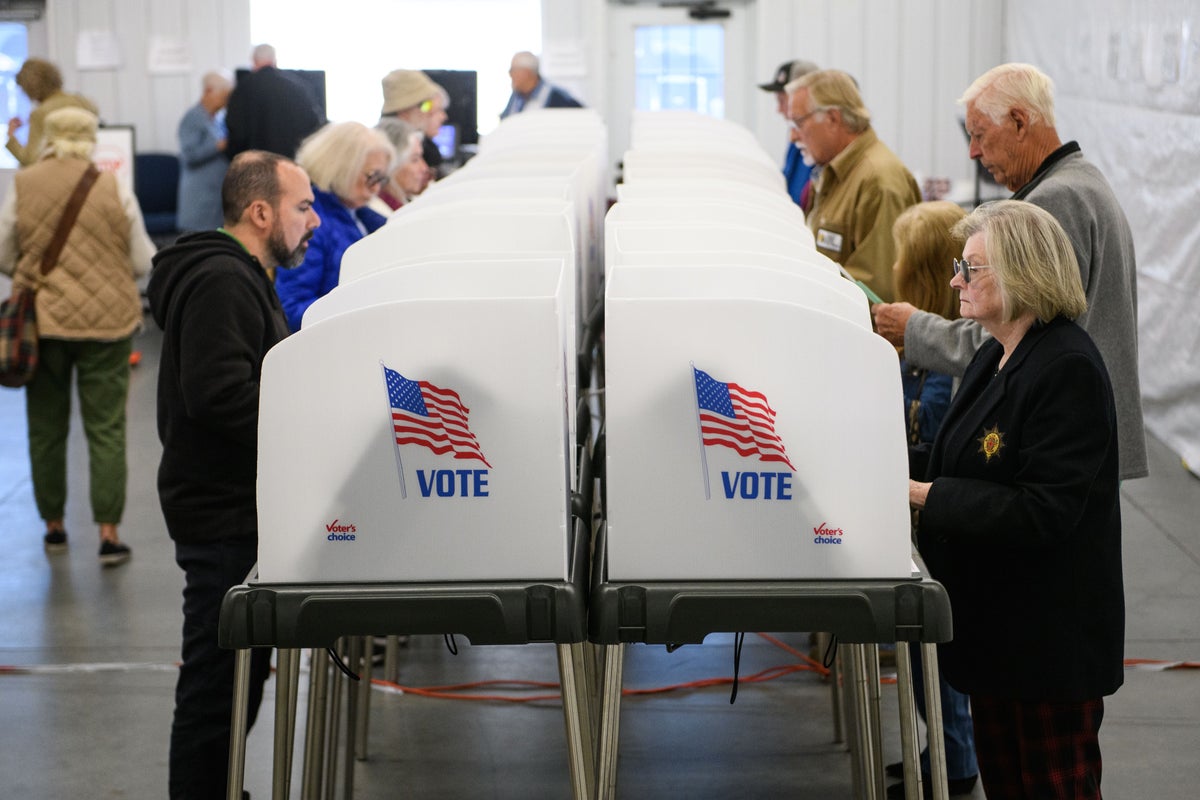
A large majority of Americans do not believe President Donald Trump would accept the results of the upcoming midterm elections if Republicans suffer losses, even as most voters retain confidence in the overall fairness of the vote, according to a survey conducted by The Washington Post, ABC News and Ipsos.
uncertain
voters → believe → Post
The skepticism crosses party lines, with seven in ten Americans overall lacking confidence that Trump would accept a defeat.
asserted
Trump → cross → defeat
That view is shared by vast majorities of Democrats and independents, as well as more than a third of Republicans.
asserted
view → share → Republicans
Most Americans still express trust in how the election will be run.
asserted
election → express → trust
Six in ten respondents said they were confident the midterms would be fair, a view shared by 70 percent of Democrats and 67 percent of Republicans.
asserted
midterms → say → Republicans
Independents were more split, with 51 percent expressing confidence.
asserted
percent → split → confidence
Americans also voiced faith in the vote counting process, with 65 percent confident that ballots would be accurately tallied.
asserted
ballots → voice → process
Democrats were the most confident at 76 percent, followed by 68 percent of Republicans and 55 percent of independents.
asserted
Democrats → follow → independents
Trump has repeatedly raised doubts about electoral integrity over the years, maintaining unproven claims regarding his 2016 and 2020 election results.
uncertain
Trump → raise → results
When asked by NBC News in February if he would trust the results should Republicans lose control of Congress, he said, “I will if the elections are honest.”
asserted
elections → ask → Congress
Courts and independent studies have consistently found no evidence of widespread voter fraud.
asserted
Courts → find → fraud
Under the U.S. Constitution, states administer elections rather than the federal government, but Trump has voiced a desire to “nationalize the voting” and “take over” elections.
asserted
Trump → administer → elections
In a January interview with The New York Times, he expressed regret over not having military personnel seize voting machines following his 2020 loss.
asserted
personnel → express → loss
Local officials reported to The Washington Post that they were taking precautionary steps for potential federal interference or attempts to seize ballots.
asserted
they → report → ballots
Additionally, his administration has scaled back operations at federal agencies focused on voting safeguards and previously sought restrictions on mail-in ballots before being blocked by the Supreme Court.
asserted
administration → scale → Court
By comparison, voters expressed broader confidence in Democratic leaders.
asserted
voters → express → leaders
Sixty-one percent of Americans — including 88 percent of Democrats, 58 percent of independents and 36 percent of Republicans — said they were confident Democratic leaders would accept a loss.
asserted
leaders → include → loss
Among undecided voters and non-voters, only 37 percent felt confident Democratic leaders would accept a loss, while just 16 percent said the same for Trump.
asserted
percent → feel → Trump
Voters across the country offered differing views on the political landscape and election reliability.
asserted
Voters → offer → landscape
Jonnie Smith, a 69-year-old human resources manager from Johnson City, Tennessee, who typically votes Republican but opposes Trump, doubted the president would accept a defeat.
asserted
president → vote → defeat
“He has to throw dirt on it if it doesn’t come out his way, period,” Smith told The Washington Post.
asserted
Smith → have → Post
“He’s shown us that every time he loses.”
asserted
he → show → that
Gary Podbielski, a 67-year-old retired information technology manager near Houston who usually votes Republican but plans to support Democrats this cycle, agreed.
asserted
who → vote → Democrats
“He’ll fight it,” Podbielski said.
asserted
Podbielski → fight → it
“He’ll say something stupid.”
asserted
He → say → something
Other voters offered a more optimistic view of the process.
asserted
voters → offer → process
Patty Nelson, a 58-year-old executive assistant in Jonesboro, Arkansas, who voted for Trump two years ago but does not plan to participate in the midterms, maintained trust in the system.
asserted
who → vote → system
“I always do feel that the elections are fair,” Nelson said.
asserted
Nelson → feel → ?
“I feel like we have a [voting] system in America that works.”
asserted
that → feel → America
However, Jennifer Fenderson, a 41-year-old nurse in Leesburg, Florida, who supported Trump in 2024 and remains undecided for this year’s governor and Senate races, voiced doubts.
asserted
who → support → doubts
“They’re never fair when it comes down to voting,” Fenderson said.
asserted
Fenderson → ’re → voting
“We just vote, but I don’t know if our vote really matters or not — or if they already have who they want selected.”
asserted
they → vote → ?
When asked about the House, 35 percent of voters predicted Democrats would capture the majority, compared with 16 percent who expected Republicans to maintain control.
asserted
Republicans → ask → control
Another 28 percent viewed the chamber as a toss-up, while 21 percent remained undecided.
asserted
percent → view → up
Republican trust in election accuracy has rebounded considerably compared to late 2024, when an ABC News-Ipsos poll showed just 49 percent of Republicans confident in vote counts.
asserted
poll → rebound → counts
Following the 2024 election, a Post-UMD poll indicated nearly all Republicans viewed Trump’s victory as legitimate, with 77 percent stating there was no solid evidence of fraud.
asserted
percent → follow → fraud
The poll surveyed 2,545 adults nationwide October 9-13 and has a margin of error of plus or minus 2 percentage points.
asserted
poll → survey → points
 The Aporia