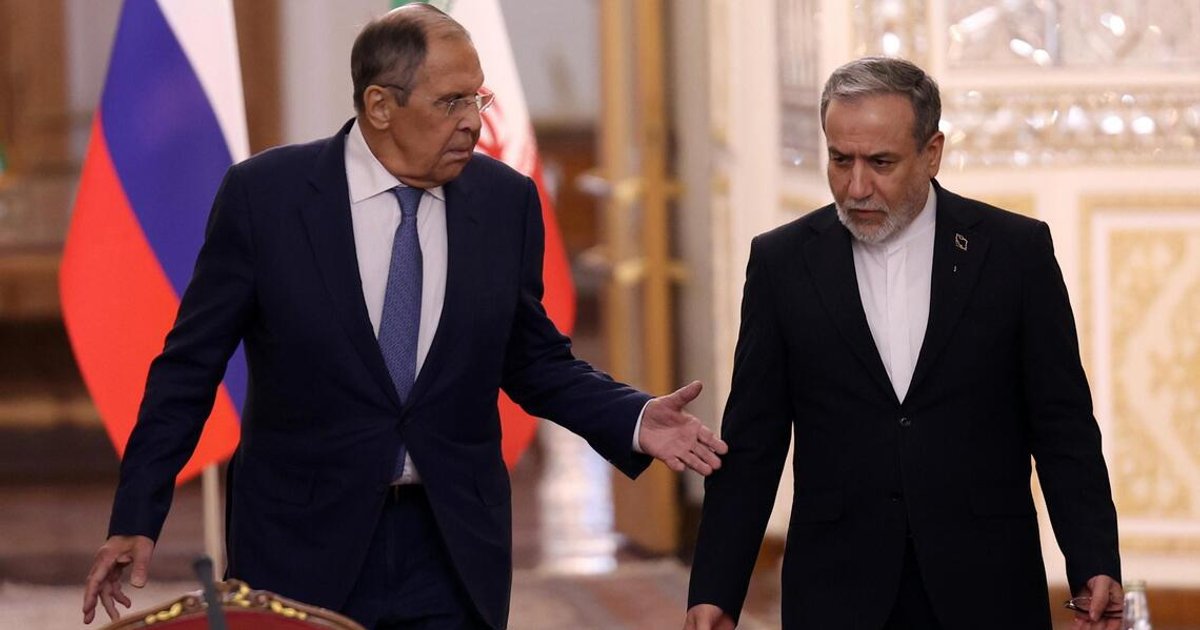
Russia’s Foreign Minister Sergey Lavrov pledged Moscow’s support for Iran when he met his counterpart, Abbas Araghchi, and President Masoud Pezeshkian in Tehran on Monday.
asserted
he → pledge → Monday
On Tuesday, Araghchi wrote on X: “Never in our history have Iran and Russia worked as closely as now.”
asserted
Iran → write → history
Recommended Stories
list of 4 items- list 1 of 4Finland seeking one million land mines as it eyes Russian threat
- list 2 of 4Drone attacks across Sudan escalate, 160 people reported killed
- list 3 of 4US-Ukraine relations sour as Trump, Zelenskyy clash over talks, arms
- list 4 of 4Zelenskyy to hold talks on Russia-Ukraine war with Witkoff, Europeans
asserted
4Zelenskyy → seek → Witkoff
The war on Iran, launched by the United States and Israel on February 28, has pushed up oil prices and handed Moscow a windfall.
asserted
war → launch → windfall
Washington has now also eased sanctions on Russian energy to bring down fuel costs – a major complaint from consumers in the US, who will shortly vote in mid-term elections.
asserted
who → ease → elections
So how close are Moscow and Tehran, and does Russia really want the US-Iran crisis to end?
asserted
crisis → want → ?
Here’s what you need to know:
asserted
you → ’ → what
Why has Lavrov visited Tehran now?
To shore up a wartime partnership, and to shape what happens next.
asserted
what → visit → partnership
Nader Hashemi, an associate professor of Middle East politics at Georgetown University, told Al Jazeera that with both countries fighting wars, Lavrov’s “primary motive is to solidify that alliance”.
asserted
motive → tell → alliance
He said the aim is to advance each side’s war goals: “Russia against Ukraine, Iran against the United States.”
asserted
aim → say → States
But Hashemi said the main reason is that the US-Israeli attack has left the Middle East regional order unravelling, and Moscow wants a say in what replaces it.
asserted
what → say → it
“I suspect there’s a longer-term agenda here,” he said.
asserted
he → suspect → ?
They have a strategic partnership, though their treaty stops short of a military alliance.
asserted
treaty → have → alliance
Putin and Pezeshkian signed a 20-year Comprehensive Strategic Partnership Treaty in Moscow in January 2025.
asserted
Putin → sign → January
It came into force that October, but unlike Russia’s pact with North Korea, it has no mutual defence clause.
asserted
it → come → clause
Ties deepened after Russia’s full-scale invasion of Ukraine in 2022, with Iran sharing Shahed drone technology that enabled Russia to build its own version.
asserted
that → deepen → version
In 2024, Washington accused Tehran of also sending Russia ballistic missiles.
asserted
Washington → accuse → missiles
In Tehran, Lavrov said Russian specialists who had left Iran’s Bushehr nuclear power plant – heavily damaged in US strikes – would gradually return.
asserted
who → say → strikes
On Sunday, Lavrov was in Bahrain for a strategic dialogue session between Russia and the Gulf Cooperation Council (GCC), and he was urged by its members to use Moscow’s influence with Tehran to press for “serious dialogue” and restore shipping through the Strait of Hormuz, the strategic Gulf waterway that Iran effectively closed shortly after the war began earlier this year.
asserted
war → urge → that
Has Russia helped Iran in the war against the US?
asserted
Russia → help → US
The Russian Foreign Ministry has condemned what it called the “unlawful aggression” of the US and Israel, but Moscow has not intervened militarily.
asserted
Moscow → condemn → US
US media outlets, citing intelligence reports, have said Russia and China supplied Iran with satellite imagery and weapons components.
asserted
Russia → cite → imagery
US President Donald Trump has dismissed those reports.
asserted
Trump → dismiss → reports
How has Russia benefitted from the US-Iran war?
Significantly.
asserted
Russia → benefit → war
After Iran effectively closed Hormuz, through which one-fifth of global oil and natural gas supplies are shipped during peacetime, the price of Brent crude rose from around $72 a barrel to as high as $120 a barrel in March and April.
asserted
price → close → March
On Tuesday, Brent – the global benchmark – was trading at above $109 a barrel.
asserted
Brent → trade → 109
By April, revenue from Russia’s biggest oil tax had roughly doubled to about $9bn, according to Reuters calculations, as buyers unable to get supplies from the Gulf switched.
uncertain
buyers → double → Gulf
Since March, the US Treasury has issued waivers allowing sales of Russian oil already loaded at sea.
asserted
Treasury → issue → sea
This month, it waived sanctions on Russian diesel until April 2027.
asserted
it → waive → April
On Friday, Trump suspended newly passed sanctions on Russia and on buyers of its oil and gas.
asserted
Trump → suspend → oil
The move has sparked outrage among members of his own Republican Party who backed the sanctions bill.
asserted
who → spark → bill
On Sunday, he claimed he did not want to “drive, foolishly, Russia away from the bargaining table” in Ukraine talks.
asserted
he → claim → talks
“The Kremlin is using this opportunity to align Russian and American interests on Ukraine to try to stop Ukraine from continuing its attacks on Russian refineries,” John Lough, an associate fellow of the Russia and Eurasia Programme at Chatham House and a senior research fellow at the New Eurasian Strategies Centre, told Al Jazeera.
asserted
Lough → use → Jazeera
“This has led to the breakdown of relations between Trump and Zelenskyy, which suits Moscow’s purposes because it is putting US policy in conflict with Europe’s policy on Ukraine,” he said.
asserted
he → lead → Ukraine
So, does Russia really want the US-Iran war to end?
asserted
war → want → ?
For now, Russia would appear to have every reason to want the stand-off between Washington and Tehran to continue, as it is “benefiting from higher oil prices and from the diesel squeeze that has encouraged Trump to lift sanctions and allow Russia to supply diesel to the US market,” Lough said.
asserted
Lough → appear → market
But Nikita Smagin, an analyst on Russia’s role in the Middle East, told Al Jazeera on Monday that while Russia certainly has a partial interest in the conflict continuing, on balance, it likely does not want to see it escalate, as the consequences could be unpredictable.
uncertain
consequences → tell → balance
Moscow talks to all sides caught up in this conflict, which Hashemi said gives it an edge over Washington.
asserted
Hashemi → talk → Washington
Much of the region has been affected as Iran has launched strikes against US military assets and energy infrastructure in the countries hosting US assets.
asserted
Iran → affect → assets
These include Bahrain, Kuwait, Oman, Jordan and the United Arab Emirates.
asserted
These → include → Bahrain
…and 13 more, not listed.
 The Aporia