Qing dynasty bowl with bats and peaches sells for $2.048 million after 87 years in a Chicago museum

Read the original at Times of India ↗
Cite

TOI World Desk. (2026, October 20). Qing dynasty bowl with bats and peaches sells for $2.048 million after 87 years in a Chicago museum. Times of India. https://timesofindia.indiatimes.com/world/rest-of-world/between-1723-and-1735-qing-artisans-made-a-porcelain-bowl-painted-with-bats-and-peaches-after-passing-through-a-paris-dealer-and-spending-87-years-at-a-chicago-museum-it-sold-for-2-048-million-in-new-york/articleshow/135068919.cms

Dated from the outlet's own feed. Check the original for its byline.

Times of India · collected 2026-10-20 · by TOI World Desk

Quick Summary

A Qing dynasty porcelain bowl from the early 18th century sold for $2.048 million at a Christie's auction in New York, far exceeding its pre-sale estimate. The 14.3-centimeter famille rose bowl was made during Emperor Yongzheng’s reign and features intricate guozhihua designs of peaches and bats symbolizing longevity and good fortune. It had been part of the Art Institute of Chicago's collection since 1939 before being auctioned to support the museum's Asian art acquisitions.
Written locally by qwen2.5:14b on 2026-10-20, using this article's own text rather than the other coverage of the same event (that is the story summary below).

AI analysis runs on qwen2.5:14b, locally

Story summary

A rare Qing dynasty porcelain bowl sold for $2.048 million at a Christie's auction in New York on October 19, 2026, five times its pre-sale estimate. The 14.3-centimeter bowl was crafted during Emperor Yongzheng’s reign (1723-1735) and features six peaches and five red bats, symbols believed to represent longevity and happiness. After passing through a Paris art dealer early in the 20th century, it was acquired by a private collector who donated it to the Art Institute of Chicago in 1939. The museum held onto the bowl for 87 years before deciding to sell it to fund its Asian art collection. Christie’s autumn auction series, which included this sale, raised a total of $25.96 million from Chinese works of art.

Written for “Qing Dynasty Bowl Sale” on 2026-10-20, grounded in this article and the 0 other(s) covering the same event.

Story

📰 Qing Dynasty Bowl Sale
Other · 1 article(s) covering the same event.

Compared with similar articles

Nothing to compare against. No article is close enough to this one for the pipeline to have linked or judged the pair.
How this article was measured signals, leaning charts, publisher record, byline, topics and claims

Signals How these are calculated →

Claims extracted
31
sentences that state something as happening or true
Uncertain
10%
3 of 31 hedged ("reportedly", "may", "according to")
Leaning
not political
takes no side on a contested political question
Publisher signals
59/100
Times of India's corrections and hedging, across everything collected from it. Not a measure of accuracy.
Outlets on this story
1
Other
Same framing elsewhere
1
articles that frame the event the way this one does
Analyzed 2026-10-20 · how these are computed

How this is being covered How these are calculated →

Article leaning vs. publisher reliability
Source leaning vs. consistency

Publisher

Times of India · 2953 article(s) · 2 correction(s) detected
Running correction rate · 2 correction(s)

Who wrote this

TOI World Desk
1072 article(s) here · 1 carrying a prediction
🔮 According to Christie's description of the auction lot, the combination of six peaches and five red bats suggests that the bowl may have been made for Emperor Yongzheng's birthday.
🔮 The appeals could continue, but the bank could not sell the property until both had been finally decided in its favour.
🔮 The family could not afford lawyers, so, while still at school, he taught himself planning law between bouts of exam revision.
🔮 From there, its provenance may have gradually disappeared as it moved through private collections and dealers, states the report.
🔮 When he read in August 2026 that Armstrong's childhood home had gone on the market, he became concerned about what might happen to the property.
🔮 Yellowstone National Park, the world’s first national park, is set to receive a $105 million private gift from energy infrastructure company Tallgrass, marking the largest single private contribution in the history of the US National Park Service.
🔮 Melani Heldt, 34, and her husband Adam paid $4,995 for an antique icebox manufactured in 1910, only to discover that getting the 1,000-pound appliance into their farmhouse would take seven weeks.
🔮 Aaron Spivak and Lior Ohayon founded Hush after exploring how weighted blankets could help people sleep better.
🔮 Rather than opening a restaurant, he chose to develop a consumer product that could grow at scale.
🔮 Armoo would eventually build another company, an influencer marketing agency that reached major brands and was sold for an eight-figure sum when he was 27.
Wire or desk byline, not an individual reporter.
Also by TOI World Desk
Nothing else under this byline is closely related to this article, so these are simply their most recent.
All 1072 articles by TOI World Desk →

Topics

China Chinese Christie's New York Paris

Subjects

Christie's ORG · 7× Chinese NORP · 5× New York GPE · 3× Yongzheng PERSON · 3× the Art Institute of Chicago ORG · 3× Paloympis PERSON · 2× Paris GPE · 2× Asian NORP · 1× China GPE · 1× Daoist NORP · 1×

Narrative

Because these symbols carry several connected meanings, historians and ceramics experts consider bowls with this combination of designs to be among the finest examples of porcelain made for the Yongzheng court.
framing: assertive · carried by 1 article(s) · first seen 2026-10-20
🔮 According to Christie's description of the auction lot, the combination of six peaches and five red bats suggests that the bowl may have been made for Emperor Yongzheng's birthday.

Claims (31 extracted, 3 hedged)

A rare porcelain bowl made by skilled imperial craftsmen during China's Qing dynasty in the early 18th century has sold for $2.048 million (£1.56 million) at a Christie's auction in New York. asserted
bowl → make → York
The 14.3-centimetre bowl was made during the short reign of Emperor Yongzheng, which lasted from 1723 to 1735. asserted
which → make → 1735
In the early 20th century, it passed through the hands of a well-known Paris art dealer. asserted
it → pass → dealer
It was later bought by a private collector and donated to the Art Institute of Chicago in 1939. asserted
It → buy → 1939
The bowl remained in the museum's collection for 87 years before being put up for auction to raise money for the care and growth of its Asian art collection. asserted
bowl → remain → collection
According to a press statement from Christie's, the final sale price was five times the bowl's lowest pre-sale estimate. uncertain
price → accord → Christie
The sale was part of a major two-day autumn auction series in New York, which brought in a total of $25.96 million (£19.8 million) from Chinese works of art. asserted
which → bring → art
The bowl is an example of famille rose porcelain, a style of coloured enamel decoration that was developed to a high level during the Qing dynasty. asserted
that → develop → dynasty
According to catalogue notes published by Christie's, the bowl uses a design method known as guozhihua, or "flowering branch passing over the rim". uncertain
bowl → accord → rim
In this technique, the painted design starts on the outside of the bowl and continues over its rim onto the inside. asserted
design → paint → inside
Creating guozhihua designs on curved porcelain bowls was very difficult for imperial craftsmen because they had only a small, rounded surface to work on. asserted
they → create → surface
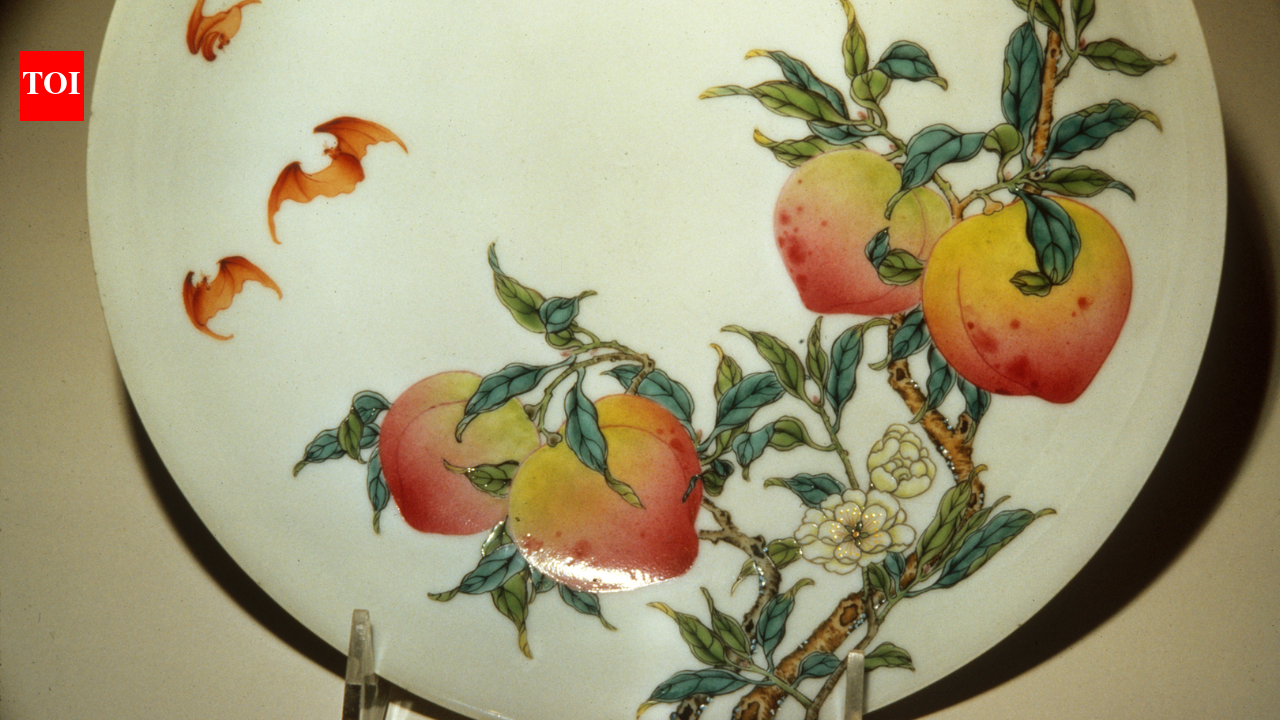
To make the peaches look realistic, the artisans blew fine enamel powders directly onto the glazed ceramic. asserted
artisans → make → ceramic
They then used brushes to add details and create smooth colour changes from pale green to rose pink. asserted
They → use → pink
The design features six ripe peaches and five red bats shown flying across both the outside and inside of the bowl. asserted
design → feature → bowl
In traditional Chinese imperial art, each image has a deeper meaning. asserted
image → have → meaning
According to Christie's description of the auction lot, the combination of six peaches and five red bats suggests that the bowl may have been made for Emperor Yongzheng's birthday. uncertain
bowl → accord → birthday
In Chinese art and symbolism: - Peaches stand for long life. asserted
Peaches → stand → life
They are linked to the Daoist star god Shou Lao and the legendary orchards of the Queen Mother of the West. asserted
They → link → West
- The number six, or liu, is linked to the idea of keeping or extending a long life. asserted
number → link → life
- Five red bats, known as hong fu, represent the Five Blessings: health, long life, wealth, love of virtue and a peaceful death. asserted
bats → know → virtue
- The phrase guoqiangzhi, meaning "branch passing over the wall", sounds like guo chang zhi, which translates as "long peace under good government". - asserted
which → mean → government
Because these symbols carry several connected meanings, historians and ceramics experts consider bowls with this combination of designs to be among the finest examples of porcelain made for the Yongzheng court. asserted
bowls → carry → court
Before joining the Art Institute of Chicago's collection, the bowl belonged to C.T. Loo (1880–1957), a leading Chinese art dealer who worked in Paris during the early 20th century. asserted
who → join → century
It was later bought by Russell Tyson (1867–1963), a Chicago art collector and supporter of the museum. asserted
It → buy → museum
Tyson donated the bowl to the Art Institute of Chicago, where it was officially added to the permanent collection in 1939. asserted
it → donate → 1939
The bowl was offered as a leading item in Christie's sale titled Important Chinese Art Including Ceramics from the Art Institute of Chicago. asserted
bowl → offer → Chicago
Vicki Paloympis, head of the Chinese Ceramics and Works of Art Department at Christie's in New York, spoke about strong demand for imperial artworks with a clear record of ownership. asserted
Paloympis → speak → ownership
"This season we had two fantastic sales that showed great results," Paloympis said in a statement released by Christie's. asserted
Paloympis → have → Christie
"As we have seen in previous seasons, but now more than ever, the strongest results were driven by works that combined superb quality with exceptional provenance." asserted
that → see → provenance
Paloympis added that the strong interest in items from the Art Institute of Chicago showed that buyers place great value on artworks with well-documented ownership histories. asserted
buyers → add → histories
The Art Institute of Chicago will keep the $2.048 million raised from the sale to support future purchases and preservation work across its Asian art department. asserted
Institute → keep → department

💬Give feedback
🕘History 🎫Support