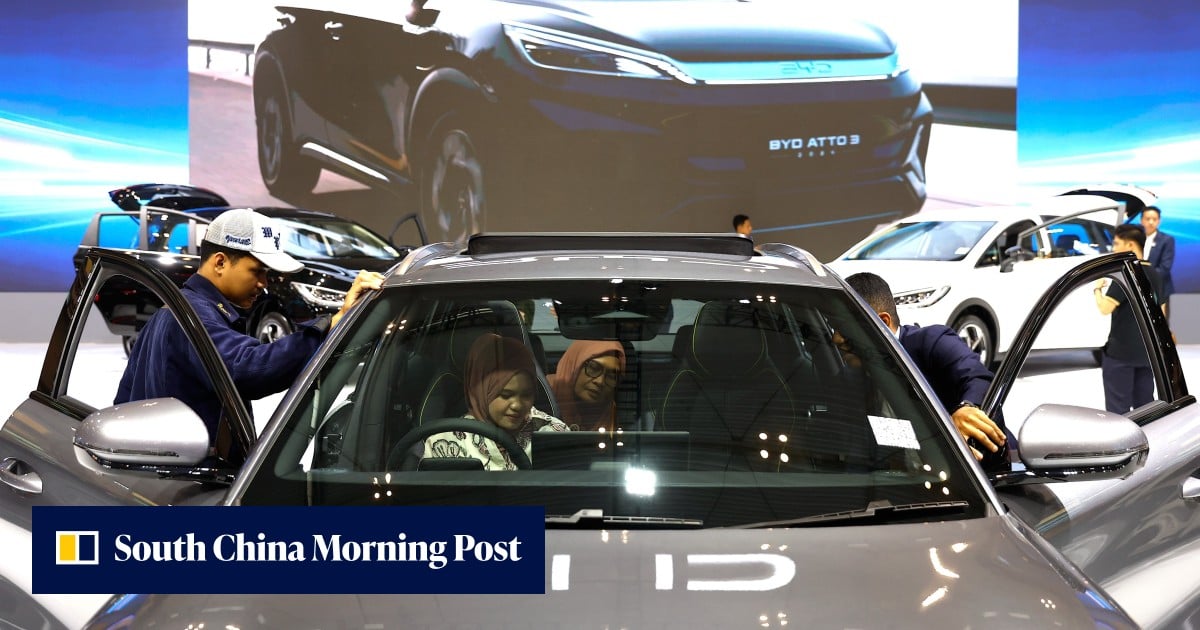
Chinese carmakers gear up European production to sidestep tariffs, import quota

Read the original at South China Morning Post ↗
Cite

Ren, D. (2026, October 20). Chinese carmakers gear up European production to sidestep tariffs, import quota. South China Morning Post. https://www.scmp.com/business/china-evs/article/3371460/chinese-carmakers-gear-european-production-sidestep-tariffs-import-quota

Dated from the outlet's own feed. Check the original for its byline.

South China Morning Post · collected 2026-10-20 · by Daniel Ren

Quick Summary

Chinese car manufacturers are exploring options to establish production facilities within Europe to avoid tariffs and import quotas. This move could involve either building new factories or utilizing idle plants from other automakers. The strategy aims to capitalize on the growing automotive market by producing vehicles locally rather than exporting them, thereby improving profit margins and establishing a broader market presence. According to Morgan Stanley analysts, this shift favors Chinese electric vehicle leaders who have already begun planning for European production.
Written locally by qwen2.5:14b on 2026-10-20, using this article's own text rather than the other coverage of the same event (that is the story summary below).

AI analysis runs on qwen2.5:14b, locally

Story summary

Chinese carmakers are ramping up production within Europe to avoid tariffs and adhere to new import quotas agreed upon by Beijing and Brussels. According to a recent Morgan Stanley research note, this shift aims to sustain the growing demand for hybrid vehicles in one of the world’s major automotive markets. Chinese automakers plan either to invest billions of yuan to establish their own factories or utilize idle plants from international brands. This move marks a strategic pivot towards local production, enhancing market share through profitability rather than just pricing advantages and diversifying export channels into multiple regional markets.

Written for “Chinese Carmakers Expand In Europe” on 2026-10-20, grounded in this article and the 0 other(s) covering the same event.
Why this leaning score
This article does not take a side on a contested political question, so it has no leaning score. That is an answer rather than a gap: a match report or a rescue can be warmly or critically written without being left or right, and scoring it anyway is how approval of a subject gets recorded as a political position.
No political leaning scored for article 92804 · logged 2026-10-20

Story

📰 Chinese Carmakers Expand In Europe
Economy/Business · 1 article(s) covering the same event.

Compared with similar articles

This article reads unscored and hedges 25% of its claims. Each row says how that neighbour differs.
Euronews
⚖️ Leans right 🔴 0% hedged 0 of 4 📰 publisher trust 60
“The articles discuss different aspects of EU-China trade relations without describing the same specific incident.”
How this article was measured signals, leaning charts, publisher record, byline, topics and claims

Signals How these are calculated →

Claims extracted
4
sentences that state something as happening or true
Uncertain
25%
1 of 4 hedged ("reportedly", "may", "according to")
Leaning
not political
takes no side on a contested political question
Publisher signals
64/100
South China Morning Post's corrections and hedging, across everything collected from it. Not a measure of accuracy.
Outlets on this story
1
Economy/Business
Same framing elsewhere
1
articles that frame the event the way this one does
Analyzed 2026-10-20 · how these are computed

How this is being covered How these are calculated →

Article leaning vs. publisher reliability
Source leaning vs. consistency

Publisher

South China Morning Post · 2697 article(s) · 6 correction(s) detected
Running correction rate · 6 correction(s)

Who wrote this

Daniel Ren
9 article(s) here · 1 carrying a prediction
🔮 Analysts say idle factories in Europe could be prime targets as Chinese carmakers look to localise production They plan to either splash out billions of yuan to set up their own factories or tap international marques’ idle plants to build their vehicles, looking to sustain a sales boom in one of the world’s major automotive markets.
🔮 “Relevant information will be released in a timely manner.”
🔮 China’s EV industry faces double blow from EU export quota, VAT rebate cut China’s carmakers have relied on booming exports to ride out a domestic sales slump, meaning new export curbs will hit hard China’s electric vehicle (EV) makers have been hit with a double blow as both Beijing and Brussels introduce measures that will affect their exports, leading analysts to revise down their earnings forecasts for the industry.
🔮 China’s carmakers eye record 12 million overseas sales in 2026 as ‘go global’ plan pays off Buoyant overseas sales could also cushion against a weak domestic market, which slumped 20 per cent in the first eight months of the year “A sluggish domestic market has been fuelling carmakers’ efforts to spur exports,” said Cui Dongshu, secretary general of the China Passenger Car Association (CPCA).
🔮 Chinese EV battery giant CATL starts trial production at Hungarian factory Analyst says development could see it secure massive orders from global marques such as BMW and Volkswagen
🔮 Chinese companies set to undergo supplier audits included heat-control component manufacturer Zhejiang Sanhua Intelligent Controls, auto parts supplier Ningbo Joyson Electronic, and chassis producer Tuopu Group, two corporate executives with business ties to the manufacturers told the South China Morning Post.
🔮 In FocusChina’s ‘Tesla imitators’ have a new mission: build affordable humanoid robots for consumers Robotics has supply chain synergy with smart EV production because key components like cameras and radar, as well as software, are in both When Nio CEO William Li outlined earnings prospects for the Shanghai-based carmaker in March, he could not help but liken the automotive business to the development of robots.
🔮 While the company stresses the tour does not signal the vehicle will be sold in China, some observers believe it could still bolster the brand’s position Tesla is facing weaker sales in China this year, but the American electric vehicle (EV) manufacturer is looking to generate a buzz in its second-largest market by exhibiting its new self-driving vehicle, the Cybercab.
Also by Daniel Ren
Nothing else under this byline is closely related to this article, so these are simply their most recent.
All 9 articles by Daniel Ren →

Topics

Beijing Brussels Chinese European Morgan Stanley

Subjects

Chinese NORP · 4× European NORP · 2× Beijing GPE · 1× Brussels GPE · 1× Morgan Stanley ORG · 1×

Narrative

“Global growth shifts from exporting vehicles to Europe to producing them locally, from price-led market share gains to margin-led positioning, and from a single export channel to a multimarket footprint,” Morgan Stanley analysts said in a research note issued last week after Beijing and Brussels agreed on an import quota for Chinese-made hybrid vehicles.
framing: mixed · carried by 1 article(s) · first seen 2026-10-20
🔮 Analysts say idle factories in Europe could be prime targets as Chinese carmakers look to localise production They plan to either splash out billions of yuan to set up their own factories or tap international marques’ idle plants to build their vehicles, looking to sustain a sales boom in one of the world’s major automotive markets.
2026-10-20 · South China Morning Post
Chinese carmakers gear up European production to sidestep tariffs, import quota · mixed framing

Claims (4 extracted, 1 hedged)

Chinese carmakers gear up European production to sidestep tariffs, import quota asserted
carmakers → gear → quota
Analysts say idle factories in Europe could be prime targets as Chinese carmakers look to localise production They plan to either splash out billions of yuan to set up their own factories or tap international marques’ idle plants to build their vehicles, looking to sustain a sales boom in one of the world’s major automotive markets. uncertain
They → say → markets
“Global growth shifts from exporting vehicles to Europe to producing them locally, from price-led market share gains to margin-led positioning, and from a single export channel to a multimarket footprint,” Morgan Stanley analysts said in a research note issued last week after Beijing and Brussels agreed on an import quota for Chinese-made hybrid vehicles. asserted
Beijing → shift → vehicles
“Such a development would favour Chinese EV leaders with the scale, balance sheets and European manufacturing plans already in motion to pivot quickly.” asserted
development → favour → motion
💬Give feedback
🕘History 🎫Support