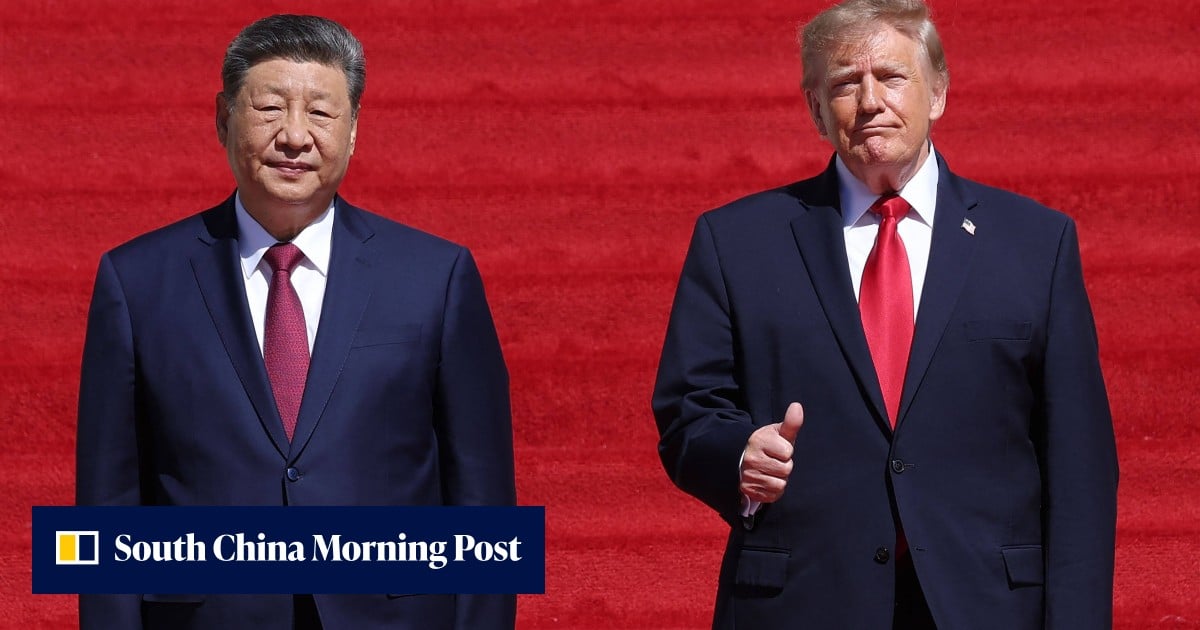
US-China AI talks must ensure safety of both tech and business

Read the original at South China Morning Post ↗
Cite

Huiyao, W. (2026, October 19). US-China AI talks must ensure safety of both tech and business. South China Morning Post. https://www.scmp.com/opinion/china-opinion/article/3370909/us-china-ai-talks-must-ensure-safety-both-tech-and-business?utm_source=rss_feed

Dated from the outlet's own feed. Check the original for its byline.

South China Morning Post · collected 2026-10-19 · by Wang Huiyao

Quick Summary

US-China talks on artificial intelligence have begun with discussions in New York and further commitments from the Xi-Trump summit in Washington, where both leaders agreed to establish a formal AI dialogue and hotline. The next meeting is scheduled for November. These discussions come as American tech companies invest heavily in AI infrastructure despite uncertainty around revenue models, potentially leading to significant financial risks if an AI bubble bursts. Public perception also varies widely: only 38% of Americans view AI positively compared to 85% in China, according to the Ipsos AI Monitor 2026.
Written locally by qwen2.5:14b on 2026-10-19, using this article's own text rather than the other coverage of the same event (that is the story summary below).

AI analysis runs on qwen2.5:14b, locally

Story summary

In October 2026, US-China talks on artificial intelligence held in New York opened pathways for cooperation, further affirmed by the Xi-Trump summit in Washington where both presidents agreed to establish a formal AI dialogue and hotline. With the next scheduled meeting set for November, it is crucial for both nations to continue fostering collaboration. American tech companies are investing heavily in chips, data centers, and energy infrastructure despite uncertain revenue models, potentially leading to significant financial risks if an AI bubble were to burst. According to Ipsos AI Monitor 2026, only 38% of Americans viewed AI products and services as more beneficial than detrimental, well below the global average, while in China this figure was 85%. Additionally, a May survey by Ipsos Consumer Tracker found that most Americans would oppose having a data center in their community.

Written for “Us China AI Talks” on 2026-10-19, grounded in this article and the 0 other(s) covering the same event.
Why this leaning score
The article's own words the score was based on. Each is quoted verbatim and was checked against the article text before being stored, so you can find it in the original.
Reading Leans right (beta estimate) Confidence high
Leaning: leans right for article 91931 (high confidence, 4 verified quotes) · logged 2026-10-19

Story

📰 Us China AI Talks
Politics · 1 article(s) covering the same event.

Compared with similar articles

This article reads leans right and hedges 33% of its claims. Each row says how that neighbour differs.
The Straits Times
⚖️ Leans right 🔴 27% hedged 4 of 15 📰 publisher trust 60
“Article A describes a specific ban on Chinese AI DeepSeek by US agencies, while Article B discusses broader US-China talks and cooperation in AI.”
South China Morning Post · 0.88 cosine similarity
⚖️ leaning not scored 🔴 0% hedged 0 of 5 📰 publisher trust 64
“The articles describe different stages or aspects of ongoing talks and agreements between the US and China regarding AI cooperation, rather than a single specific incident.”
How this article was measured signals, leaning charts, publisher record, byline, topics and claims

Signals How these are calculated →

Claims extracted
9
sentences that state something as happening or true
Uncertain
33%
3 of 9 hedged ("reportedly", "may", "according to")
Leaning
Leans right
of the writing, not the subject · beta estimate
Publisher signals
64/100
South China Morning Post's corrections and hedging, across everything collected from it. Not a measure of accuracy.
Outlets on this story
1
Politics
Same framing elsewhere
1
articles that frame the event the way this one does
Analyzed 2026-10-19 · how these are computed

How this is being covered How these are calculated →

Article leaning vs. publisher reliability
Source leaning vs. consistency

Publisher

South China Morning Post · 2608 article(s) · 6 correction(s) detected
Running correction rate · 6 correction(s)

Who wrote this

Wang Huiyao
1 article(s) here · 1 carrying a prediction
🔮 With the next AI meeting set to happen in November, it is imperative that both countries further cooperation.
The only article under this byline in the corpus.

Topics

American Americans China New York Washington

Subjects

Americans NORP · 2× American NORP · 1× China GPE · 1× New York GPE · 1× Washington GPE · 1× the Ipsos AI Monitor ORG · 1×

Narrative

American tech companies are draining their coffers as they commit vast sums to chips, data centres and energy before the revenue model is even settled.
framing: mixed · carried by 1 article(s) · first seen 2026-10-19
🔮 With the next AI meeting set to happen in November, it is imperative that both countries further cooperation.
2026-10-19 · South China Morning Post
US-China AI talks must ensure safety of both tech and business · mixed framing

Claims (9 extracted, 3 hedged)

In New York last month, US-China talks on artificial intelligence opened up a path of cooperation. asserted
talks → open → cooperation
This was affirmed by the Xi-Trump summit in Washington where both presidents agreed to establish a formal AI dialogue and hotline. asserted
presidents → affirm → dialogue
With the next AI meeting set to happen in November, it is imperative that both countries further cooperation. asserted
countries → set → November
American tech companies are draining their coffers as they commit vast sums to chips, data centres and energy before the revenue model is even settled. asserted
model → drain → chips
Trillions of dollars are being committed to the AI buildout. asserted
Trillions → commit → buildout
While this exposure is not the same as the overleveraging in the mortgage market that triggered the 2008 global financial crisis, a sudden bursting of the AI bubble could have far-reaching consequences. uncertain
bursting → trigger → consequences
Much of US economic growth this year has been from AI or AI-enabling companies. asserted
Much → enable → companies
Yet, only 38 per cent of Americans saw “more benefits than drawbacks” in AI products and services – well below the global average – against 85 per cent in China, according to the Ipsos AI Monitor 2026. uncertain
cent → see → Monitor
In May, the Ipsos Consumer Tracker found that most Americans would oppose a data centre in their community. uncertain
Americans → find → community
💬Give feedback
🕘History 🎫Support