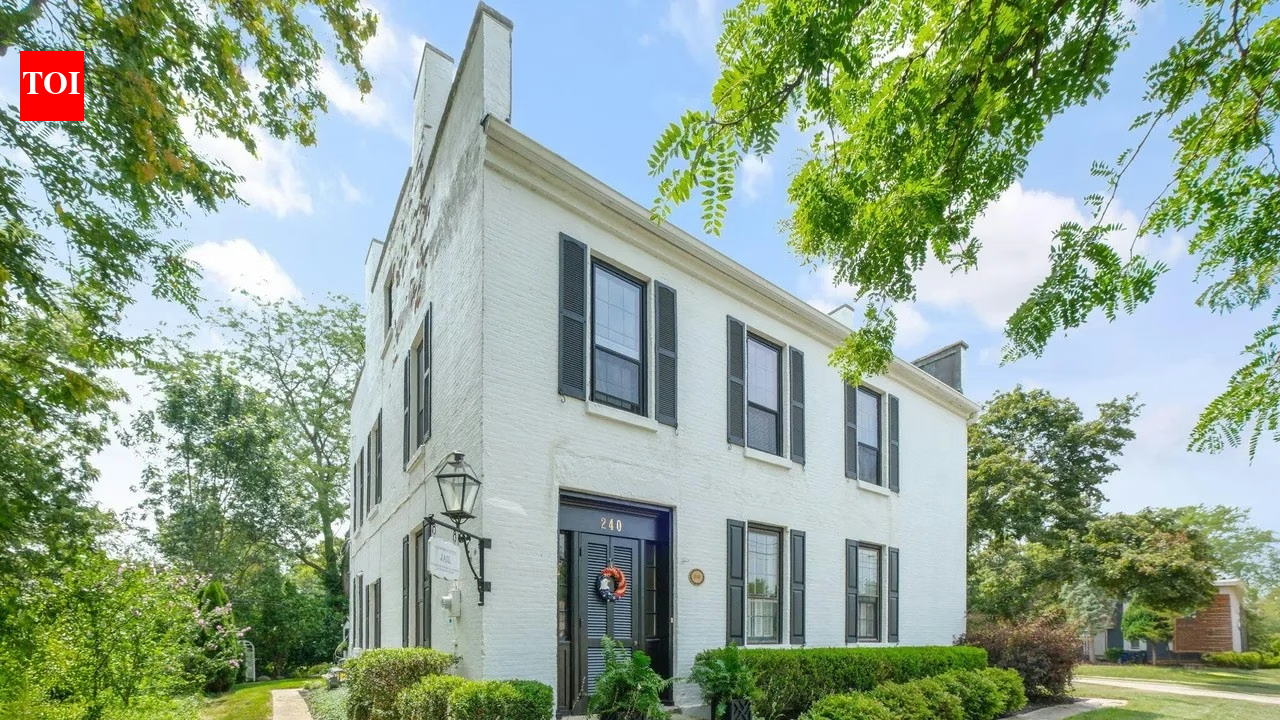
Built in 1847 in Perrysburg, Ohio, a former county jail has been converted into a single-family residence and is now listed at $400,000 with a contingent offer. The property includes six original jail cells that are repurposed as storage spaces, closets, and pantries within the 2,960-square-foot home. Realtor.com reports on how the structure transitioned from civic use to residential through generations of ownership by the Hoffmann family.
Written by the local model on 2026-09-14,
using this article's own text rather than the other coverage of the
same event (that is the story summary below).
A former county jail in Ohio has taken on a very different life after spending more than a century in one family.
asserted
jail → take → family
Built in 1847 in Perrysburg, the historic brick building once housed inmates but was later converted into apartments and eventually became a single-family residence.
asserted
building → build → apartments
Six original jail cells still remain inside the 2,960-square-foot property, with several now serving everyday household purposes such as storage, closets and a pantry.
asserted
several → remain → storage
Listed for $400,000, the unusual home is currently under contract with a contingent offer.
asserted
home → list → offer
A Realtor.com report featuring an interview with listing agent Caroline Hoffmann, whose family owned the property for generations, details how the former jail evolved from a civic building into a distinctive family home.
asserted
jail → feature → home
From county lockup to residential property
The building was constructed in 1847 and originally operated as a county lockup until 1870.
asserted
building → construct → 1870
It subsequently continued to serve as the city jail until 1899, preserving its role as a place of confinement for much of the 19th century.
asserted
It → continue → century
Its connection with the Hoffmann family began decades later.
asserted
connection → begin → family
According to Hoffmann, her great-great-grandfather acquired the property from his brother-in-law in 1924, while that relative had purchased it in 1918.
uncertain
relative → accord → 1918
The historic structure was eventually divided into three separate apartments; one occupied the lower level while two were located upstairs.
asserted
two → divide → level
Each apartment had its own bedroom, bathroom and small kitchen, turning the former jail into an income-generating residential property.
asserted
apartment → have → property
For decades, the building functioned primarily as an investment property, with different tenants living in its converted spaces.
asserted
tenants → function → spaces
6 inmate cells became pantries and closets and the $400,000 home is now under offer
asserted
home → become → offer
(Image Credit: Danberry Realtors via Realtor.com)
How the family turned three apartments into one home
asserted
family → turn → home
The property's role changed around 15 years ago when Hoffmann's parents returned to Ohio and decided to make the building their primary residence.
asserted
building → change → Ohio
Rather than maintaining the three apartments as separate rental units, they allowed the leases to lapse and began using the entire building as one home.
asserted
leases → maintain → home
The original layout still provided some separation between the spaces, but interior doors could be opened to connect the rooms.
uncertain
doors → provide → rooms
This allowed the family to use the former apartments for different purposes while making the property function as a single residence.
asserted
property → allow → residence
The family made practical use of virtually every part of the building.
asserted
family → make → building
A downstairs bedroom became Hoffmann's father's office and later served as a guest room.
asserted
bedroom → become → room
The downstairs living room was used for family gatherings and entertaining.
asserted
room → use → gatherings
Six jail cells became part of everyday life
asserted
cells → become → life
The most striking feature remains the six historic jail cells
asserted
feature → remain → ?
Instead of removing the cells, the family incorporated them into the home's design.
asserted
family → remove → design
Five of the lower-level cells were adapted for storage, including use as walk-in closets, a china cabinet and a pantry.
asserted
Five → adapt → closets
One cell was deliberately left largely intact to preserve a sense of the building's history.
asserted
cell → leave → history
It still contains a wooden plank that once served as a cot, while the family also kept a bucket and other objects there to illustrate how the space would have looked when it was used as a jail.
asserted
it → contain → jail
The unusual arrangement means that the property's dining area sits directly opposite the old cells, creating a feature that is difficult to find in an ordinary residential home.
asserted
that → mean → home
Six original jail cells still remain inside the 2,960-square-foot property, with several now serving everyday household purposes (Image Credit: Danberry Realtors via Realtor.com)
The jail's old infirmary is now a bedroom
Other reminders of the building's former purpose remain upstairs.
asserted
reminders → remain → purpose
Its original door is still in place and weighs about 250 pounds; Hoffmann said it is lead-lined and was designed to keep inmates secured even when they were being treated in the infirmary.
asserted
they → weigh → infirmary
Another heavy door was removed from the lower level by Hoffmann's father.
asserted
door → remove → father
Rather than discarding it, he had it converted into a table.
asserted
it → discard → table
Because of its weight, the family needed specially made sawhorses to move it.
asserted
family → need → it
The result is a home where historic jail hardware has become part of the furniture and interior design rather than simply being preserved behind glass.
asserted
hardware → become → glass
Why the family decided to sell
Selling the property was not an easy decision for the family because of its long history with the building.
asserted
Selling → decide → building
Hoffmann said the family wanted to have some influence over who would become the property's next steward.
asserted
who → say → influence
Rather than eventually having the building sold as part of an estate, they hoped to find a buyer who appreciated its historic character and would preserve it for another generation.
asserted
who → have → generation
The family therefore looked for someone interested in historic homes and willing to maintain the building's unusual features.
asserted
family → look → features
That concern is particularly important because the property is considered a distinctive part of Perrysburg's historic landscape.
asserted
property → consider → landscape
Hoffmann described it as a one-of-a-kind building and one of the town's oldest civic structures.
asserted
Hoffmann → describe → structures
…and 4 more, not listed.