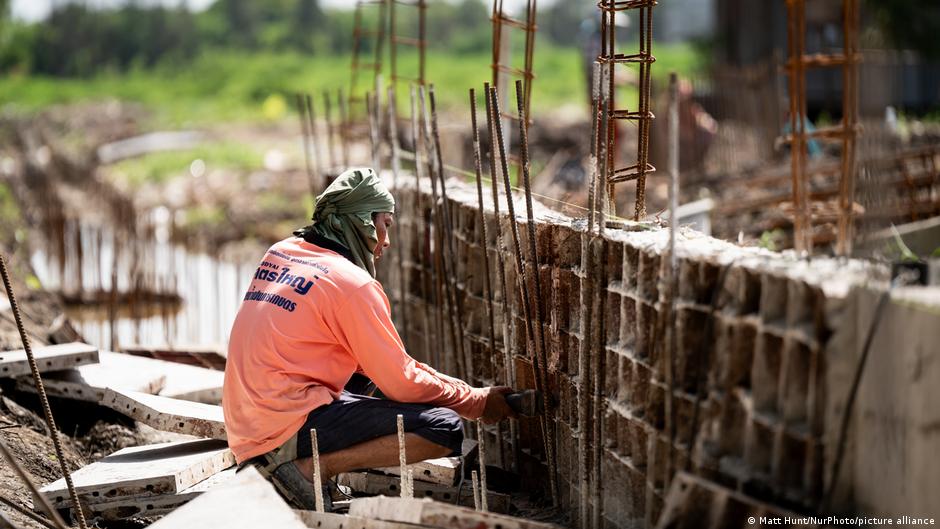
At a glance, Ray Boe doesn't stand out from the tens of thousands of other foreign workers toiling at countless construction sites that push Bangkok's soaring skyline ever higher.
asserted
that → stand → skyline
Unlike most of them, though, the 31-year-old came to Thailand's capital from one of the country's nine camps for refugees who have fled decades of civil strife inMyanmar.
asserted
who → come → inMyanmar
The camps, which hug the Thai-Myanmar border, are home to more than 100,000 people — in some cases since the 1980s, when the refugees first started arriving.
asserted
refugees → hug → 1980s
Until a year ago this month, the Thai government had refused to let them leave the camps to find work, forcing most to live hand-to-mouth on foreign donor aid.
asserted
them → refuse → aid
That changed in October 2025, after foreign aid cutbacks — mostly by the United States — forced the camps to slash the food support and healthcare they could provide.
uncertain
they → change → support
Around the same time, fighting between Thailand and Cambodia over territorial claims had sent hundreds of thousands of migrant workers from Cambodia back home, leaving behind a yawning labor gap.
uncertain
fighting → send → gap
Myanmar refugees allowed to work outside of camps
To cope with the aid cuts and labor deficit, the Thai government reversed decades of policy and began issuing the refugees permits to work outside the camps, to help them meet their own needs.
asserted
them → allow → needs
Ray Boe is one of the 6,800 camp refugees the government said have entered the Thai labor force in the first year of the program.
asserted
government → say → program
And there is not enough healthcare in the camps anymore," he said.
asserted
he → be → camps
The cuts forced him and his parents to borrow from neighbors and to pare down their already modest meals.
asserted
cuts → force → meals
Since last month, he has earned 400 baht (about $12) a day pouring concrete and erecting scaffolding around what's to be a 12-story apartment building in central Bangkok.
asserted
what → earn → Bangkok
He hopes to start sending money home soon.
asserted
He → hop → money
"It will help us pay for food and other basic needs, and for health are for my parents," Ray Boe said.
asserted
Boe → help → parents
"Compared to how we were living in the camp before, it will be a big difference, having my own income and supporting my family on my own, not having to wait for other people to support us day to day," he told DW.
asserted
he → compare → DW
Refugee work program offers hope, but faces a rocky start
The program allows the refugees to work in 43 of Thailand's 76 provinces and in any sector not reserved by law for Thai citizens only.
asserted
refugees → offer → citizens
The Ministry of Foreign Affairs said the government has improved the vocational training on offer inside the camps to better prepare refugees for work outside.
asserted
government → say → work
"We are hopeful that this policy would enhance opportunities and empower the [refugees] to realize their potential, as well as contribute to Thai socioeconomic development," said Praporn Waenluang, a spokesman for the ministry's information department.
asserted
Waenluang → enhance → department
Labor and refugee rights groups have welcomed the program.
asserted
groups → welcome → program
"I have met a lot of camp [refugees] who have come outside and worked.
asserted
who → meet → refugees
They are so happy to work and earn money, a lot of money compared to what they [can] get in the camp," said Siwawong Sooktawee, Thailand project coordinator for the International Detention Coalition.
asserted
Sooktawee → work → Coalition
"This is good because they feel they can help themselves, they can support themselves, not depend on aid anymore," he added.
asserted
he → feel → aid
Yet he and others have said the program has gotten off to a slow start, with many flaws to work out.
asserted
program → say → flaws
They said many of the refugees who have taken part have not been given contracts by their employers, only to find the conditions rougher, the work harder, or the pay lower than what they were promised before leaving the camps.
asserted
they → say → camps
The program also lacks a clear system for lodging and settling complaints, according to observers.
uncertain
program → lack → observers
"Many refugees go, come back, go, come back so many times.
asserted
refugees → go → ?
Some refugees, their families have to raise funds or borrow money in the refugee camps so that their father or their family member will be able to return," said K'nyaw Paw, general secretary of the Karen Women's Organization, an NGO serving the camp's ethnic Karen group.
asserted
Paw → have → group
Financial burdens placed on Myanmar refugees
Siwawong and K'nyaw Paw said refugees are sometimes made to repay employers through wage deductions for hiring them, including medical exams, government permits and transportation to job sites.
asserted
refugees → place → sites
As a result, they often start work already in debt, sometimes without prior warning.
asserted
they → start → warning
Akwah, a father of two who goes by one name, left his camp with 20 other refugees in November 2025 for what was supposed to be a job harvesting sugarcane on a farm on the other side of the country for 250 baht per day.
asserted
what → go → day
When he arrived, however, he was told to cut eucalyptus trees — a much more difficult and dangerous job, he said — for only 200 baht per day.
asserted
he → arrive → day
Workers had to sleep outdoors, with no electricity and only a nearby pond for water.
asserted
Workers → have → water
"We spoke to the boss, but the boss did not care.
asserted
boss → speak → boss
He said, 'Just do the work because you are already here.'
asserted
you → say → work
But we said we could not do it," said Akwah.
uncertain
Akwah → say → it
They left after three months.
asserted
They → leave → months
The Ministry of Foreign Affairs did not reply to DW's request for comment on the program's alleged problems.
asserted
Ministry → reply → problems
The Labor and Interior ministries, which mainly oversee the program, did not reply to requests for an interview either.
asserted
which → oversee → interview
Rights groups say program still needs to improve
Siwawong and K'nyaw Paw said refugees who take part should be guaranteed clear and detailed contracts — translated if needed into Burmese, Karen or Karenni, the main languages spoken in the camps — and an easy-to-access system for filing and settling complaints.
asserted
who → say → complaints
They also suggest that the government open more provinces up to the program and screen the job brokers coming to the camps as middlemen, to weed out the unscrupulous ones.
asserted
government → suggest → ones
They said their NGOs and others are working with the government on making some of the upgrades, and that they're hopeful the program will improve with time, so that more of the refugees are able and willing to take part.
asserted
more → say → part
…and 4 more, not listed.
 The Aporia