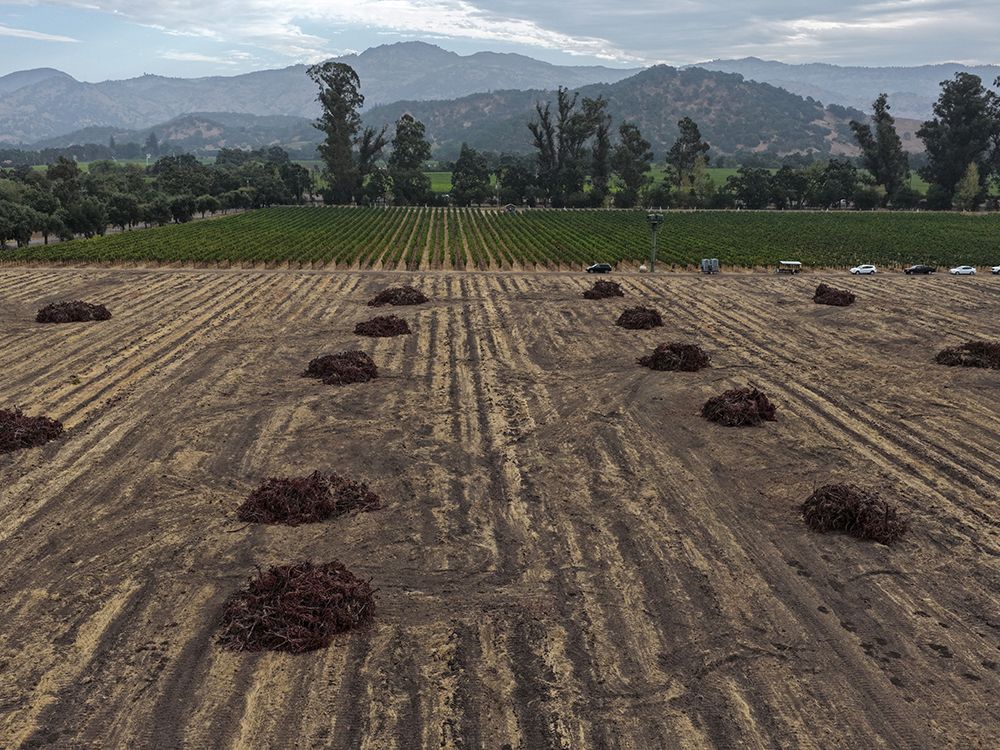
California growers have removed more than 100,000 acres of healthy vineyards in recent years, according to industry estimates.
uncertain
growers → remove → estimates
In the last two, 1.2 million tons of wine grapes have reportedly been left to rot on the vine.
uncertain
tons → leave → vine
This may seem counterintuitive, especially with wildfires recently threatening wine-producing regions elsewhere, including the Okanagan Valley and France’s famed Bordeaux area.
uncertain
wildfires → seem → Valley
Facing low sales and a “historic drop in wine consumption,” the industry is experiencing a reset, experts told National Post.
asserted
experts → face → Post
In California, which produces roughly 80 per cent of U.S. wine, the Canada-United States trade war and the resulting provincial bans on American alcohol have exacerbated the situation.
asserted
war → produce → situation
“The lack of the Canadian market isn’t responsible for 100,000 acres of California wine grapes disappearing in the last five years, but it makes things worse,” says Mike Veseth, an economist who specializes in global wine markets and author of The Wine Economist.
asserted
who → disappear → Economist
Vineyards are disappearing around the world, including France, Italy, Spain, Australia, Chile and Argentina, adds Veseth.
asserted
Veseth → disappear → France
“It’s not just California.”
asserted
It → ’ → ?
“As we look back at the numbers, it’s clear that globally, this has been going on for 20 years.”
asserted
this → look → years
Canada was the largest foreign export market for California wine before retaliatory boycotts began in early 2025.
asserted
boycotts → begin → 2025
Provincial bans on U.S. alcohol are having “a big effect,” says Robin Goldstein, deputy director of the Robert Mondavi Institute Center for Wine Economics at UC Davis.
asserted
Goldstein → have → Davis
“Canada also makes great wine, but it’s a limited amount of wine from a limited number of places because of climate, so we export a huge amount to Canada, not just from California, but the Pacific Northwest and some from the East Coast.
asserted
we → make → Coast
Identity plays a major role in influencing our choices as consumers, says Antonia Mantonakis, a professor of marketing and consumer psychology and a fellow at the Cool Climate Oenology and Viticulture Institute at Brock University in St. Catharines, Ont.
asserted
Mantonakis → play → Catharines
“The whole trade war has really highlighted our identity as Canadians, but it’s not just our identity as Canadians that influences our choices.
asserted
that → highlight → choices
It’s what we call a dissociative identity.
asserted
we → ’ → what
So America, more than ever, has become a dissociative identity for us as Canadians.”
asserted
America → become → Canadians
As a result, Ontarians aren’t simply more likely to buy wine from Niagara or Prince Edward County, for instance.
asserted
Ontarians → buy → instance
“It’s that they’re less likely to buy California wine,” says Mantonakis.
asserted
Mantonakis → ’ → wine
Last year alone, growers reportedly removed more than 38,000 acres of wine grapes California-wide — amounting to seven per cent of the state’s acreage.
uncertain
growers → remove → acreage
Another 40,000 acres are expected to come out this year, according to Ag Alert, a California Farm Bureau publication.
uncertain
acres → expect → Alert
As American business magazine Inc. reports, “That would push three-year removals past 100,000 acres.”
asserted
That → report → acres
Uprooting vineyards is expensive, and farmers need a business plan if they’re going to use the land to plant something else.
asserted
they → uproot → something
In an economically difficult situation, it’s much more common not to farm that year, says Goldstein.
asserted
Goldstein → ’ → situation
“You have to have a good reason to (remove the vines) rather than to just let them sit there.”
asserted
them → have → vines
In 2024, an estimated 400,000 tons of grapes were reportedly left to do just that.
uncertain
tons → estimate → that
A record at the time, that number more than doubled in 2025, when industry estimates suggest that roughly 820,000 tons of wine grapes went unharvested.
asserted
tons → double → grapes
Some wineries aren’t buying grapes because they have so much wine from previous harvests in the tanks, says Veseth.
asserted
Veseth → buy → tanks
He estimates that in his home state of Washington, roughly half of the vines have disappeared since before the pandemic.
asserted
half → estimate → pandemic
“The ones that aren’t pulled out, we know that many of those weren’t harvested the last few years.
asserted
many → pull → those
So they either left the grapes on the vine because it doesn’t pay to harvest grapes if you can’t sell them or they hired workers to come in and just drop the grapes to the ground.
asserted
workers → leave → ground
The wine business is like any other, says Mantonakis.
asserted
Mantonakis → say → other
If the cost of producing grapes exceeds what farmers can sell them for, some might remove their vineyards and plant something else.
uncertain
some → produce → something
The opposite was happening when she moved to the Niagara region 20 years ago, as farmers tore out peach and plum orchards to make room for more profitable wine grapes.
asserted
farmers → happen → grapes
Goldstein highlights that in California, the costs of running a vineyard are extraordinarily high, and he doesn’t see the current situation as cause for panic.
asserted
he → highlight → panic
“I don’t think that the consumption is just going to continue to linearly drop to the floor and everyone’s going to lose their business.”
asserted
everyone → think → business
He notes that humans have been making wine for thousands of years, and in North America, consumption fluctuates every few decades.
asserted
consumption → note → America
Mantonakis shares this sentiment: “Across cultures, across continents, across generations, wine is an important part of history.
asserted
wine → share → history
It can be challenging for wineries to differentiate themselves in a competitive market, says Goldstein.
asserted
Goldstein → differentiate → market
Over the past five to 10 years, wine clubs have been a successful model, in which small wineries have a hospitality facility where people gather.
asserted
people → have → facility
“It’s starting to spread around the world, this idea of a wine club and wine tourism, but it really started in California.
asserted
it → start → California
…and 11 more, not listed.
 The Aporia