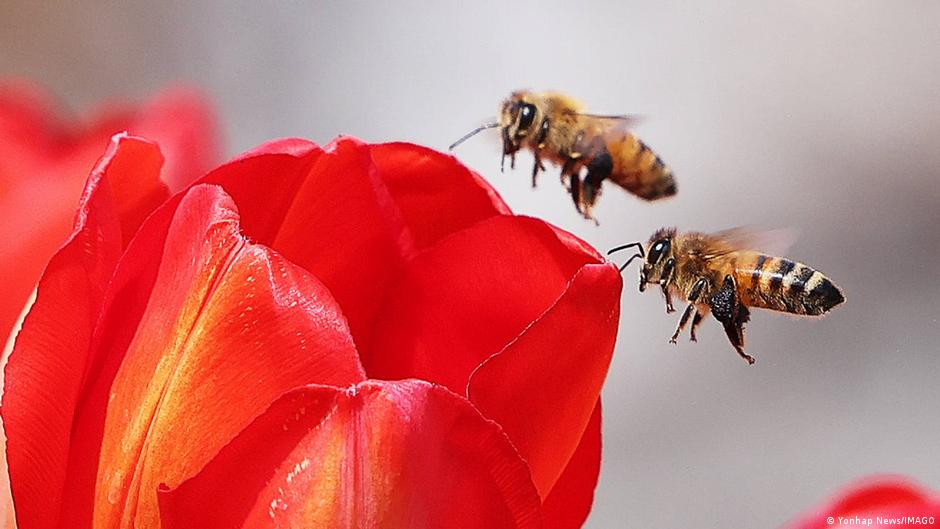
And because nature is like a team, every player has a job.
asserted
player → have → job
When various species from trees to animals work together, they regulate weather, maintain soil health, purify water and support food production.
asserted
they → work → production
These benefits are known as ecosystem services and they underpin human wellbeing.
asserted
they → know → wellbeing
"It is really an abstract concept, but we experience it absolutely every day," said Rebecca Shaw, chief scientist at conservation group WWF "And we almost never think about it when nature is functioning.
asserted
nature → experience → it
But as it declines, she and other scientists are calling on the world to really think about it.
asserted
she → decline → it
Because biodiversity is struggling as humans push ecosystems to the brink through intensive farming, burning fossil fuels,and pollution from sources like plastic and chemicals.
asserted
humans → struggle → plastic
Over the past 52 years, monitored vertebrate populations have collapsed by an average of 73%, while freshwater ecosystems are faring worst with a drop of 85%, according to WWF's recent Living Planet report.
uncertain
ecosystems → monitor → report
It tallies with other studies that show a million animal and plant species face extinction unless humanity reduces its pressure on nature.
asserted
humanity → tally → nature
"It is a really steep decline," said Shaw.
asserted
Shaw → say → ?
"What it's telling us is that nature is in trouble, and it's an early warning indicator of the fabric of life that we depend on for freshwater and food and for clean air is unravelling."
asserted
we → tell → air
Thousands of policymakers, business leaders and civil society groups are meeting in Yerevan, Armenia over the next two weeks for COP17, the latest UN biodiversity summit, to advance commitments to reverse nature loss by 2030.
asserted
Thousands → meet → 2030
But progress towards those targets remains insufficient, with funding and implementation among the biggest challenges.
asserted
funding → remain → challenges
What happens when ecosystem services decline or disappear?
asserted
services → happen → ?
Some 85% of these vital ecosystems disappeared between 1700 and 2000.
asserted
% → disappear → 1700
One study from Canada's University of Waterloo found that habitats like marshes and swamps in Southern Ontario provide C$4.2 billion (€2.63 billion) worth of water filtration services each year, removing nutrients like phosphorus and keeping drinking water sources clean.
asserted
habitats → find → sources
The study found that as they disappear, water quality worsens, which massively increases the cost of treating it.
asserted
which → find → it
More than 75% of global food crop types rely in part on animal pollination.
asserted
% → rely → pollination
At the same time, soil and ecosystem degradation coupled with storms and heat waves linked to climate change are already damaging harvests.
asserted
degradation → couple → harvests
A recent UK government report stated that every critical ecosystem is on a "pathway to collapse," warning that nature's decline posed a grave threat to global food supply and geopolitical stability.
asserted
decline → state → supply
"The UK, like many other countries, relies on imports for much of the food and so is reliant on ecosystems around the world," said Louise McRae, a research fellow at the Zoological Society of London, who also contributed to WWF's Living Planet report.
asserted
who → rely → report
"This is why we need to care about global biodiversity."
asserted
we → need → biodiversity
It also provides the basis for many modern human medicines, with some 50% coming from natural compounds.
asserted
% → provide → compounds
Penicillin, the first antibiotic, is produced by a mold and is estimated to have saved over 500 million lives.
asserted
Penicillin → produce → lives
Before its discovery, a person could die from a simple cut.
uncertain
person → die → cut
Around 70% of cancer drugs come from natural products or synthetic compounds "inspired by nature," according to the World Health Organisation (WHO).
uncertain
% → come → Organisation
As biodiversity disappears, humans risk losing access to undiscovered treatments.
Does it really matter if one species disappears?
To return to the "nature as a team" metaphor, if a player disappears, sometimes a species with similar functions in the ecosystem can jump in as a substitute.
asserted
species → disappear → substitute
They play a disproportionately large role in their environments, and their disappearance has significant knock-on effects.
asserted
disappearance → play → effects
Wild oyster populations are facing massive declines, while 85% of their reefs have been lost worldwide.
asserted
% → face → reefs
An adult oyster filters up to 50 gallons of water a day.
asserted
oyster → filter → water
"No one would ever think, they did anything but sit in a shell and be slimy," said Shaw.
asserted
Shaw → think → shell
"But you lose oysters, you can lose water filtration and clean water, you can lose the habitat for many other species that we interact with or sometimes consume.
asserted
we → lose → that
And, said Shaw, the humble oyster protects coastal communities from storm surges.
asserted
oyster → say → surges
If you lose it "you lose the coastal protection."
asserted
you → lose → protection
The loss of a single species can also lead to more disease.
asserted
loss → lead → disease
One study suggests a decline in red foxes in North America is linked to the spread of Lyme disease, a tick-borne illness that also impacts humans.
uncertain
that → suggest → humans
Is humanity living through a sixth mass extinction and is it too late to prevent it?
asserted
it → live → it
The planet has experienced five mass extinctions when a large proportion of species globally disappeared over a short geological period.
asserted
proportion → experience → period
But the rate at which species are disappearing today, suggests Earth is experiencing a sixth event, driven largely by human activity, according to scientists.
uncertain
Earth → disappear → scientists
Both McRae and Shaw called the declines extremely worrying, but said they shouldn't provoke despair.
asserted
they → call → despair
Though she acknowledges that the underlying global trend is moving in the wrong direction and cannot be ignored, McRae says "the statistics are there to just motivate us to action rather than to cause alarm."
And the Living Planet report also highlights conservation successes, showing that nature can recover.
asserted
nature → acknowledge → successes
…and 10 more, not listed.
 The Aporia