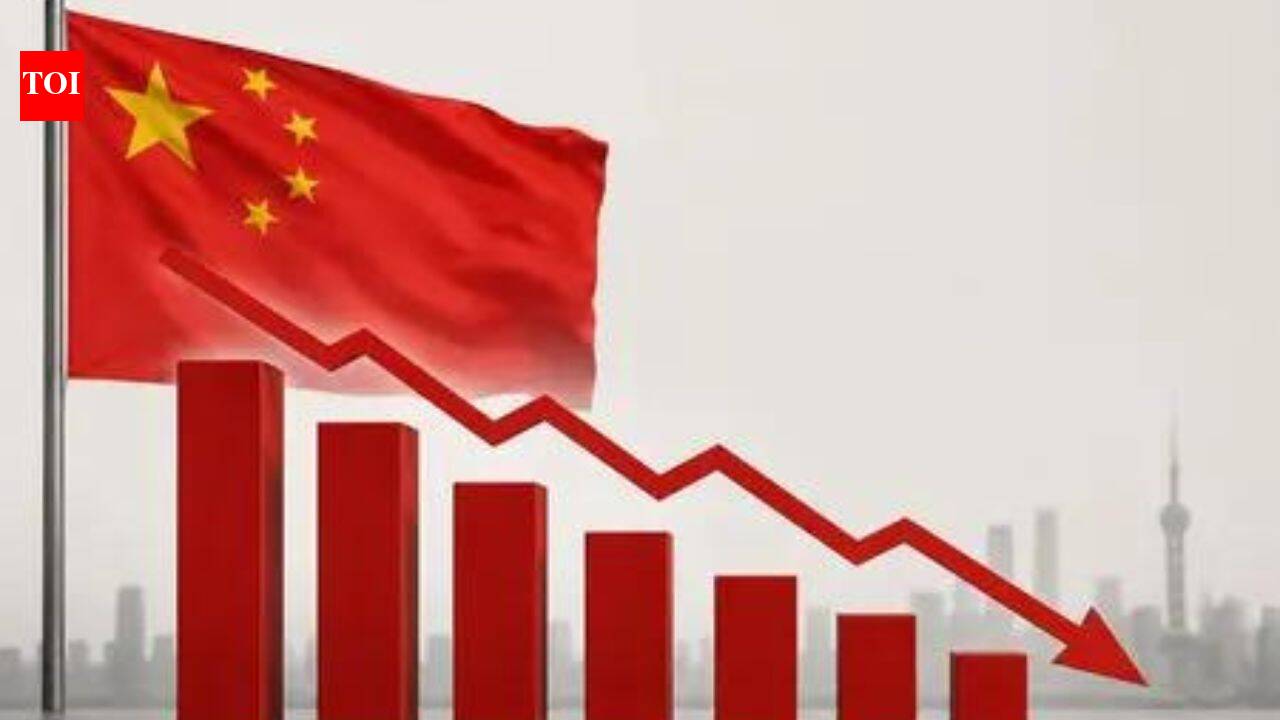
China's economy expanded by 4.5% in the July-September quarter compared with the same period a year earlier, supported by strong exports, official data showed on Monday.
asserted
data → expand → Monday
The growth brings Beijing closer to achieving its annual economic target as the year draws to a close, even as trading partners intensify efforts to address their trade imbalances with the world's second-largest economy.
asserted
partners → bring → economy
The latest growth figure exceeded expectations and marked an improvement from the 4.3% expansion recorded in the April-June quarter, which was China's slowest pace of growth in more than three years, reported by news agency AP.
asserted
which → exceed → AP
Chinese leaders have set a full-year growth target of 4.5%-5% for 2026, lower than the 5% expansion achieved last year.
asserted
leaders → set → expansion
Earlier this month, the International Monetary Fund lowered its forecast for China's economic growth in 2026 to 4.5%, placing its projection at the bottom of Beijing's target range.
asserted
Fund → lower → range
Strong exports support growth as domestic demand remains weak
The headline growth figure is becoming “an increasingly poor indicator of how the broader economy is performing”, said Max Zenglein, asia pacific senior economist at the conference board.
asserted
Zenglein → support → board
According to Zenglein, the overall figure conceals widening differences across industries, regions and households.
uncertain
figure → accord → industries
He added that Beijing faces difficult policy choices, with correcting domestic economic imbalances potentially proving more challenging than managing external pressures.
asserted
correcting → add → pressures
China's domestic demand has weakened amid a prolonged property market downturn that has reduced household wealth and encouraged people to save more rather than spend.
asserted
that → weaken → people
Exports, however, remain one of the economy's key sources of strength.
asserted
Exports → remain → strength
China is on course to exceed last year's record global trade surplus of $1.2 trillion after exports rose 36% last month.
asserted
exports → exceed → trillion
Its trade surplus had already reached $938 billion between January and September.
asserted
surplus → reach → January
Higher US tariffs have disrupted some bilateral trade between Washington and Beijing, prompting Chinese exporters to seek alternative markets in Southeast Asia, latin America and Europe.
asserted
tariffs → disrupt → Asia
High-tech products, including semiconductors, as well as automobiles, particularly hybrid and electric vehicles, have helped drive export growth this year.
asserted
products → include → growth
As China seeks greater self-reliance to reduce its vulnerability to western export controls and trade uncertainty, it has expanded manufacturing capacity across sectors such as solar energy and electric vehicles.
asserted
it → seek → energy
These industries have also received substantial government subsidies.
asserted
industries → receive → subsidies
However, production capacity expanded rapidly while domestic consumption remained subdued, leaving manufacturers increasingly dependent on overseas markets to sell their goods at competitive prices.
asserted
consumption → expand → prices
Ecaterina Bigos, senior market strategist at BNP paribas asset management, said China's export-led, technology-driven growth model had generated limited employment and broad-based income gains.
asserted
model → say → employment
She also warned that the risk of artificial intelligence displacing workers was increasing.
asserted
intelligence → warn → workers
European Union presses China to rebalance trade
asserted
Union → press → trade
China's growing exports of relatively inexpensive manufactured goods have raised concerns among trading partners about the pressure on their domestic industries and economies.
asserted
exports → grow → industries
Eswar Prasad, a professor of economics and trade policy at Cornell University, said it was unsustainable for the world's second-largest economy to depend on foreign demand to support its growth.
asserted
economy → say → growth
He argued that China's persistent and substantial trade surpluses had become a drag on global growth rather than helping drive expansion in other economies.
asserted
surpluses → argue → economies
The European Union is among the trading partners seeking to narrow the imbalance.
asserted
Union → trade → imbalance
The 27-member bloc runs a trade deficit with China exceeding $1.1 billion a day, while Chinese exports to the EU increased 16% during the first nine months of the year.
asserted
exports → run → year
European countries are considering further restrictions on Chinese products after the EU and China reached an agreement this month aimed at roughly halving the number of Chinese hybrid vehicle imports over the next few years.
asserted
EU → consider → years
Gary Ng, a senior Asia Pacific economist at French bank Natixis, said China wanted to maintain access to overseas markets and could work with other countries to resolve trade disputes.
uncertain
China → say → disputes
An agreement on hybrid vehicles, for instance, could allow Chinese manufacturers to continue expanding sales in Europe over the longer term while avoiding a broader increase in tariffs.
uncertain
manufacturers → allow → tariffs
Nevertheless, Lynn Song, chief economist for greater China at Dutch bank ING, cautioned that trade imbalances would be difficult to correct quickly, even if agreements were reached.
asserted
agreements → caution → ING
Some policymakers have also argued that the yuan's undervaluation against the US dollar and the euro has contributed to China's growing trade surplus.
asserted
undervaluation → argue → surplus
China's central bank has rejected these claims.
uncertain
bank → reject → claims
Bigos said economies around the world were likely to maintain resistance to Chinese exports, with protectionist measures and pressure to safeguard domestic industries and employment expected to persist, particularly in high-value sectors.
asserted
measures → say → sectors
Beijing has maintained that it does not seek to generate a large trade surplus.
asserted
it → maintain → surplus
On Friday, People's bank of China governor Pan Gongsheng said countries running trade deficits and those recording surpluses should work together.
asserted
countries → say → surpluses
He added that China, as a responsible country, remained committed to expanding domestic demand.
asserted
China → add → demand
 The Aporia