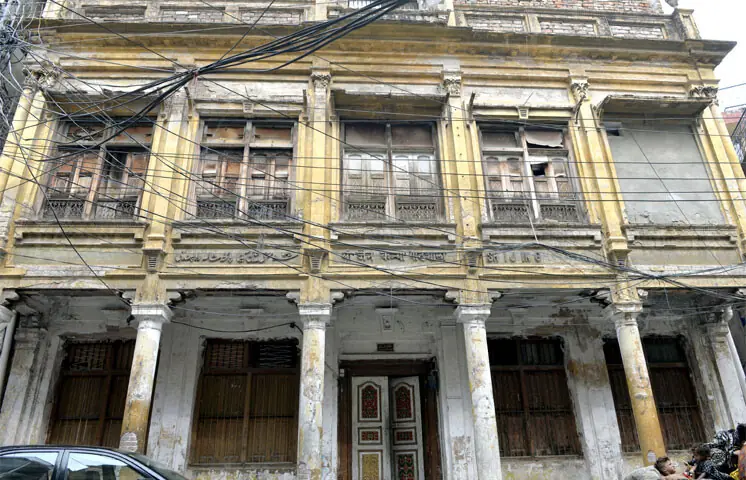
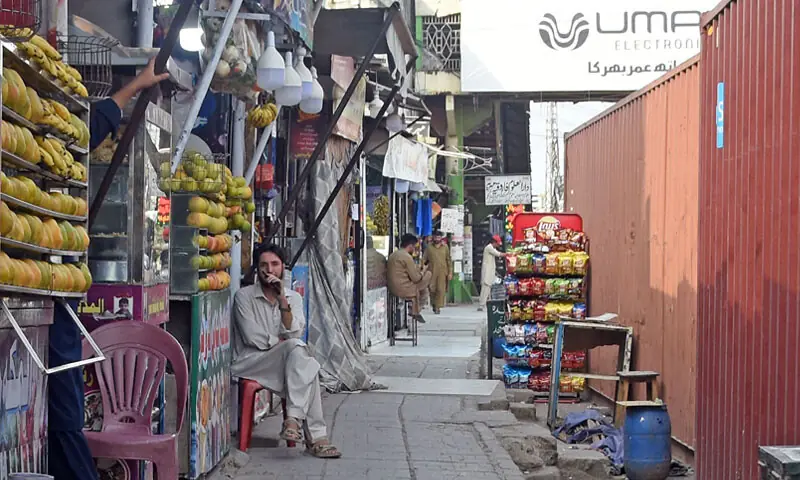
Once an upscale locality of Rawalpindi under British rule, Bhabara Bazaar recalls the region’s majestic past in the heart of the garrison city.
asserted
Bazaar → recall → city
Centuries may have passed, but the area still has many structures that reflect the splendour of Mughal, Central Asian and Indian architecture.
uncertain
that → pass → architecture
Walking through the winding lanes of the downtown area, one can find buildings inspired by Mughal architecture.
asserted
one → walk → architecture
Almost all the old buildings have wooden balconies, or jharokas, a prominent feature of Mughal and Turkish architecture.
asserted
buildings → have → architecture
These structures tell the stories of wealthy families who lived there before the partition of the Indian subcontinent.
asserted
who → tell → subcontinent
Bhabara Bazaar is a two-kilometre-long residential and commercial locality built by the Bhabra community, belonging to Jainism, in the early 18th century.
asserted
Bazaar → build → century
The old residential streets of Bhabara Bazaar have winding, narrow lanes, houses with handcrafted wooden doors and corridors leading to enclosed courtyards within their outer walls.
asserted
streets → have → walls
These British-era houses usually have two or three storeys, painted ceilings and ceramic tiles.
asserted
houses → have → storeys
Bhabara Bazaar and its surrounding areas were considered upscale neighbourhoods at the time.
asserted
Bazaar → surround → time
According to the Gazetteer of Rawalpindi District 1893-94, the Bhabras were a small trading community in Rawalpindi that, despite their limited numbers, deserved mention.
uncertain
that → accord → mention
Describing the community, the gazetteer stated, “They were willing to do all the work, and are all well-to-do.
asserted
They → describe → work
They only number 800 souls all told, but are divided into nine tribes.
asserted
They → number → tribes
Their most remarkable characteristic is their custom of undergoing long voluntary fasts, ranging from 6 to 10 days, during which they are said to eat nothing and only to drink water.
asserted
they → undergo → water
They are not eating flesh or drink wine and very careful not to kill animals.”
asserted
They → eat → animals
It further noted, “Bhabaras usually wear red ‘Pagris’ (turban) whatever their age and generally some Jewellery.
asserted
age → note → Pagris
They formed a somewhat little colony in Rawalpindi called Bhabara Bazaar.
asserted
They → form → Rawalpindi
No other Hindu sects deserve separate notice.”
asserted
sects → deserve → notice
The community not only built houses and shops in the area but also established schools, including a Path Shala of the Jain sect, where religious education was imparted.
asserted
education → build → sect
Many houses along the main road from Sarafa Bazaar to Teli Mohallah near Murree Road reflected the community’s commercial lifestyle, with shops on the ground floors and residences on the second and third floors.
asserted
houses → reflect → floors
In the narrow streets of the old locality, Om symbols and the Jain greeting Jai Jinendra can still be seen on many buildings.
asserted
symbols → see → buildings
Historians say the Bhabras mostly worked as moneylenders and goldsmiths, but they were also involved in grain trading and other businesses.
asserted
they → say → trading
The community’s wealth was reflected in the houses it built, which still evoke memories of its past.
asserted
which → reflect → past
After the partition of the Indian subcontinent in 1947, members of the community migrated to India and settled in Delhi and elsewhere.
asserted
members → migrate → Delhi
Their houses were subsequently allotted to Muslim migrants from East Punjab, including Amritsar, Ludhiana and Jalandhar, as well as Kashmiri migrants who arrived later.
asserted
who → allot → Amritsar
As people from different parts of the subcontinent settled in the area and sought livelihood opportunities, they established traditional food businesses in the bazaar.
asserted
they → settle → bazaar
Over the past seven decades, Bhabara Bazaar has developed into a food street serving the twin cities of Rawalpindi and Islamabad.
asserted
Bazaar → develop → Rawalpindi
In 2021, then Rawalpindi commissioner Muhammad Mehmood initiated a project to preserve the historic Bhabara Bazaar.
asserted
Mehmood → initiate → Bazaar
The plan included the rehabilitation of Sujan Singh Haveli and the development of Bhabara Bazaar Food Street at a total cost of Rs184 million.
asserted
plan → include → million
However, the project was shelved in 2024.
asserted
project → shelve → 2024
Of the allocated amount, Rs104 million had been earmarked for the rehabilitation of Sujan Singh Haveli and Rs80 million for the food street project.
asserted
million → allocate → project
Under the plan, a one-kilometre stretch of Bhabara Bazaar was to be restored in the style of streets from 1857, while the exteriors of surrounding heritage houses were also to be renovated in the traditional style.
asserted
exteriors → restore → style
All electricity, telephone and other utility cables were to be shifted underground, while the sewerage system was to be upgraded with larger underground pipes.
asserted
system → shift → pipes
The main objective of the rehabilitation projects was to make Rawalpindi more attractive to tourists through urban regeneration.
asserted
Rawalpindi → make → regeneration
The plan also aimed to attract visitors travelling to Murree through Rawalpindi and create employment opportunities for local residents.
asserted
plan → aim → residents
 The Aporia