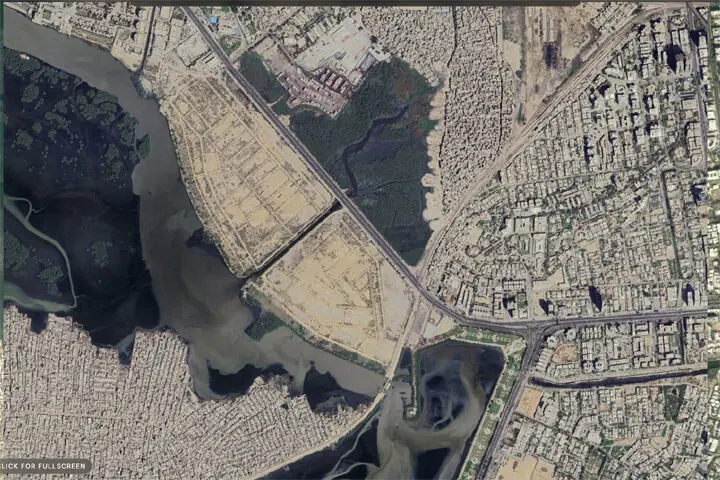
Mangrove loss raises flood, erosion risks along Karachi coast

Read the original at Dawn ↗
Cite

Shahid, J. (2026, October 19). Mangrove loss raises flood, erosion risks along Karachi coast. Dawn. https://www.dawn.com/news/2038190/mangrove-loss-raises-flood-erosion-risks-along-karachi-coast

Dated from the outlet's own feed. Check the original for its byline.

Dawn · collected 2026-10-19 · by Jamal Shahid

Quick Summary

Satellite images from Pakistan’s Space and Upper Atmosphere Research Commission (Suparco) show significant changes in Karachi’s coastal zone near the Mai Kolachi Bypass between 2000 and 2025, with mangrove areas being replaced by reclaimed land and urban development. The report highlights that this transformation reduces natural protection against climate stressors like flooding and erosion, as mangroves are vital for regulating temperatures, trapping sediments, and absorbing carbon. Climate policy specialist Mohammad Saleem Shaikh emphasizes the urgent need to protect remaining mangroves and restore degraded areas to safeguard coastal communities from rising sea levels and extreme weather events.
Written locally by qwen2.5:14b on 2026-10-19, using this article's own text rather than the other coverage of the same event (that is the story summary below).

AI analysis runs on qwen2.5:14b, locally

Story summary

As of October 19, 2026, Suparco, Pakistan's space agency, released satellite images showing significant changes along Karachi’s coast near the Mai Kolachi Bypass between 2000 and 2025. The data revealed that mangrove forests and natural tidal creeks have largely been replaced by reclaimed land and urban development, raising serious environmental concerns.

Climate policy specialist Mohammad Saleem Shaikh warned that Pakistan must urgently protect its mangroves to prevent coastal communities from facing increased flood risks and erosion due to rising sea levels and extreme weather events. Mangrove loss weakens the natural defenses against these threats, according to Suparco's findings.

The satellite evidence highlights a shift from ecosystem-based protection towards hard infrastructure development, undermining the critical role of mangroves in regulating local temperatures, trapping sediments, and absorbing carbon dioxide. This transformation disrupts hydrological connectivity and increases surface runoff, posing long-term risks to coastal stability and economic viability.

Written for “Mangrove Loss In Karachi” on 2026-10-19, grounded in this article and the 0 other(s) covering the same event.
Why this leaning score
The model judged this article politically coded and scored it -0.65, but 2 quote(s) could not be found in the article and the other 2 are attributed speech rather than the article's own narration, so the score is not published.
Written under an earlier scoring contract, which gave a paragraph rather than checkable quotes. Re-analysing this article replaces it.
Leaning score withheld for article 89884: no verified evidence · logged 2026-10-19

Story

📰 Mangrove Loss In Karachi
Environment · 1 article(s) covering the same event.

Compared with similar articles

Nothing to compare against. No article is close enough to this one for the pipeline to have linked or judged the pair.
How this article was measured signals, leaning charts, publisher record, byline, topics and claims

Signals How these are calculated →

Claims extracted
21
sentences that state something as happening or true
Uncertain
5%
1 of 21 hedged ("reportedly", "may", "according to")
Leaning
withheld
no quote in the article backed the model's score
Publisher signals
72/100
Dawn's corrections and hedging, across everything collected from it. Not a measure of accuracy.
Outlets on this story
1
Environment
Same framing elsewhere
1
articles that frame the event the way this one does
Analyzed 2026-10-19 · how these are computed

How this is being covered How these are calculated →

Article leaning vs. publisher reliability
Source leaning vs. consistency

Publisher

Dawn · 1884 article(s) · 3 correction(s) detected
Running correction rate · 3 correction(s)

Who wrote this

Jamal Shahid
2 article(s) here · 1 carrying a prediction
🔮 Karachi Mayor Murtaza Wahab did not respond to messages.
🔮 This may indicate increased water storage and a higher likelihood of moraine dam instability or failure, which can increase the risk of a Glof event.
Also by Jamal Shahid
Nothing else under this byline is closely related to this article, so these are simply their most recent.

Topics

ISLAMABAD Karachi Pakistan Suparco the Space and Upper Atmosphere Research Commission

Subjects

Karachi GPE · 4× Suparco ORG · 4× Pakistan GPE · 2× Shaikh PERSON · 2× ISLAMABAD GPE · 1× Mohammad Saleem Shaikh PERSON · 1× Murtaza Wahab PERSON · 1× Sherry Rehman PERSON · 1× the Senate Standing Committee on Climate Change ORG · 1× the Space and Upper Atmosphere Research Commission ORG · 1×

Narrative

Climate policy specialist Mohammad Saleem Shaikh warned that Pakistan must protect its mangrove forests and natural tidal creeks, stressing that their destruction threatened coastal communities, livelihoods and economic stability. Referring to Suparco’s satellite evidence showing changes along Karachi’s coast near Mai Kolachi Bypass between 2000 and 2025, Mr Shaikh called for urgent measures to prevent further environmental degradation.
framing: assertive · carried by 1 article(s) · first seen 2026-10-19
🔮 Karachi Mayor Murtaza Wahab did not respond to messages.
2026-10-19 · Dawn
Mangrove loss raises flood, erosion risks along Karachi coast · assertive framing

Claims (21 extracted, 1 hedged)

New satellite images from 2000 and 2025 released by the country’s space agency show a fundamental shift in land cover along Karachi’s coastal zone near the Mai Kolachi Bypass, where mangrove stands and natural tidal creeks have increasingly given way to reclaimed land and urban development. asserted
stands → release → land
In a note on the development, the Space and Upper Atmosphere Research Commission (Suparco) said areas once characterised by continuous mangrove cover and natural tidal creeks had progressively been converted into reclaimed land and urban plots. asserted
areas → say → land
“This transformation reflects a transition from ecosystem-based coastal protection to hard, land-intensive development. asserted
transformation → reflect → development
Mangrove removal directly weakens the coastal system’s ability to respond to climate stress,” the agency said. asserted
agency → weaken → stress
Suparco observed that mangroves played a key role in regulating coastal temperatures, trapping sediments and absorbing atmospheric carbon. asserted
mangroves → observe → carbon
Their clearance not only eliminated an important blue-carbon reservoir but also disrupted hydrological connectivity, increasing surface runoff and altering tidal flows, it said. asserted
it → eliminate → flows
“Over time, this raises the likelihood of localised flooding, shoreline instability and long-term land subsidence. asserted
this → raise → flooding
From a climate perspective, the conversion of mangrove wetlands into built-up land represents a loss of natural resilience at a time when sea-level rise and extreme weather events are accelerating,” it said. asserted
it → build → time
Unlike engineered structures, mangroves adapt and regenerate, offering protection that strengthens over time. asserted
that → engineer → time
Their replacement with static infrastructure transfers climate risk directly to urban assets and populations, the agency observed. asserted
agency → transfer → assets
When contacted, Senator Sherry Rehman, chairperson of the Senate Standing Committee on Climate Change, declined to comment. asserted
Rehman → contact → Change
Karachi Mayor Murtaza Wahab did not respond to messages. asserted
Wahab → respond → messages
Climate policy specialist Mohammad Saleem Shaikh warned that Pakistan must protect its mangrove forests and natural tidal creeks, stressing that their destruction threatened coastal communities, livelihoods and economic stability. Referring to Suparco’s satellite evidence showing changes along Karachi’s coast near Mai Kolachi Bypass between 2000 and 2025, Mr Shaikh called for urgent measures to prevent further environmental degradation. asserted
Shaikh → warn → degradation
He said mangroves stored carbon, reduced coastal erosion, weakened storm surges and sustained fisheries and biodiversity. asserted
mangroves → say → fisheries
Their loss could increase Pakistan’s vulnerability to rising sea levels, cyclones and other climate-related threats, particularly along Karachi’s coastline and the Indus Delta, he warned. uncertain
he → increase → coastline
Mr Shaikh urged the federal and Sindh governments to strengthen environmental enforcement, prevent encroachment and ensure that coastal development projects underwent comprehensive environmental assessments. asserted
projects → urge → assessments
He also called for transparent satellite monitoring, community participation and scientifically planned restoration using native species. asserted
He → call → species
He said mangroves should be treated as natural climate infrastructure essential for disaster resilience and future generations. asserted
mangroves → say → resilience
Meanwhile, satellite imagery acquired between 2019 and 2026 and posted on Suparco’s Space4Climate webpage showed a substantial mangrove afforestation event in the Shah Bandar region of Sujawal. asserted
imagery → acquire → Sujawal
Comparative analysis of 19 Areas of Interest showed a 115pc increase in mangrove forest cover relative to 2019 baseline area of 116.46 hectares. asserted
analysis → show → hectares
Newly established mangrove vegetation of 151.24 hectares accounted for around 6.5pc of the total 2,321.8-hectare study area. asserted
vegetation → establish → area

💬Give feedback
🕘History 🎫Support