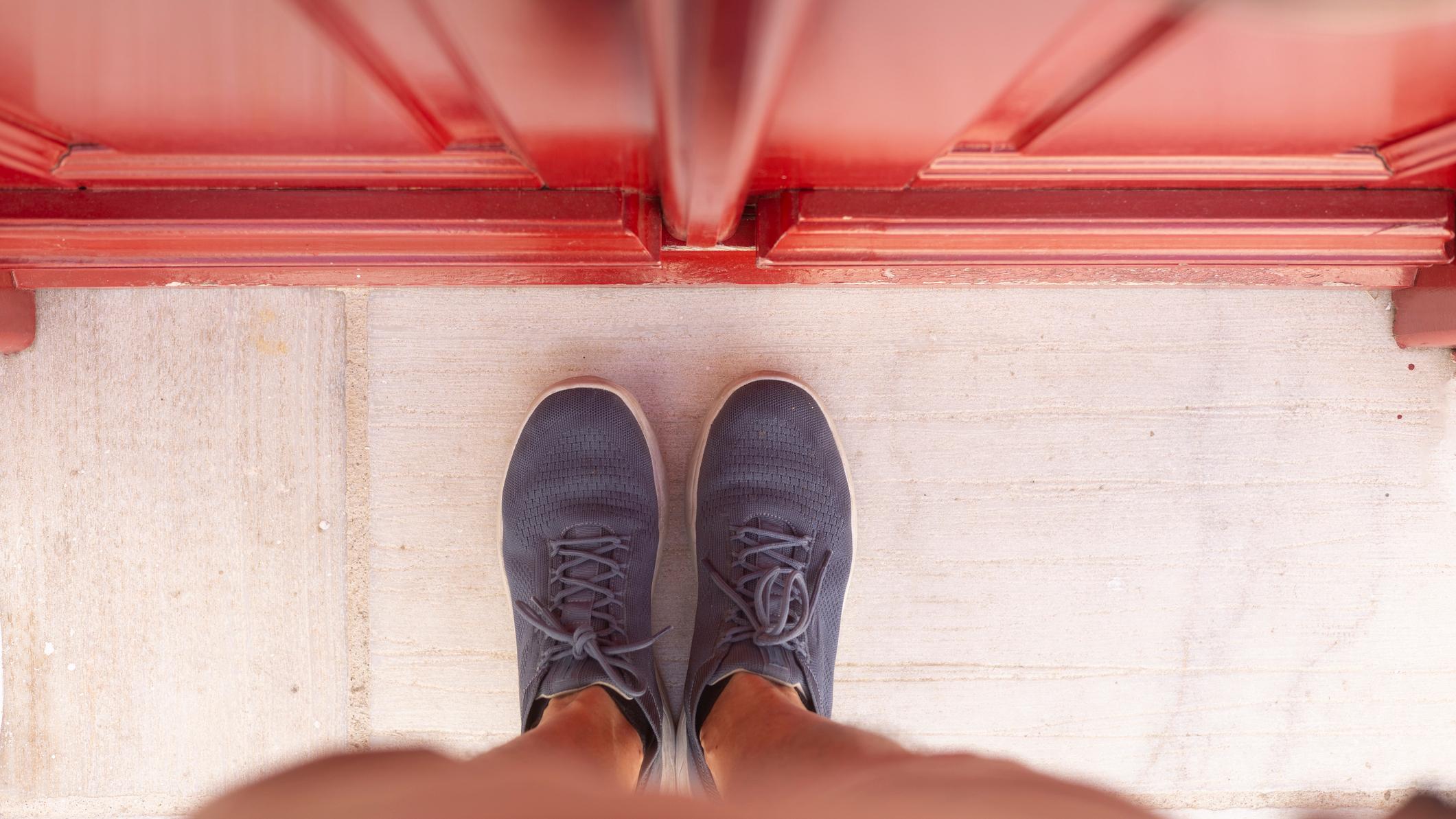
Every time you welcome a guest into your home, you may be letting in thousands of other ones as well—if you allow your visitors to wear their shoes when they enter.
uncertain
they → welcome → shoes
The world outside your door is a messy place—full of bacteria, viruses, and environmental toxins—and the soles of your shoes can pick up a lot.
asserted
soles → pick → lot
According to one 2023 CBS News/YouGov poll, 63% of Americans regularly remove their shoes when they get home, and 24% ask their guests to do the same.
uncertain
% → accord → same
This year, the Indiana Department of Health launched a “Shoes Free Protects You and Me” ad campaign about the benefits of a no-shoes policy at home, targeting tracked-in lead in particular.
asserted
Shoes → launch → lead
How serious is the risk that shoes pose, and should your house be a no-shoes zone?
asserted
house → pose → that
What the research says about wearing shoes inside
asserted
says → say → shoes
The published research on shoe contamination is not extensive, but some stands out.
asserted
some → publish → contamination
In one 2008 study, Charles Gerba, professor of virology at the University of Arizona, studied 26 pairs of shoes that had been worn for three months in the outside world and came up with some alarming results.
asserted
that → study → results
The shoes carried between 3,600 and 8 million colony-forming units of bacteria, both on the inside and outside of the shoes.
asserted
shoes → carry → shoes
E. coli, or fecal bacteria, was the most common organism being tracked around.
asserted
coli → track → ?
“[About] 80% of the bottoms of the shoes had fecal bacteria on them,” Gerba wrote in an email to TIME, “largely picking them up from the floors of public restrooms, which always have fecal bacteria on them.
asserted
which → have → them
They may also pick them up outside, in places that dogs and birds are.”
uncertain
dogs → pick → places
According to Gerba’s numbers, shoes are significantly more germ-ridden than public toilet seats, which have an average of 3,200 colony forming bacterial units.
uncertain
which → accord → units
E. coli is not the only infectious agent that shoes carry around.
asserted
shoes → carry → that
According to University of Houston researchers, 40% of shoes tested carry C. difficile, an intestinal bacterium that causes diarrhea.
uncertain
that → accord → diarrhea
Health care settings are particularly germ-filled.
asserted
settings → fill → ?
One 2016 meta-analysis in the Journal of Applied Microbiology surveyed 13 studies, tracing where shoes have traveled and what they picked up there.
asserted
they → survey → what
A small study in that group found that after physicians did rounds in hospitals, 65% of their shoes tested positive for either antibiotic-resistant Staphylococcus aureus (MRSA) or Enterococcus faecalis, another gastrointestinal bacterium.
asserted
% → find → Staphylococcus
Another found that 48% of shoes worn in operating rooms tested positive for at least one pathogenic bacterium, most commonly Staphylococcus.
asserted
% → find → bacterium
One 2009 study conducted in rural Alaska had people put on sterilized boots, then walk along a randomly selected outdoor path, and finally step onto a piece of sterilized linoleum and remove the boots.
asserted
people → conduct → boots
People then wore the contaminated boots on short walks across a sterile floor.
asserted
People → wear → floor
On half of those walks, bacteria were transferred to the flooring.
asserted
bacteria → transfer → flooring
Urban settings present their own perils, particularly as a result of dogs being walked on sidewalks and in parks.
asserted
dogs → present → parks
Even in cities where owners routinely pick up after their dogs, traces of fecal bacteria—and pools of urine—regularly collect on heavily foot-trafficked routes.
asserted
traces → pick → routes
In one 2023 study published in Design, Architecture, and Ergonomics, investigators from Northeastern University in New York City sampled sidewalk rain puddles, shoe bottoms, and flooring inside one of the school’s buildings on its urban campus.
asserted
investigators → publish → campus
On average, they found 30,000 gut bacteria per 100 milliliters of water in puddles on the neighborhood sidewalks.
asserted
they → find → sidewalks
Every shoe sole they sampled from student and teacher volunteers carried varying levels of the same bacteria, and the interior of the building was also contaminated—especially in carpeted areas.
asserted
interior → sample → areas
“The surface of your flooring makes an enormous difference,” says Alessandra Leri, professor of chemistry and biology at the school and the lead author of the study.
asserted
Leri → make → study
“If you have carpets, they function as a reservoir of bacteria.”
asserted
they → have → bacteria
, she says, “shoe soles are a serious vector of transmission of fecal bacteria from the outdoor environment to the indoor environment.”
asserted
soles → say → environment
Shoes track in more than germs
PFAS, the “forever chemicals” so named for how long they linger in the environment and our bodies, are regularly picked up by shoes and used in manufacturing the soles.
asserted
they → track → soles
Lead dust, which can often be stirred up and released into the air during remodeling of older homes and other buildings, can cling to shoes as well.
asserted
which → stir → shoes
Pesticides, used both on farms and in home gardens, are similarly free-riders on our shoes.
asserted
Pesticides → use → shoes
Where shoe-removal matters most
In most homes in which people do not remove their shoes upon entering, the area nearest the front door is generally the most contaminated.
asserted
area → matter → door
“We found that the first four steps at the entrance to the household are the germiest floor area in the home,” says Gerba.
asserted
Gerba → find → home
“We also did tracer studies putting dye and tracer viruses on the bottom of shoes and could see how they left a trail on the floor.”
uncertain
they → do → floor
Wherever contaminants spread in the home, they present the greatest danger to the household members who have the most contact with the floor—typically babies and small children who crawl and play on surfaces.
asserted
who → spread → surfaces
Leri follows a no-shoes policy in her home and leaves her shoes by the door when she enters.
asserted
she → follow → door
She does not ask guests to remove their shoes, especially when she hosts parties.
asserted
she → ask → parties
“If you are having a cocktail party, you are sensitive to guests feeling like shoes are a part of their ensemble,” she says.
asserted
she → have → ensemble
…and 4 more, not listed.