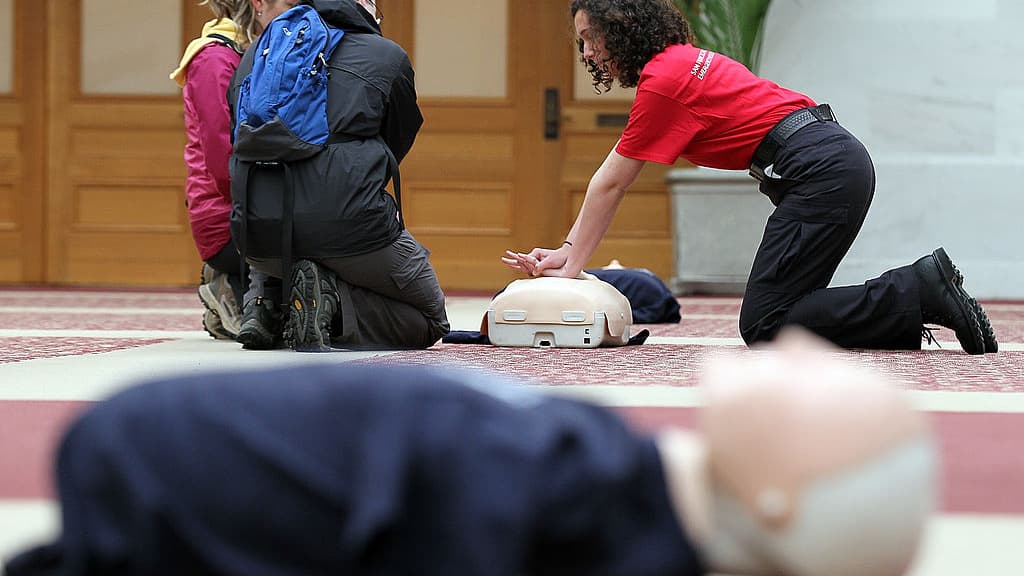
In 2024, two Michigan high school students were sitting in the bleachers during a student-teacher basketball game when their physical education teacher collapsed from cardiac arrest.
asserted
teacher → sit → arrest
They had both recently learned cardiopulmonary resuscitation (CPR) at a career-focused technical nursing center and rushed to help, beginning chest compressions and using an automated external defibrillator (AED) before emergency responders arrived.
asserted
responders → learn → defibrillator
We often describe the difference between life and death as a matter of speed: how quickly emergency services arrive and how fast a hospital can intervene.
asserted
hospital → describe → speed
But in reality, cardiac arrest outcomes often depend on whether someone nearby begins CPR in the first few minutes, which rarely belong to emergency responders, but instead to whomever is standing closest: a classmate, teacher, stranger at a basketball game, or someone waiting for a train.
asserted
whomever → depend → train
Every minute without CPR sharply reduces the chances the patient will live long enough to reach a hospital.
asserted
patient → reduce → hospital
Schools occupy a special role in public health.
asserted
Schools → occupy → health
As a location most Americans pass through and one of the only places they may ever encounter CPR training, a high school classroom may be the best opportunity to prepare the next generation of lifesavers.
uncertain
classroom → pass → lifesavers
Schools already rehearse fire drills and lockdown drills for dangers that are statistically rare.
asserted
that → rehearse → dangers
Cardiac arrest is the reverse: far more common, and far less rehearsed.
asserted
arrest → rehearse → ?
CPR skills can save lives years down the road when a cardiac arrest occurs at home, in a gym, at an airport, or at a university.
asserted
arrest → save → university
Harnessing that opportunity requires both the resources to teach CPR effectively and the policies to ensure every student has the chance to learn it.
asserted
student → harness → it
In Europe, Belgium, Denmark, France, Italy, Norway, Portugal, and England implemented school CPR education through national requirements or curriculum standards.
asserted
Belgium → implement → requirements
Denmark offers a clear example of the positive impact.
asserted
Denmark → offer → impact
From 2001 to 2010, as Denmark introduced nationwide resuscitation initiatives including mandatory school CPR education, bystander CPR rates more than doubled, while 30-day survival after out-of-hospital cardiac arrest more than tripled.
asserted
survival → introduce → arrest
A central challenge is how to implement CPR training at scale.
asserted
challenge → implement → scale
The international KIDS SAVE LIVES initiative offers a practical blueprint.
asserted
initiative → save → blueprint
Endorsed by the World Health Organization, it calls for recurring, age-appropriate basic life support education beginning in childhood.
asserted
it → endorse → childhood
Research from the International Liaison Committee on Resuscitation shows children can learn the early links in the chain of survival from the young age of 4, perform effective chest compressions by age 12, and pass skills to family members and others.
asserted
children → show → members
Some may hesitate to perform CPR because of legal concerns over causing injury—like rib fractures—while administering CPR, but every state has Good Samaritan laws providing protections to people who render emergency aid in good faith.
uncertain
who → hesitate → faith
A 30-year review of U.S. litigation across all 50 states from 1989 to 2019 found no cases in which a layperson who provided CPR was held liable for causing harm.
asserted
who → find → harm
The U.S. has also made significant progress in bringing CPR education into schools.
asserted
U.S. → make → schools
In 1984, Alabama became the first state to require CPR instruction for high school graduation.
asserted
Alabama → become → graduation
Over the four decades since, communities have taken different approaches to bring CPR into the classroom.
asserted
communities → take → classroom
In West Virginia and Alaska, educators’ unions formally backed legislation requiring CPR education, while efforts in Washington and Illinois advanced in memory of students lost to cardiac arrest.
asserted
efforts → back → arrest
Today, 43 states require some form of CPR education before high school graduation.
asserted
states → require → graduation
California, Colorado, Hawaii, Massachusetts, Nebraska, New Hampshire, and Wyoming are the seven that remain.
asserted
that → remain → ?
Several are already taking steps to expand CPR education.
asserted
Several → take → education
Massachusetts invested $425,000 to expand CPR education in public schools, while Colorado includes hands-on CPR and AED instruction in its statewide health education guidelines but stops short of requiring schools to provide it.
asserted
Colorado → invest → it
California Gov. Gavin Newsom recently signed a resolution directing the Instructional Quality Commission to include high school CPR in the state’s next health curriculum framework.
asserted
Newsom → sign → framework
San Francisco is taking an even broader approach, with paramedics and firefighters working to train 100,000 community members in CPR.
asserted
paramedics → take → CPR
There is evidence that laws can translate into lifesaving action.
asserted
laws → be → action
A study of nearly 300,000 out-of-hospital cardiac arrests across 20 states found that patients had 12% higher odds of receiving bystander CPR in states with high school CPR education laws than those without them.
asserted
patients → find → them
Other lifesaving education efforts can also offer a roadmap.
asserted
efforts → offer → roadmap
In Georgia, Wesley’s Law, championed by Laura and Larry Gay after their son’s death, required public schools to stock overdose-reversal medication such as naloxone.
asserted
Law → champion → naloxone
In 2025, the state launched an opioid-settlement-funded initiative to provide overdose-reversal kits to public schools statewide, along with training resources for staff.
asserted
state → launch → staff
In Indiana, emergency-response professionals helped expand Stop the Bleed training in schools, and the state’s Secured School Safety Grant program now offers funding for school bleeding-control programs and kits.
asserted
program → help → programs
Both examples demonstrate how local champions and an existing source of funding can help turn a lifesaving idea into reality.
asserted
champions → demonstrate → reality
Broadening collaboration among organizations such as the American Medical Association, American Red Cross, Project ADAM, and American Heart Association can also help expand CPR education nationwide.
asserted
collaboration → broaden → education
After Buffalo Bills safety Damar Hamlin suffered cardiac arrest on the field in 2023, he became a leading advocate for the bipartisan HEARTS Act, which Congress passed unanimously in 2024.
asserted
Congress → suffer → 2024
President Biden signed it into law later that year, supporting schools in expanding access to AEDs, CPR and AED education, and cardiac emergency response planning.
asserted
Biden → sign → AEDs
…and 3 more, not listed.
 The Aporia