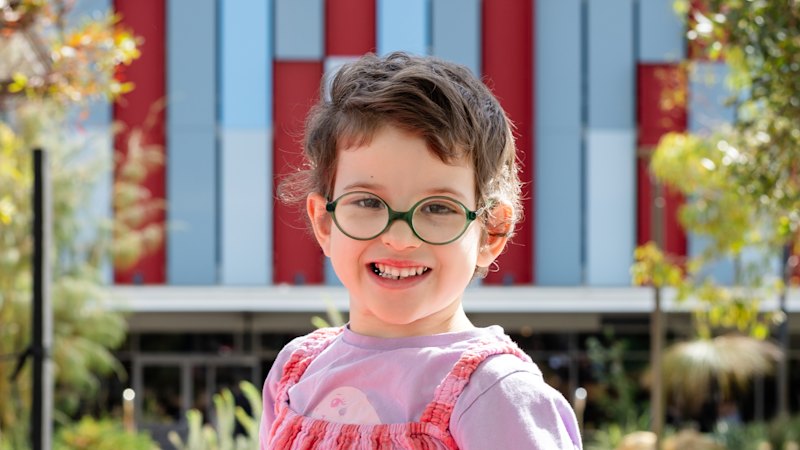
Riley Shawcross is five years old, a time of life that ought to be measured in lost baby teeth, scuffed knees, and primary school milestones.
asserted
that → measure → teeth
Instead, the last two years of her childhood have been calibrated in hospital monitors and dozens of silent brain injuries.
asserted
years → calibrate → injuries
Born with a gene mutation so rare that there are only one in four cases in Australia and 80 worldwide, it causes the blood vessels throughout her body to behave abnormally, leaving her particularly vulnerable to stroke.
asserted
vessels → bear → stroke
Since suffering her first transient ischaemic attack (TIA) in July 2024, she has experienced more than 25 mini strokes.
asserted
she → suffer → strokes
Her family has watched her suddenly lose her speech, struggle to move parts of her body and, at times, be unable to get words out at all.
asserted
her → watch → words
“[After her first stroke] we ended up being in and out of Perth Children’s Hospital for about three months.
asserted
we → end → months
Riley ended up having upwards of 10 TIA’s in a three-month period, and that’s when the doctors decided that they needed to do something intervening,” Riley’s mum Stephanie Shawcross said.
asserted
mum → end → something
But a $1 million leap in surgical precision gave doctors the ultimate vantage point that has left the Margaret River youngster stroke-free for more than four months.
asserted
that → give → months
Riley was born with multisystemic smooth muscle dysfunction syndrome (MSMDS), caused by a mutation in the ACTA2 gene.
asserted
Riley → bear → gene
The condition affects smooth muscle throughout the body, including the heart, lungs, digestive system and blood vessels.
asserted
condition → affect → heart
In Riley’s brain, smaller blood vessels can narrow or close over time, restricting blood flow and increasing her risk of stroke.
asserted
vessels → narrow → stroke
After extensive consultation with specialists, Riley’s medical team determined that a highly specialised revascularisation surgery could help improve blood flow to her brain.
uncertain
surgery → determine → brain
The first surgery on the right side of Riley’s brain was performed in July 2025.
asserted
surgery → perform → July
Just before her second surgery, the hospital was given a new state-of-the-art neuro-microscope that would help surgeons navigate the complex brain surgery even more precisely.
asserted
surgeons → give → surgery
The technology, funded by Perth Children’s Hospital Foundation (PCHF) led surgeons to discover that Riley’s brain had begun growing its own new blood vessels.
asserted
brain → fund → vessels
Riley’s surgeon, Dr Edward White said the technology had been incredibly valuable in helping the team understand Riley’s changing brain anatomy and tailor the surgery to her individual needs.
asserted
team → say → needs
“Blood vessels are around half a millimetre wide, so these are structures that are incredibly difficult to see with the naked eye,” White said.
asserted
White → see → eye
“The technology gives us a much clearer view of what we are working with and, in Riley’s case, allowed us to tailor the surgery to preserve the blood vessels already supplying her brain.
asserted
us → give → brain
Following the surgeries, Riley has been stroke free, and her family is hopeful that the new blood vessels growing in her brain will continue to improve blood flow and protect her from future strokes.
“Parenting a child with a complex medical condition, there will always be a worry in the back of your mind of what is next,” Shawcross said.
asserted
Shawcross → follow → mind
“However, we will take all the good days we can get and right now, Riley is stroke-free since April, and we are beyond thankful for that!”
asserted
we → take → that
Riley is one of the first kids in WA to benefit from the new neuro-microscope, following its arrival at the hospital earlier this year.
asserted
Riley → benefit → hospital
The device combines advanced magnification and illumination with AI-powered and robotic features to give surgeons greater precision and visualisation when operating on the brain and spine.
asserted
device → combine → brain
The neuro-microscope also incorporates fluorescence imaging, allowing surgeons to use a contrast dye to visualise vascular structures in real time, alongside voice controls and robotic assistance that automate microscope adjustments during surgery.
asserted
that → incorporate → surgery
PCHF chief executive Carrick Robinson said the investment in technology would help ensure the hospital remained at the forefront of paediatric healthcare.
asserted
hospital → say → healthcare
“Our $1 million investment is about giving PCH surgeons access to the very best tools available as they care for children like Riley with incredibly complex conditions,” Robinson said.
asserted
Robinson → give → conditions
“As the first children’s hospital in Australia to have this technology, we’re proud to be leading the way in bringing next-generation surgical technology to WA kids and their families.”
asserted
we → have → kids
PCH neurosurgeon Dr Snigdha Saha said the technology was already proving valuable across the hospital’s neurosurgical services.
asserted
technology → say → services
“Better visualisation can help make surgery safer and more accurate for patients,” Saha said.
asserted
Saha → help → patients
“We’ve already used the microscope for brain tumour resection and the additional features such as voice command and robotic assistance, automating adjustments and visual workflows, were highly useful and has facilitated good outcomes.
asserted
features → use → outcomes
The microscope is expected to be used in more than half of neurosurgeries at PCH, including neurovascular, brain cancer and spinal cases.
asserted
microscope → expect → cases
 The Aporia