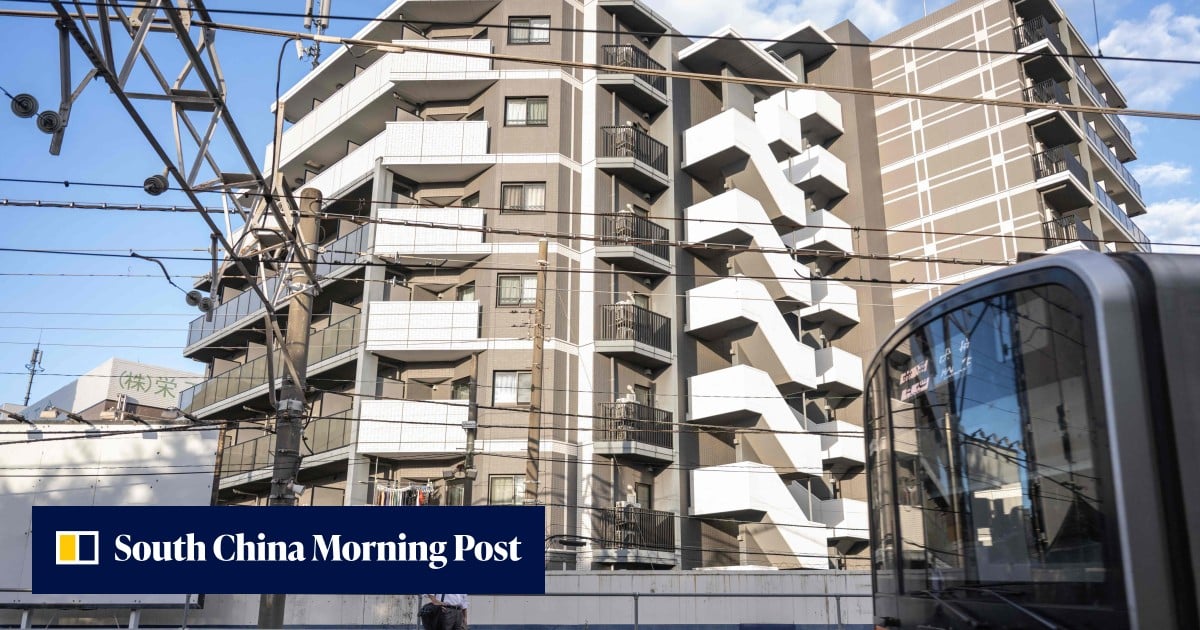
New property purchase disclosure rule in Japan sparks fears it may curb foreign investment

Read the original at South China Morning Post ↗
Cite

Arcibal, C. (2026, October 18). New property purchase disclosure rule in Japan sparks fears it may curb foreign investment. South China Morning Post. https://www.scmp.com/business/article/3371224/new-property-purchase-disclosure-rule-japan-sparks-fears-it-may-curb-foreign-investment?utm_source=rss_feed

Dated from the outlet's own feed. Check the original for its byline.

South China Morning Post · collected 2026-10-18 · by Cheryl Arcibal

Quick Summary

Japan has introduced a rule requiring all property buyers to disclose their nationality, raising concerns among analysts that this might deter foreign investors. Concurrently, Japan's shift towards higher interest rates is also affecting investor sentiment. Neil Brookes from Savills notes the strong performance of Japanese real estate in recent years but suggests that rising interest rates may reduce demand. Data from MSCI shows Japan ranked second in Asia-Pacific for property investment in the first half of the year, with a total netted amount of US$27.2 billion.
Written locally by qwen2.5:14b on 2026-10-18, using this article's own text rather than the other coverage of the same event (that is the story summary below).

AI analysis runs on qwen2.5:14b, locally

Story summary

Tokyo has implemented a new rule requiring all property buyers to declare their nationality, which is raising concerns among investors and may curb foreign investment in Japan's real estate market. This comes as Japan shifts from an ultra-loose monetary policy to gradually normalizing interest rates, making real estate assets less attractive for investors. According to Neil Brookes, head of Asia-Pacific capital markets at property consultancy Savills, Japan has seen strong demand over the past seven or eight years but rising interest rates are now dampening that enthusiasm. In the first half of 2026, Japan's property investment netted US$27.2 billion, ranking second in Asia-Pacific behind mainland China.

Written for “Japan Property Purchase Rule” on 2026-10-18, grounded in this article and the 0 other(s) covering the same event.
Why this leaning score
The article's own words the score was based on. Each is quoted verbatim and was checked against the article text before being stored, so you can find it in the original.
Reading Leans right (beta estimate) Confidence high
Leaning: leans right for article 88120 (high confidence, 1 verified quote) · logged 2026-10-18

Story

📰 Japan Property Purchase Rule
Economy/Business · 1 article(s) covering the same event.

Compared with similar articles

Nothing to compare against. No article is close enough to this one for the pipeline to have linked or judged the pair.
How this article was measured signals, leaning charts, publisher record, byline, topics and claims

Signals How these are calculated →

Claims extracted
5
sentences that state something as happening or true
Uncertain
40%
2 of 5 hedged ("reportedly", "may", "according to")
Leaning
Leans right
of the writing, not the subject · beta estimate
Publisher signals
64/100
South China Morning Post's corrections and hedging, across everything collected from it. Not a measure of accuracy.
Outlets on this story
1
Economy/Business
Same framing elsewhere
1
articles that frame the event the way this one does
Analyzed 2026-10-18 · how these are computed

How this is being covered How these are calculated →

Article leaning vs. publisher reliability
Source leaning vs. consistency

Publisher

South China Morning Post · 2508 article(s) · 6 correction(s) detected
Running correction rate · 6 correction(s)

Who wrote this

Cheryl Arcibal
17 article(s) here · 1 carrying a prediction
🔮 New property purchase disclosure rule in Japan sparks fears it may curb foreign investment Rising interest rates and new legislation on nationality disclosure are raising concerns that foreign investors may reconsider real estate investment Tokyo’s implementation of a rule that requires all property buyers to declare their nationality is raising concerns among investors, according to analysts.

🔮 AI job losses set to rein in office demand in developed Asia-Pacific economies: report CBRE says 3.9 per cent of office jobs in developed parts of region are vulnerable to replacement by artificial intelligence A mild displacement of jobs across the Asia-Pacific region as companies expand their use of AI would trim five percentage points off growth in office space demand in the next few years, according to property consultancy CBRE. In a report released on Thursday it said 3.9 per cent of office jobs were vulnerable to artificial intelligence-driven displacement in developed markets in the region, including Hong Kong, Singapore, Japan, South Korea, Taiwan, Australia and New Zealand. However, only 1.7 per cent were similarly vulnerable in developing markets including mainland China, India, Indonesia, Malaysia, Philippines, Thailand and Vietnam.
🔮 DFI Retail Group says it will continue to invest in Hong Kong supermarkets Owner of Wellcome, Market Place, 3hreesixty and Oliver’s chains operates a network of more than 325 stores Hong Kong-headquartered DFI Retail Group, which owns and operates the city’s largest supermarket network, says it will continue to invest in new stores even though consumers remain cautious.
🔮 The 8,974 square feet Dairy Farm Guildford Road Shopping Centre will be sold via a public tender that closes at noon on November 19
🔮 Could Northern Metropolis draw educational leasing from Hong Kong’s Grade A office sector?
🔮 Higher borrowing costs could moderate investment activity in some markets during the second half of the year, Carroll said, adding that investor interest remained concentrated in markets with strong growth and positive supply-demand fundamentals.
🔮 Hong Kong developer New World gets nod to spin off K11 Shanghai assets Shanghai listing of Reit worth US$570 million will ‘recycle capital for more value-accretive projects’, analyst says New World Development (NWD) received the green light from the Shanghai Stock Exchange to spin off and list a Reit (real estate investment trust) on the bourse, according to the distressed developer controlled by one of Hong Kong’s wealthiest families.
🔮 The 598-room hotel, located in Hong Kong’s eastern Kowloon Peninsula, a former industrial area, was taken over by Nanyang Commercial Bank for HK$1.87 billion (US$238.4 million) in 2025, with the bank now looking to dispose of the asset to the highest bidder.
🔮 Will AI adoption shrink office space?
🔮 Which overseas property markets will be the winners and losers if Fed raises US rates?
Also by Cheryl Arcibal
Nothing else under this byline is closely related to this article, so these are simply their most recent.
All 17 articles by Cheryl Arcibal →

Topics

China Japan MSCI Savills Tokyo

Subjects

Japan GPE · 4× China GPE · 1× MSCI ORG · 1× Neil Brookes PERSON · 1× Savills ORG · 1× Tokyo GPE · 1×

Narrative

Japan’s shift from an ultra-loose monetary policy to gradual normalisation of its interest rates was also likely to force investors to reconsider whether real estate assets were still attractive, they added.
framing: mixed · carried by 1 article(s) · first seen 2026-10-18
🔮 New property purchase disclosure rule in Japan sparks fears it may curb foreign investment Rising interest rates and new legislation on nationality disclosure are raising concerns that foreign investors may reconsider real estate investment Tokyo’s implementation of a rule that requires all property buyers to declare their nationality is raising concerns among investors, according to analysts.
Claims (5 extracted, 2 hedged)

New property purchase disclosure rule in Japan sparks fears it may curb foreign investment Rising interest rates and new legislation on nationality disclosure are raising concerns that foreign investors may reconsider real estate investment Tokyo’s implementation of a rule that requires all property buyers to declare their nationality is raising concerns among investors, according to analysts. uncertain
that → spark → analysts
Japan’s shift from an ultra-loose monetary policy to gradual normalisation of its interest rates was also likely to force investors to reconsider whether real estate assets were still attractive, they added. asserted
they → force → investors
“Japan has had a really strong run for the last seven or eight years,” said Neil Brookes, head of Asia-Pacific capital markets at property consultancy Savills. asserted
Brookes → have → Savills
“But generally, because interest rates have gone up so much, there’s definitely less demand for Japan.” asserted
rates → go → Japan
The world’s fourth-largest economy netted US$27.2 billion in property investment in the first half of the year, ranking second behind mainland China in Asia-Pacific, according to data tracked by MSCI. uncertain
economy → net → MSCI
💬Give feedback
🕘History 🎫Support