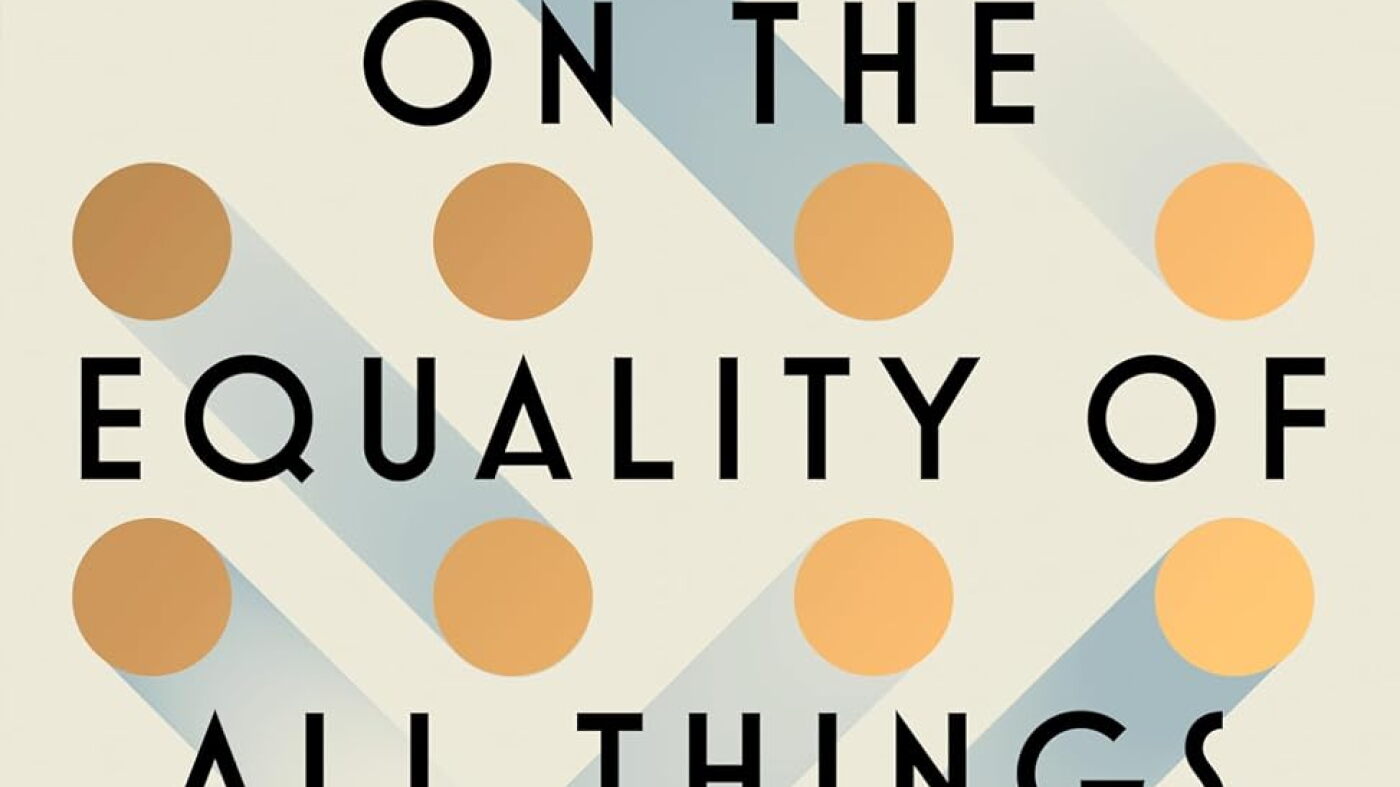
New Carlo Rovelli book challenges science's understanding of reality and the universe
I have a book on my shelf called Physics and Ultimate Reality.
asserted
I → challenge → shelf
The title perfectly expresses the dream many physicists like me have when we begin our studies as young students.
asserted
we → express → students
We yearn for perfect, objective knowledge of a perfectly knowable universe.
asserted
We → yearn → universe
This "God's-eye view" is also what's claimed as the purpose and promise of physics in many popular books on the subject.
asserted
what → claim → subject
But, now, comes a new book by physicist Carlo Rovelli that explicitly rejects any path to an ultimate reality.
asserted
that → come → reality
The force with which Rovelli -- one of the leading researchers and popularizers in the field – argues for this seemingly heretical view is what makes his On the Equality of All Things such a compelling, exciting and important read.
asserted
what → lead → Things
Rovelli begins with a simple and compelling point: We humans have access to a very limited set of experiences when it comes to the universe.
asserted
it → begin → universe
Because we live on the solid surface of a planet, we think there are solid objects.
asserted
we → live → planet
Because that solid surface offers fixed reference points like mountain tops, we think solid objects can have fixed locations in space.
asserted
objects → offer → space
And if those objects do move, we think we can use our fixed reference points to give us an absolute measure of that motion.
asserted
we → move → motion
In each case, however, modern physics has shown these assumptions to be illusions.
asserted
assumptions → show → case
Albert Einstein's relativity revealed that measurements of time and space (including our sense of when two events are simultaneous) are relative.
asserted
events → reveal → sense
Quantum mechanics, our best theory of matter at the atomic level, showed us that the properties we can ascribe to things cannot be disentangled from how we measure them.
asserted
we → show → them
In this way, Rovelli argues, modern physics began to erode the sense that physics gives us a perfect access to a world as seen from the outside (i.e. the God's-eye view).
asserted
physics → argue → outside
What we get instead is the world as viewed from within.
asserted
get → get → within
Rovelli dedicates considerable space to a view of quantum mechanics called the relational interpretation.
asserted
Rovelli → dedicate → mechanics
When quantum physics appeared in the early 20th century, it came as a shock to the physicists who were creating it.
asserted
who → appear → it
In the 250 years since Newton introduced his famous laws of motion, physicists had come to believe their equations described a reality that was entirely independent of human action or interpretation.
asserted
that → introduce → action
The "stuff" described by Newton's laws, and the laws themselves existed "out there" in the "Ultimate Reality" that the book on my shelf points to.
asserted
book → describe → shelf
But in quantum mechanics it became difficult to speak of objects having properties before those properties were measured.
asserted
properties → become → properties
This is the source of the famous Schrodinger's Cat parable where a cat in a box can be both dead and alive before the box is opened and a measurement is made.
asserted
measurement → open → box
For some physicists, it was so important to get that Ultimate Reality back that they invented interpretations of quantum physics that claimed the universe splits into separate parallel versions of itself when the box is opened.
asserted
box → get → itself
Rovelli thinks these attempts are nonsense.
asserted
attempts → think → ?
Everything exists only in relation to everything else.
asserted
Everything → exist → everything
That means the properties of a system – any object – are always relational properties.
asserted
properties → mean → system
And in the absence of an ultimate perspective the power of physics to ultimately "explain everything" also falls apart.
asserted
power → explain → everything
As Rovelli puts it in his latest book, "Physics is often credited with a power it does not have: that of exhausting what can be known about the world.
asserted
what → put → world
Knowing the physical laws of the world does not amount to knowing the world."
This is a radical claim about physics, particularly for one of the world's most well-regarded physicists.
uncertain
This → know → physicists
Not only does it directly contradict the scientific triumphalism that one finds in many popular books about science, it's also a view that crashes against the perspectives of many contemporary philosophers of science.
asserted
that → contradict → science
But as Rovelli writes, "we never leave the circle of perspectives."
asserted
we → write → perspectives
One of the most original aspects of Rovelli's argument is to draw on philosophical sources beyond the usual suspects in the Greek or European tradition.
asserted
One → draw → tradition
He relies heavily on the classical philosophies of India and Asia.
asserted
He → rely → India
Thinkers like Nagarjuna (from the 2nd century) or Zhuangzi (4th century BC China) appear many times in the book.
asserted
Thinkers → appear → book
In this way, Rovelli recognizes them as the equals of Plato, Aristotle and others in their ability to penetrate difficult questions of reality but doing so from a different perspective.
asserted
Rovelli → recognize → perspective
What's particularly compelling in this book is how lyrically Rovelli still vehemently defends the power and promise of physics (and science in general).
asserted
Rovelli → defend → physics
Rather than unworkable claims of an absolute certainty about an absolute reality, Rovelli sees science as an invitation to the great creative effort of seeking knowledge.
uncertain
Rovelli → see → knowledge
And, indeed, science does produce knowledge that is both profoundly beautiful and useful.
asserted
that → produce → knowledge
Rovelli argues for a change in view that is not a defeat but a new kind of humility in the face of the universe's vast complexity.
asserted
that → argue → complexity
There are places to disagree with Rovelli, such as his neglect of the primacy of experience in considering how science is even possible.
asserted
science → be → experience
In some places Rovelli dismisses this view with a wave of hand, like in his treatment of the great philosopher Henri Bergson, who emphasized that lived time is essentially different from time represented in science.
asserted
time → dismiss → science
…and 2 more, not listed.