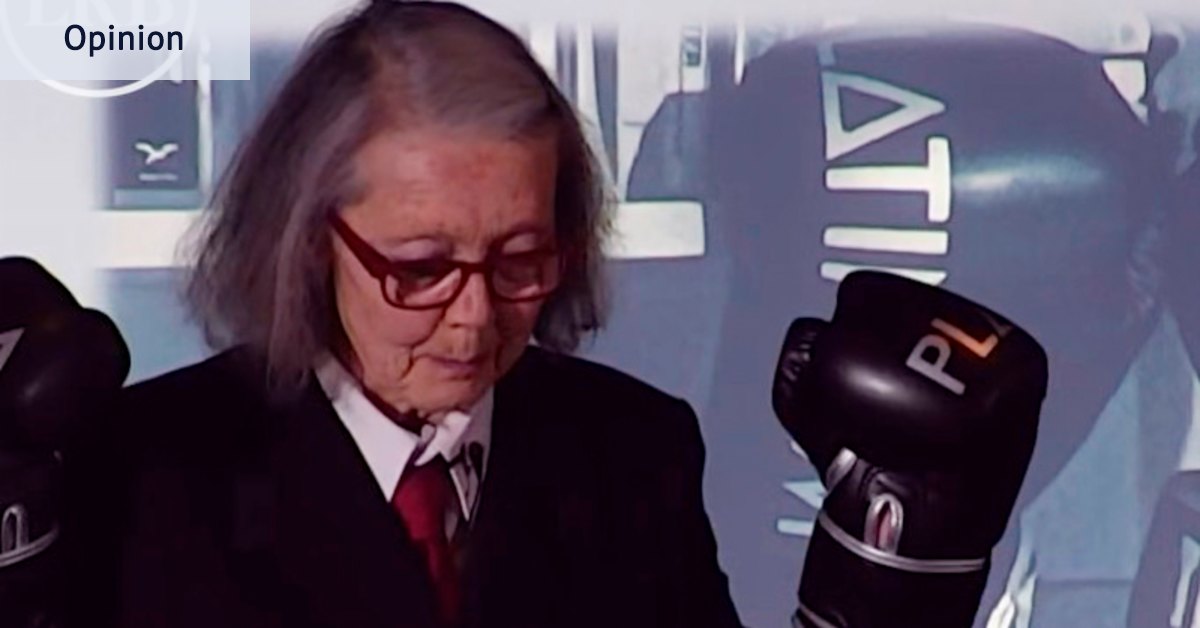
Why the woman who won the Nobel Prize for Literature wears boxing gloves

Read the original at The Sydney Morning Herald ↗
Cite

Gee, S. (2026, October 17). Why the woman who won the Nobel Prize for Literature wears boxing gloves. The Sydney Morning Herald. https://www.smh.com.au/culture/books/why-the-woman-who-won-the-nobel-prize-for-literature-wears-boxing-gloves-20261018-p6153x.html?ref=rss&utm_medium=rss&utm_source=rss_feed

Dated from the outlet's own feed. Check the original for its byline.

The Sydney Morning Herald · collected 2026-10-17 · by Sophie Gee

Quick Summary

Anne Carson, a Canadian-Icelandic poet and classics professor, won the Nobel Prize for Literature this month despite not being widely known or expected to win. Her work primarily involves inventive translations and creative transformations of ancient texts by authors like Euripides and Sappho. Notably, she often wears boxing gloves at public events due to her Parkinson’s disease, symbolizing her confrontation with mortality and illness. The article emphasizes Carson's significance in addressing contemporary issues related to artificial intelligence through her engagement with ancient literature and human experience.
Written locally by qwen2.5:14b on 2026-10-17, using this article's own text rather than the other coverage of the same event (that is the story summary below).

AI analysis runs on qwen2.5:14b, locally

Story summary

Anne Carson won the Nobel Prize for Literature this month, despite not being a frontrunner or crowd favorite. She is a Canadian-Icelandic poet and classics professor who teaches ancient Greek literature in Canada and the US. Her work primarily involves inventive translations and creative transformations of ancient texts by authors like Euripides, Aeschylus, Sappho, and Catullus. Carson's modern literary influences include Emily Brontë, Emily Dickinson, and Virginia Woolf.

Carson was selected to deliver the Robert Fagles Lecture for Classics in the Contemporary Arts at Princeton University last year, during which she wore boxing gloves. She has Parkinson’s disease and uses her work as a form of confrontation with degenerative illness and death, addressing urgent global issues such as generative artificial intelligence and the rise of powerful AI companies.

Written for “Nobel Prize Winner's Boxing Gloves” on 2026-10-17, grounded in this article and the 0 other(s) covering the same event.
Why this leaning score
This article does not take a side on a contested political question, so it has no leaning score. That is an answer rather than a gap: a match report or a rescue can be warmly or critically written without being left or right, and scoring it anyway is how approval of a subject gets recorded as a political position.
No political leaning scored for article 87503 · logged 2026-10-17

Story

📰 Nobel Prize Winner's Boxing Gloves
Entertainment · 1 article(s) covering the same event.

Compared with similar articles

Nothing to compare against. No article is close enough to this one for the pipeline to have linked or judged the pair.
How this article was measured signals, leaning charts, publisher record, byline, topics and claims

Signals How these are calculated →

Claims extracted
32
sentences that state something as happening or true
Uncertain
0%
0 of 32 hedged ("reportedly", "may", "according to")
Leaning
not political
takes no side on a contested political question
Publisher signals
61/100
The Sydney Morning Herald's corrections and hedging, across everything collected from it. Not a measure of accuracy.
Outlets on this story
1
Entertainment
Same framing elsewhere
1
articles that frame the event the way this one does
Analyzed 2026-10-17 · how these are computed

How this is being covered How these are calculated →

Article leaning vs. publisher reliability
Source leaning vs. consistency

Publisher

The Sydney Morning Herald · 3994 article(s) · 10 correction(s) detected
Running correction rate · 10 correction(s)

Who wrote this

Sophie Gee
1 article(s) here · 1 carrying a prediction
🔮 She wasn’t the crowd-pleasing choice either – that would’ve been Salman Rushdie, or Margaret Atwood, or Thomas Pynchon or Helen Garner, or really almost anybody but Carson, a Canadian-Icelandic poet and classics professor whom (let’s face it) very few people had heard of.
The only article under this byline in the corpus.

Topics

Canada Canadian Chinese Lesbos Princeton University

Subjects

Carson PERSON · 11× Sappho PERSON · 2× Anne Carson PERSON · 1× Can Xue PERSON · 1× Canadian NORP · 1× Chinese NORP · 1× Helen Garner PERSON · 1× Margaret Atwood PERSON · 1× Salman Rushdie PERSON · 1× Thomas Pynchon PERSON · 1×

Narrative

The Nobel Prize is a barometer of what feels urgent and globally important across all major domains of human knowledge, and Carson’s purposeful confrontation with degenerative illness and death, paired with her provocative sparring with the poetry and drama of 3000 years ago, gives us a crucial primer for human intelligence as we confront the crises of generative artificial intelligence and the unstoppable rise of powerful, warring AI companies.
framing: assertive · carried by 1 article(s) · first seen 2026-10-17
🔮 She wasn’t the crowd-pleasing choice either – that would’ve been Salman Rushdie, or Margaret Atwood, or Thomas Pynchon or Helen Garner, or really almost anybody but Carson, a Canadian-Icelandic poet and classics professor whom (let’s face it) very few people had heard of.
2026-10-17 · The Sydney Morning Herald
Why the woman who won the Nobel Prize for Literature wears boxing gloves · assertive framing

Claims (32 extracted, 0 hedged)

Anne Carson won the Nobel Prize for Literature this month. asserted
Carson → win → Literature
She wasn’t the crowd-pleasing choice either – that would’ve been Salman Rushdie, or Margaret Atwood, or Thomas Pynchon or Helen Garner, or really almost anybody but Carson, a Canadian-Icelandic poet and classics professor whom (let’s face it) very few people had heard of. asserted
people → please → it
Carson spent much of her career teaching ancient Greek in classics departments in Canada and the US, and almost all her Nobel Prize-winning poems are inventive translations or creative transformations of ancient texts, including Euripides, Aeschylus, Sappho and Catullus. asserted
poems → spend → Euripides
Her modern literary influences include Emily Brontë, Emily Dickinson and Virginia Woolf. asserted
influences → include → Brontë
Since the 1990s, Carson has been one of the poetry world’s anointed ones, canonised in classics and English departments and independent poetry bookshops across North America. asserted
Carson → anoint → America
Just last year she was chosen to deliver the Robert Fagles Lecture for Classics in the Contemporary Arts at Princeton University, which she did wearing boxing gloves. asserted
she → choose → gloves
Carson has Parkinson’s disease and says that it’s “all but impossible” to worry about the “black doorway” of death when someone has strapped a boxing glove onto your hand. asserted
someone → have → hand
Since the announcement, Carson has gone viral. asserted
Carson → go → announcement
The Nobel Prize is a barometer of what feels urgent and globally important across all major domains of human knowledge, and Carson’s purposeful confrontation with degenerative illness and death, paired with her provocative sparring with the poetry and drama of 3000 years ago, gives us a crucial primer for human intelligence as we confront the crises of generative artificial intelligence and the unstoppable rise of powerful, warring AI companies. asserted
we → feel → companies
Ancient writing constantly reminds us how close death is to life. asserted
death → remind → life
To read Carson’s translations of ancient Greek and Latin is to feel, viscerally, the urgency and beauty of being human in this present. asserted
read → read → present
Here’s her translation of lines from the 6th century BC poet Sappho, a wealthy woman from Lesbos, whose poems survive only in fragments and scraps of language. asserted
poems → ’ → language
The poet is watching as a random man at a dinner leans in and “listens close” to the “sweet speech” of a woman whom she herself loves. asserted
she → watch → whom
The speaker’s heart races with envy, longing, desire and fear, so intense that she feels dead. asserted
she → race → envy
There the fragments end. asserted
fragments → end → ?
We won’t ever know what happens. asserted
what → know → ?
oh it puts the heart in my chest on wings for when I look at you, even a moment, no speaking is left in me Carson’s shift from Ivy League darling to global literary celebrity shows that what we want, and need, to do is get clear about what human intelligence (HI) is, stat. asserted
intelligence → put → what
HI is a set of wise, discerning – above all clunky and imperfect – capabilities that are inextricable from feelings and bodies, and that are entirely distinct from their synthetic counterparts in data centres. asserted
that → discern → centres
It’s often unhelpful, the opposite of a chatbot, pushing back at the reader without trying to soothe, flatter and appease. asserted
It → ’ → reader
At the end of her lecture at Princeton, brandishing her boxing mitt, Carson said, “Form fights back!” asserted
Form → brandish → mitt
She meant that, when we humans apply our attention to a human-made form that is highly structured or rule-based, like poetry or boxing, we discover our weak spots. asserted
we → mean → spots
We also find our power. asserted
We → find → power
Humans need clashes with demanding mental activities like reading hard books, writing essays, or translating from other languages because these are the human habits that enable us to “fight back” against our tendency towards avoiding discomfort, ignoring complexity and being afraid of uncertainty. asserted
that → need → uncertainty
Even more importantly, when we grapple and clash with difficult forms, rules and frameworks, we don’t necessarily get the win. asserted
we → grapple → win
Carson has written that, when one translates Greek and Latin poetry, “mistakenness is valuable”. asserted
mistakenness → write → poetry
“I came to think of translating as a room, not exactly an unknown room, where one gropes for the light switch. asserted
one → come → switch
I guess it never ends.” asserted
it → guess → ?
Translating pushes writers and readers to accept imperfection, unlikeness and even error. asserted
Translating → push → imperfection
Poetry, like humanity, demands courage. asserted
Poetry → demand → courage
At the University of Sydney she holds roles as the inaugural Vice Chancellor’s Fellow (2024–) and co-director of the Eleos Collaboration. asserted
she → hold → Collaboration
She co- asserted
She → co → ?
Get it delivered every Friday. asserted
it → get → ?

💬Give feedback
🕘History 🎫Support