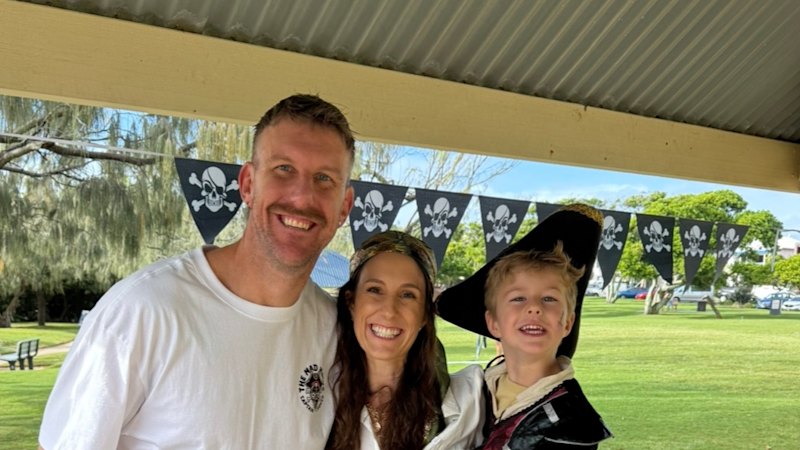
Sunshine Coast couple Luke and Emily Forrest had two miscarriages when they started trying for a baby.
asserted
they → have → baby
Since the birth of their son Jack, they’ve endured another three losses: a chemical pregnancy, ectopic pregnancy and a recent miscarriage at 12 weeks.
asserted
they → endure → weeks
Luke, a breakfast radio host, says each loss has been tough, but for the most part, he’s tried to suppress his grief to be “the strong person” for his wife and son.
asserted
he → say → wife
That was until he spoke about their struggle with IVF and early pregnancy loss in June on his show on 91.9 Sea FM.
asserted
he → speak → FM
Choking back tears, he described the heartbreak of losing multiple pregnancies and “emotions that are almost impossible to explain unless you’ve lived them yourself”.
asserted
you → choke → them
“When I [spoke about it] on air, all the emotion came out because I was thinking about the miscarriages, thinking about my wife, Em, and what she’s been through,” Forrest explains.
asserted
Forrest → speak → what
“[Before that] I had internalised it.”
asserted
I → internalise → it
After the show, Forrest remembers Emily asking why he hadn’t expressed that emotion at home.
asserted
he → remember → home
“And I said, ‘well, I thought I just had to be the strong one’.
asserted
I → say → ?
“A lot of guys think that they’ve got to be the strong person at home … and the one that’s not showing as much emotion.
asserted
that → think → emotion
“But I think men need to be more vulnerable sometimes.”
A new program by support network Pink Elephants is helping men work through the grief of early pregnancy loss, with specific resources tailored to dads.
“
asserted
men → think → dads
Dads are often placed into the supporter role quickly because it’s physically happening to the mum or the women, as in, the baby is carried within her,” Pink Elephants co-founder Sam Payne says.
asserted
Payne → place → her
“So they’re not often given the space for their own grief.
asserted
they → give → grief
“Yet if we think about the experience of miscarriage grief, it is about an imagined future … it’s not just the mum that’s lost the future they envision together.”
asserted
they → think → future
Miscarriage is the loss of pregnancy before 20 weeks gestation, and is estimated to affect 1 in 4 pregnancies.
asserted
Miscarriage → estimate → pregnancies
Before co-founding Pink Elephants 10 years ago, Payne, who experienced recurrent pregnancy loss, says there were few support services for women or men – only organisations focused on later term loss.
asserted
who → co → loss
“We have this thing in society where you validate a [pregnancy] loss based on how far along you were, which is ridiculous,” she says.
“
asserted
she → have → loss
So I struggled alone.”
asserted
I → struggle → ?
The Dad’s Support Circle has been a long time coming, Payne says, but has been delayed by the work needed to de-stigmatise early pregnancy loss and develop programs for women.
asserted
Payne → come → women
“We’re giving more and more women now permission to grieve their baby, no matter what the gestation of that baby was,” she says.
“Now we have to bring dads in too.”
asserted
we → give → dads
University of Queensland research psychologist Dr Marjolein Kammers says acknowledging grief after the loss of a baby is important regardless of gender, and can improve mental health outcomes for women and men.
asserted
acknowledging → say → women
“We know that from the research, what women are finding is that what’s contributing to negative experiences with healthcare providers is often the lack of acknowledgement of the emotional impact [of miscarriage],” Kammers says.
asserted
Kammers → know → miscarriage
“When we’re not allowed to grieve, when we can’t share that we feel we’ve lost something, that creates that isolation and worse mental health outcomes.
asserted
that → allow → isolation
“If we look at males specifically, there’s also that expectation of being strong and having your emotions in check, being there as the provider for the woman.
asserted
we → look → woman
“That adds to not talking about your feelings, not talking about how it’s impacted you, and that again leads to worse mental health outcomes.”
asserted
that → add → outcomes
Forrest has received thousands of emails and messages from women and men since sharing his experience with IVF and early pregnancy loss on radio.
asserted
Forrest → receive → radio
It’s been overwhelming at times, he says, but has reinforced the importance of speaking up, “rather than holding it in”.
asserted
he → say → it
“If there was a message I could give to any sort of guy, it would be to find someone to speak to through the journey … because you’re both going through it.
uncertain
you → be → it
 The Aporia