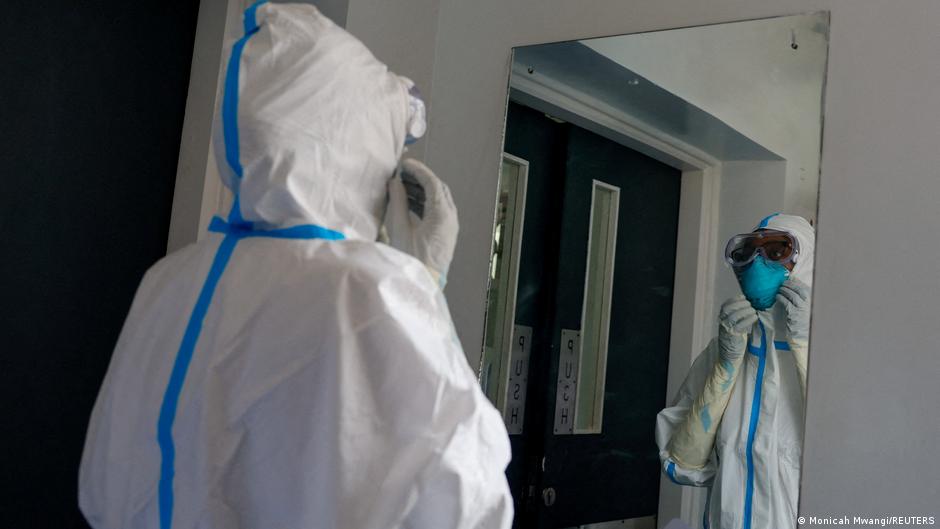
The discovery of two Ebola cases in Kenya five months after the fastest-growing outbreak in history was declared in the Democratic Republic of Congo (DRC) has exposed severe weaknesses in virus tracking efforts, experts say.
asserted
experts → grow → efforts
A 40-year-old Kenyan man who had been living in the DRC and had felt unwell for a month travelled by road to Kampala, Uganda, and then flew on to Nairobi, Kenya.
asserted
who → live → Nairobi
There he was diagnosed with Ebola and died on 5 October.
asserted
he → diagnose → October
This week, Kenya confirmed a second case of Ebola, a 39-year-old man who is a close relative of the first and was already in quarantine when he fell ill on Tuesday, according to Kenya's health ministry.
uncertain
he → confirm → ministry
It is the latest sign that the DR Congo’s Ebola outbreak, which is the DR Congo’s deadliest ever, is far from being contained.
asserted
which → contain → ?
Experts told The Independent that around a third of cases go undetected until after death, and about half of confirmed cases have no known epidemiological link, meaning it’s not known where the person was infected and from whom.
asserted
person → tell → whom
Contact tracing remains below target at under 80 per cent, but identifying contacts in the first place remains one of the biggest problems, according to Trish Newport, emergency programme manager for Médecins Sans Frontières (MSF) in DRC.
uncertain
identifying → remain → DRC
It is hard to track the movements of someone with the disease posthumously and “people are moving around without knowing they might have Ebola,” said Ms Newport.
uncertain
Newport → track → Ebola
“The whole process of listing contacts needs to improve,” she added.
asserted
she → list → contacts
Mapping the movements of people with an infection also “requires a lot of resources, and it isn’t being done today.”
asserted
it → map → resources
Efforts to respond to the Ebola outbreak, caused by the rare Bundibugyo strain for which there is no treatment or cure, have been hampered by widespread cuts to international aid, reducing the availability of trained staff and operational support.
asserted
Efforts → respond → staff
US emergency assistance to DR Congo fell from $805 million (£603m) in 2024 to $373 million in 2025, with the World Health Organisation (WHO) saying in June it had less than half the funding it needed for the Ebola response.
asserted
it → fall → response
The United Nations children’s agency UNICEF said this month it had been left with a $73.3 million funding gap – about 65 per cent of what it believes is needed – as more than 1,900 children had been orphaned or separated from their families by the outbreak.
asserted
children → say → outbreak
The epidemic, the second deadliest anywhere on record, has killed 4,300 and infected at least 9,000 people since it was declared in mid-May.
uncertain
it → kill → May
Although a handful of cases in people from the DR Congo were reported in Uganda over the summer, the country has since declared itself Ebola-free.
asserted
itself → report → summer
“Now the outbreak is so widespread … there are cases in so many places, making it even more challenging to train people to track cases, supervise them and follow up.
asserted
it → be → them
For me, it’s a question of resources,” Ms Newport said.
asserted
Newport → ’ → resources
“I think trust is always an issue, also,” she added.
asserted
she → think → ?
As well as mistrust of doctors and hospitals spread by misinformation, communities feel nervous to provide lists of their friends and family to the government for political reasons.
asserted
communities → spread → reasons
It makes community leaders invaluable to the response for the role they can play in engaging people with Ebola awareness, education and prevention.
asserted
they → make → awareness
“Community leaders are the answer to the outbreak,” said Ms Newport.
asserted
Newport → say → outbreak
“Village leaders and community health workers are indispensable because they know local households, movement patterns and community concerns,” said Dr Abdirahman Mahamud, the WHO’s Director of Health Emergency Alert and Response Operations.
asserted
Mahamud → know → Operations
“However, they cannot carry the response alone,” he added, saying that they need to work with a well-resourced system.
asserted
they → carry → system
The WHO has also warned that without significant improvements in contact tracing, the outbreak could see continued undetected transmission, late diagnoses, geographically expanding clusters and further cross-border spread.
uncertain
outbreak → warn → transmission
“Without faster case detection and more complete contact follow-up, the response will remain reactive rather than getting ahead of the outbreak,” said Dr Mahamud.
asserted
Mahamud → remain → outbreak
This article has been produced as part of The Independent’s Rethinking Global Aid project
asserted
article → produce → project
 The Aporia