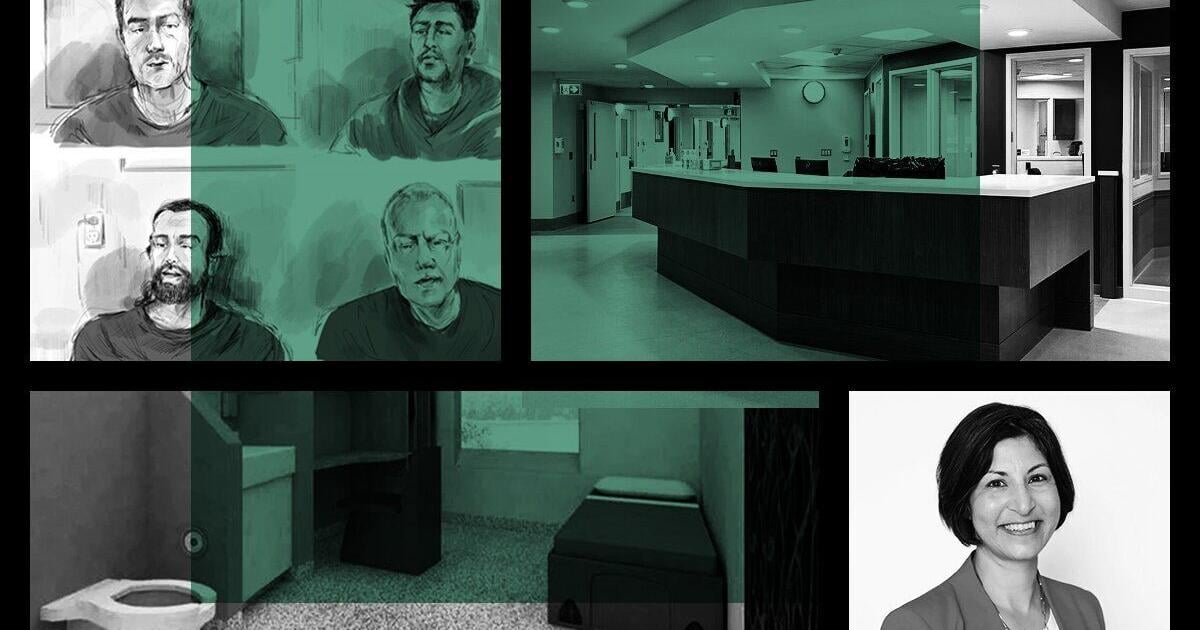
Barron Jenner moves close to the camera and describes the feeling of being held in seclusion in hospital.
asserted
Jenner → move → hospital
It’s early August, and the 40-year-old is in his eleventh year of being detained at Waypoint Centre for Mental Health Care in Penetanguishene, the province’s only maximum-security psychiatric hospital with more than 300 patient beds.
asserted
old → ’ → beds
He’s been an involuntary patient in various Ontario hospitals his entire adult life, after being found not criminally responsible (NCR) for mischief in 2004 at the age of 18.
asserted
He → find → 18
Jenner is one of four patients who agreed to be interviewed via Zoom as part of the Star’s ongoing investigation into the use of long-term seclusion at Waypoint, a practice that leading experts have described as abusive, akin to torture and unlike anything seen in other North American hospitals.
asserted
experts → agree → hospitals
Hamblett may be the person who has spent the most time in psychiatric seclusion in any Ontario hospital.
uncertain
who → spend → hospital
Hamblett may be the person who has spent the most time in psychiatric seclusion in any Ontario hospital.
uncertain
who → spend → hospital
While the Star’s coverage this year has included interviews with lawyers, doctors, advocates and relatives of patients, this is the first time that the voices of those experiencing seclusion have been featured, offering a rare look at life inside Waypoint.
asserted
voices → include → Waypoint
The four men have all been found NCR, some for non-violent incidents.
asserted
some → find → incidents
Two of them, including Jenner, are presently out of seclusion, but all have experienced being in isolation for prolonged periods.
asserted
all → include → periods
For Jenner, who has been diagnosed with schizophrenia and obsessive-compulsive disorder, it was months at a time.
asserted
it → diagnose → time
He said seclusion only makes him feel worse.
asserted
him → say → ?
“It just bogs me down and makes me feel uncomfortable and unhappy and stuck in a trap,” he said.
asserted
he → bog → trap
“I tell them I don’t like being in seclusion.
asserted
I → tell → seclusion
They don’t usually ask what it feels like.”
asserted
it → ask → what
Waypoint’s own policy states that seclusion is to be used as a last resort — and for as brief a time as possible — to deal with patients who pose an imminent risk of bodily harm to themselves or others.
asserted
who → state → themselves
The Star’s investigation has revealed that Waypoint is keeping patients in seclusion for years, including Camelott Hamblett, who has been held for 20 years and counting.
asserted
who → reveal → years
The four patients spoke in August and September in the company of their lawyers, Golnaz Nayerahmadi and Pritpal Mann of Toronto firm Rochon Genova, which had tried to certify a class-action lawsuit against Waypoint; the courts dismissed the case, finding that seclusion is an individualized process and patients would have to bring individual claims.
uncertain
patients → speak → claims
The firm is exploring other ways of pursuing the lawsuit.
asserted
firm → explore → lawsuit
“What’s it like being in seclusion?
asserted
it → ’ → seclusion
It’s not fun,” said patient Richard DeJong.
asserted
DeJong → ’ → ?
“It feels like there’s no oxygen.
asserted
It → feel → ?
It feels like you can’t breathe.”
asserted
you → feel → ?
The men described strikingly similar experiences: feeling that they’ve been placed in seclusion as punishment rather than because they were a threat; staff not checking on them regularly or telling them why their seclusion was being maintained each day; and being left in their room for days at a time without being escorted out for seclusion relief — even though hospital policies say staff must offer two hours a day.
asserted
staff → describe → hours
They also spoke about staff failing to de-escalate when they’re in a state of crisis, and instead resorting to the nuclear option: seclusion.
asserted
they → speak → option
“They’ll just push your buttons and make no effort to calm you down,” said Christopher Ducharme.
asserted
Ducharme → push → you
“You’re gonna get even more angry.
asserted
You → go → ?
You’re gonna slam your fist or slam a door.
asserted
You → go → door
You’re just gonna lose more and more self-control.”
asserted
You → go → control
Their experiences are in line with the findings of corrections expert Andrea Monteiro, who prepared an independent assessment this summer in the case of Waypoint patient Andrew Azevedo, who spent five years in seclusion.
asserted
who → prepare → seclusion
Monteiro concluded that Waypoint appears to be using seclusion to pre-emptively manage seriously mentally ill patients who might become violent later, a practice she said is now prohibited in many prisons.
uncertain
she → conclude → prisons
She found that patients in prolonged seclusion are being held in conditions the United Nations has “deemed to constitute torture” in similar settings.
asserted
Nations → find → settings
Craig Thompson has been “closely following” the Star’s investigation into the use of long-term seclusion at Waypoint Centre for Mental Health Care.
asserted
Thompson → follow → Care
Craig Thompson has been “closely following” the Star’s investigation into the use of long-term seclusion at Waypoint Centre for Mental Health Care.
asserted
Thompson → follow → Care
In a decision last month that could have a ripple effect on other secluded patients, the Ontario Review Board (ORB) — the independent body that oversees people found NCR and unfit to stand trial — relied on Monteiro’s report in finding that Waypoint had routinely violated its own policies on seclusion in Azevedo’s case, ordering the hospital to adopt measures to reduce his time in isolation.
uncertain
Waypoint → have → isolation
Waypoint is appealing that decision, with president and CEO Dr. Nadiya Sunderji saying the ORB’s orders “raise concerns about the board’s jurisdiction and intrusion upon both clinical decision-making and the management of hospital operations.”
asserted
orders → appeal → operations
Asked for a response regarding the experiences of the patients interviewed, Sunderji said she couldn’t comment due to patient confidentiality requirements.
asserted
she → ask → requirements
“Person-centred care, reflecting the unique circumstances of each patient, is at the core of the work we do at Waypoint,” she said in a statement.
asserted
she → centre → statement
In the 13 years that Sukhbir Mann has spent mostly locked in seclusion at Waypoint, he’s written close to 500 poems.
asserted
he → spend → poems
One excerpt reads: “Sometimes, I come out of my room and don’t shower for weeks/I feel sometimes I’m losing my soul and at 41, my body is turning weak.”
asserted
body → read → 41
Mann, who spoke to the Star on a tablet while in seclusion in his room, has been detained at Waypoint since being found NCR for a random knife attack in a Toronto gas station in 2013.
asserted
who → speak → 2013
…and 123 more, not listed.
 The Aporia