- Published
With a packet of biscuits in one hand and her smartphone in the other in the biscuits sucrées aisle of her local Hyper U supermarket west of Paris, Nathalie sees red.
asserted
Nathalie → publish → red
"Look at that!" she says showing me her phone.
asserted
she → look → phone
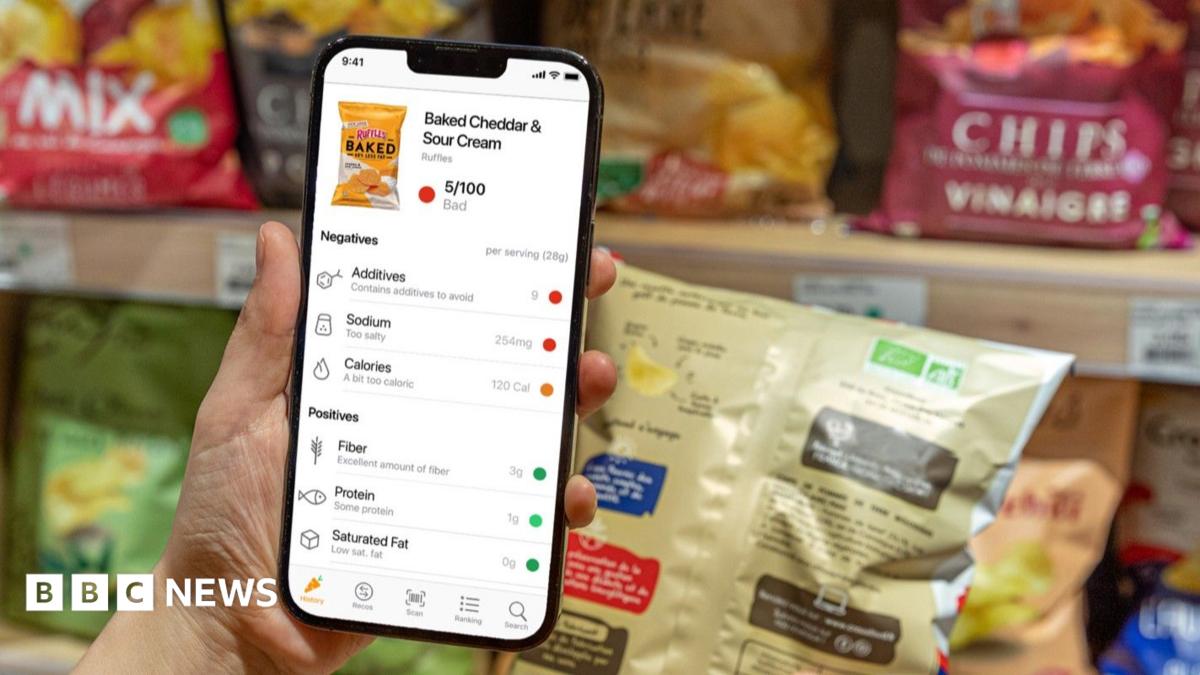
0/100 is marked in red lettering.
asserted
0/100 → mark → lettering
"This is one of Malo's [her 12-year-old son's] favourites but it's not only full of sugar and saturated fats, there are four additives as well including one health risk," she says.
asserted
she → be → risk
Nathalie clicks on the additive in question: E450.
asserted
Nathalie → click → question
"A mineral which, taken in excess, can lead to bone marrow and kidney problems," she reads.
asserted
she → take → marrow
"Honestly, that they can put this sort of thing in food aimed at children drives me nuts!" she says.
asserted
she → put → nuts
We scan an Italian alternative whose packaging gives you the impression those biscuits have been hand-made by peasant women wearing black shawls.
asserted
biscuits → scan → shawls
The score is not much better: "Malo hates shopping with me now," says Nathalie.
asserted
Nathalie → hat → me
"You spend ages scanning and he can never have what he wants."
asserted
he → spend → what
The app, having activated the red alert, suggests a healthier alternative.
uncertain
app → activate → alternative
It's organic, containing wholewheat, fruit and fibre.
asserted
It → contain → wholewheat
"You end up buying a lot more organic stuff so it's more expensive," she says.
asserted
she → end → stuff
Nathalie is one of a growing number of people using Yuka, an app developed in France, to shop more healthily.
asserted
Nathalie → grow → France
Download it and you can use your phone to scan the barcodes of any one of the six million products on the Yuka database (about 1,200 new ones a day) and it'll tell you immediately – green for good, red for bad, yellow for could be better.
uncertain
it → download → you
If you want to know more, you can delve further.
asserted
you → want → more
Pages and pages if you want.
asserted
you → want → ?
Started in 2015, Yuka now has 85 million users in 12 countries: numerous European ones plus the US, Canada and Australia.
asserted
Yuka → start → countries
The third-biggest user is the UK with around five million, second is France with six million, but the biggest by a very long way is the US with 28 million.
Yuka has some high-profile fans in the US.
asserted
Yuka → have → US
For example, Donald Trump's Secretary of Health and Human Services, Robert F Kennedy Jr, says it's his favourite app.
asserted
it → say → Health
Yuka was founded in France where it still has its headquarters, but three years ago co-founder and CEO Julie Chapon moved to the States because the app was doing so well there.
asserted
app → found → States
She says the app is more successful in the US because the need is greater.
asserted
need → say → US
"I'm thrilled to be in a country where there is still so much progress to be made," she says, diplomatically.
asserted
she → be → country
In 2012, a French programmer called Stéphane Gigandet launched a free, online and crowdsourced food product database called Open Food Facts during the Food Revolution Day organised by English chef Jamie Oliver.
asserted
programmer → call → Oliver
A community-driven non-profit rather than a private company, it now makes available information on over four million food products around the world.
asserted
information → drive → world
Also, two months after Yuka's launch, the French government started its Nutri-Score labeling, external.
asserted
government → start → labeling
"I was inspired in particular by the UK's Traffic Light system which gives green, amber or red lights for sugar, fat, salt, calories... but I wanted something simpler.
asserted
I → inspire → something
The Nutri-Score gives a global score.
asserted
Score → give → score
You can tell at a glance whether a product is going to be good or bad for your health," he says.
asserted
he → tell → health
Introduced after a bit of an arm-wrestle with the food industry, Nutri-Score is a voluntary front-of-pack label for pre-packaged food.
asserted
Score → introduce → food
Many big food manufacturers such as Danone and Nestlé have adopted it widely, but some brands – especially where they'd score poorly - simply opt out.
asserted
they → adopt → it
"Applications like Yuka and Open Food Facts fill that gap," says Hercberg.
asserted
Hercberg → fill → gap
They also go further than Nutri-Score, giving info, for example, about additives (chemicals added to preserve or colour food for example which are coded as e-numbers) whose presence is a strong indicator that food is ultra-processed.
asserted
food → go → numbers
Christian Reynolds, Reader in Food Policy at City St George's University, London says tech is one of a basket of solutions but research shows the limits.
asserted
research → say → limits
"I supported a [British government] review on how people interact with labels, external and information, and the take home from that was that few people have the time, capacity or inclination to engage with shopping and food choices beyond routine."
asserted
people → support → routine
Hercberg see the limitations to food tracking systems as well: "Unfortunately, they essentially only touch the more privileged section of the population, who are not those most at risk of health problems linked to the way they eat.
asserted
they → see → way
"
He considers the Nutri-Score labeling system he created and apps like Yuka and Open Food Facts to be allies.
asserted
he → consider → Yuka
They are all about sharing information, which they already do among themselves.
asserted
they → share → themselves
Yuka has its own food scientists but relies essentially on academic publications and publicly-available data.
asserted
Yuka → have → publications
It incorporates Nutri-Score data in its product assessments.
asserted
It → incorporate → assessments
…and 12 more, not listed.
 The Aporia