This article is brought to you by American Purpose, the magazine and community founded by Francis Fukuyama in 2020, which is proudly part of the Persuasion family.
asserted
which → bring → family
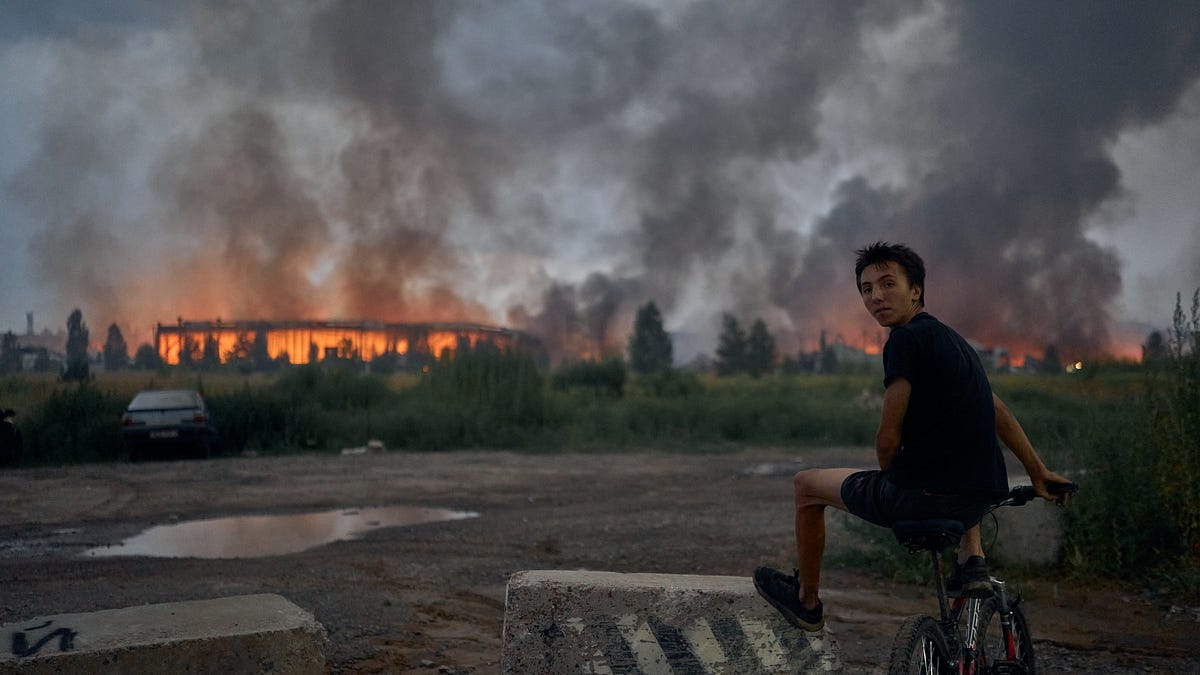
The war in Ukraine is spreading and, like quicksand, dragging in more and more countries.
asserted
war → spread → countries
When the first missile fell on Poland in 2022, the world held its breath, waiting to see if NATO’s Article 5 would be triggered.
asserted
Article → fall → breath
Now, ships attacking off Romania and Bulgaria for two weeks straight, armed men crossing into Latvia from Belarus, and drones galore along the eastern border, generally do not even elicit a murmur.
asserted
ships → attack → murmur
The more we try to contain this war, the further it spreads.
asserted
it → try → war
We got here in large part because Russia has worked out that Europe will keep playing by the rules, whatever Russia does.
asserted
Russia → get → whatever
Its modus operandi is fairly simple: It uses the protections offered by the civilized Europe it detests so much, such as courts.
asserted
it → use → courts
Several Russian oligarchs have successfully argued their cases against sanctions in European courts.
asserted
oligarchs → argue → courts
Russian money frozen in Europe is not being used to help Ukraine win for fear of (wait for it) Russia taking European countries to court!
asserted
Russia → freeze → court
We have a rogue state attempting to massacre an entire nation on European soil, having broken the UN Charter and every rule of war, and we are worried about being sued.
asserted
we → have → war
Russia discards its obligations but hangs on to those protections.
asserted
Russia → discard → protections
As the historian Timothy Snyder put it, we are now in 1938, but Czechoslovakia has decided to fight.
asserted
Czechoslovakia → put → 1938
So how do we make sure September 1, 1939 does not happen again?
asserted
happen → make → ?
The answer lies in the prisoner’s dilemma, the best-known model in game theory.
asserted
answer → lie → theory
It is about strategy, and about the fact that Europe is ignoring its most basic principles.
asserted
Europe → ignore → principles
In 1950, as the Cold War set in and both superpowers acquired nuclear weapons, mathematicians at the RAND Corporation devised a simple game to explore how two rivals with opposing goals and values could avoid destroying each other: the prisoner’s dilemma.
uncertain
rivals → set → other
Two accomplices, held in separate cells, can either cover for each other or rat each other out to the police.
asserted
accomplices → hold → police
If both stay silent, both get a light sentence.
asserted
both → stay → sentence
If both betray each other, both get a severe one.
asserted
both → betray → one
But if one betrays the other while the other covers for him, the traitor walks free and the one who did not break faith bears the full punishment.
asserted
who → betray → punishment
Each is tempted to betray the other, yet if both do that, they both lose.
asserted
they → tempt → that
In 1980, the political scientist Robert Axelrod set out to discover what happens when this game is played not once, but over and over.
asserted
game → set → 1980
He had computer programs play it against each other, 200 rounds at a time.
asserted
programs → have → time
In each round, a player could “cooperate” or “defect.”
uncertain
player → cooperate → round
A player who always cooperates, facing an opponent who always defects, loses every round.
asserted
who → cooperate → round
The most successful strategy turned out to be never defecting first but instead answering every defection in kind.
asserted
strategy → turn → kind
That shows defecting does not pay, and gives the opponent every reason to return to cooperation.
asserted
defecting → show → cooperation
Let’s apply this to our world.
asserted
’s → apply → world
In order for the 200-odd countries in the world to coexist without a common sovereign who could punish them, they have to follow rules that come down to two main principles: do not kill and do not steal.
uncertain
that → coexist → principles
Each keeps to them on the understanding that everybody else will do the same.
asserted
everybody → keep → same
When one country does not abide by the rules that constrain the others, it gains an unfair advantage.
asserted
it → abide → advantage
That is exactly what Russia has been doing: disregarding the rules while counting on Europe to keep its promises, follow its procedures, and protect Russian rights, whatever Russia does.
asserted
Russia → do → whatever
For Europe, defecting would mean refusing to be a “sucker” who keeps granting Russia the protections of rules it has abandoned.
asserted
it → defect → rules
We Really Should Know Better
asserted
We → know → ?
On every single occasion, Germany’s actions amounted to defection from agreements and customary international law.
asserted
actions → amount → agreements
And in every single one of those cases, Britain, France, and the League of Nations played nice—or, in game terms, cooperated.
asserted
Britain → play → terms
This did not stop Germany; it only made it stronger.
asserted
it → stop → Germany
For almost half a century, global stability rested on the understanding that any attack would be answered in kind.
asserted
attack → rest → kind
When the Cuban missile crisis struck in 1962, both sides escalated, Moscow first and Washington in response, until they realized that they would both lose.
asserted
they → strike → response
When one side returned to cooperation, the other did the same.
asserted
other → return → same
…and 42 more, not listed.
 The Aporia