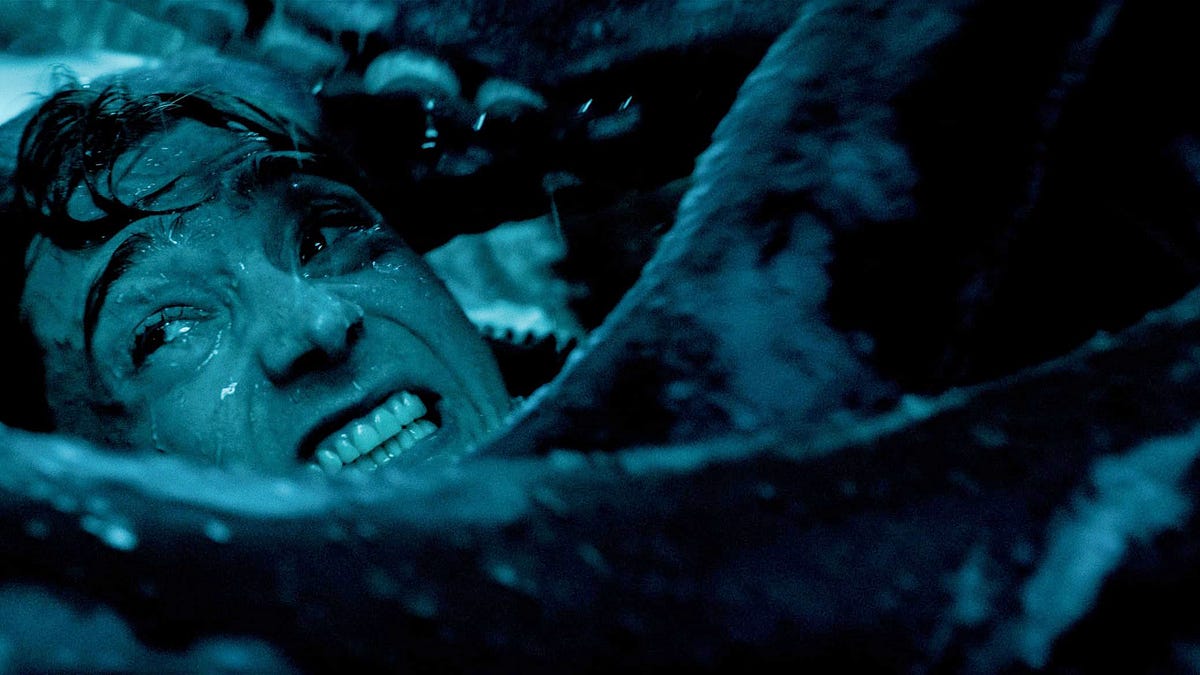
Just when you think it's safe to go back in the water, along comes Whalefall.
asserted
Whalefall → think → water
Based on Daniel Kraus's 2023 novel, the thriller follows Jay Gardiner (Austin Abrams), a young scuba diver who attempts to shake off the grief of his father's recent passing with a dive.
But his swim turns dangerous when Jay's diving gear becomes tangled with a giant squid that has been marked as lunch by a hungry sperm whale, and Jay is swallowed with his mollusc companion.
Stuck in the belly of a whale, Jay must figure out a way to escape in 60 minutes before the oxygen in his scuba tank runs out.
asserted
oxygen → base → tank
When the trailer for Brian Duffield's Whalefall film adaptation hit the internet this year, fans were thrilled to see Kraus's story of grief and acceptance hit cinema screens.
asserted
story → hit → screens
But a question remained: Could a human actually be swallowed by a whale and survive?
uncertain
human → remain → whale
Dr Vanessa Pirotta, a lecturer and whale scientist in the Marine Predator Research Group at Macquarie University, has written books on the gigantic creatures and addressed the National Press Club in 2025 on the importance of ocean research to our wider environment.
asserted
Pirotta → write → environment
She's currently conducting Australian-led research as a part of the Sydney Offshore Megafauna Surveys to find out how many gentle giants we have in our waters.
asserted
we → conduct → waters
We're talking about Whalefall.
asserted
We → talk → Whalefall
But before we dive into it, I must ask: what is your favourite whale fact?
asserted
fact → dive → it
Oh, God, where do I start?
asserted
I → start → ?
I think the one I love is that whales have belly buttons because they're mammals.
asserted
they → think → buttons
They live birth.
asserted
They → live → birth
I've done many whale necropsies where I've measured a whale but I never thought to measure the actual width of the belly button.
asserted
I → do → button
I would say, focusing on an adult whale, maybe it's like the size of a clenched fist.
asserted
it → say → fist
One of my favourite things and most interesting things to do as a whale scientist is understanding, working with pathologists and vets, to understand why the animals died.
asserted
animals → do → pathologists
It sounds completely morbid, but the only opportunity for me really to see and learn about whale anatomy is by investigating dead whales and it's really the most interesting thing in my life that I do.
asserted
I → sound → that
I've got to ask you the question on everybody's mind.
asserted
I → get → mind
Could a human be eaten and swallowed by a whale?
uncertain
human → eat → whale
So, when we're talking about Whalefall, the movie, it's a sperm whale.
asserted
it → talk → Whalefall
They have baleen plates, which are hair-like strands hanging from the roof of their mouth.
asserted
which → have → mouth
They're designed not to bite down on food but to engulf lots of tiny, tiny food and water and then get rid of the water out the side of their mouth.
asserted
They → design → mouth
So, what I'm trying to say is, the biology of the whale that we're dealing with in this movie, you could potentially as a human go down the throat but whether you make it alive or not, I don't think anyone knows that.
uncertain
anyone → try → that
Full disclosure: I have not yet done a sperm whale necropsy, but a human could easily fit inside their mouth and potentially be sucked into their throat.
Incredible.
uncertain
human → do → throat
In the movie, Austin Abram's character is accidentally swallowed while tangled up with a giant squid, which the whale is hunting.
asserted
whale → swallow → which
Could this situation ever happen in real life?
uncertain
situation → happen → life
This is where the movie is doing my head in.
asserted
movie → do → head
That feeding behaviour would usually happen kilometres, at least a kilometre or so, underneath the ocean, so there's huge pressure.
asserted
behaviour → happen → ocean
The animal is equipped for pressure.
asserted
animal → equip → pressure
So technically, if a sperm whale was feeding at that shallow a depth, then potentially you could.
uncertain
you → feed → depth
The sperm whale wouldn't use its teeth to crunch you up and bite you and chew you like what we would be doing.
asserted
we → use → what
They would simply use the teeth to grab onto you, like it's doing with the squid.
asserted
it → use → squid
So, I would say that that's why it's doing my head in because, A, it's not usual to see a sperm whale feeding at this depth and, B, how has it miraculously followed a giant squid all the way to the surface?
asserted
it → say → surface
The squid would have been gone by that stage.
asserted
squid → go → stage
Humans are not part of a whale's diet, I must point out.
asserted
I → point → diet
So, these animals are not targeting humans.
asserted
animals → target → humans
A human would be dead and implode by the time they get down to that depth.
asserted
they → implode → depth
Abrams is also covered in the plastic and metal of his scuba gear.
asserted
Abrams → cover → gear
Would a whale not realise that was not viable sustenance?
asserted
that → realise → ?
If that did all happen at the subsurface, my assumption would be that the whale would probably bite onto the tank attached to him and instantly know that something's not right.
asserted
something → happen → him
There have been other divers that have been kayaking or swimming next to humpback whales or other baleen whales with no teeth, and these animals have had these people at least touch their mouths but realise very soon after that something wasn't right and then they usually open their mouth and eject whatever it is.
asserted
it → kayak → mouth
Those whales with the kayakers, those kayakers are simply basically hanging out where their dinner plate is and then the whales don't give a hoot about them.
asserted
whales → hang → them
…and 42 more, not listed.
 The Aporia