EV boom zaps second-hand prices for petrol and diesel cars

Read the original at The Sydney Morning Herald ↗
Cite

Visontay, E., & Slonim, T. (2026, October 16). EV boom zaps second-hand prices for petrol and diesel cars. The Sydney Morning Herald. https://www.smh.com.au/business/consumer-affairs/ev-boom-zaps-second-hand-prices-for-petrol-and-diesel-cars-20261017-p6157p.html?ref=rss&utm_medium=rss&utm_source=rss_feed

Dated from the outlet's own feed. Check the original for its byline.

The Sydney Morning Herald · collected 2026-10-16 · by Elias Visontay, Talia Slonim

Quick Summary

Electric vehicle adoption in Australia is driving a significant shift in the used car market, with many sellers reducing prices for petrol and diesel cars to attract buyers. According to AutoGrab data, used car listings reached a peak of 437,855 in July, mostly comprising traditional fuel vehicles. This surge contrasts with record sales of new EVs—157,958 units in the first six months of this year—driving up demand for cheaper, newer entry-level electric models and pushing down prices for older internal combustion engine cars.
Written locally by qwen2.5:14b on 2026-10-16, using this article's own text rather than the other coverage of the same event (that is the story summary below).

AI analysis runs on qwen2.5:14b, locally

Story summary

As of October 16, 2026, the surge in electric vehicle (EV) adoption has dramatically impacted the used car market in Australia. According to data from AutoGrab, which tracks dealership and private listings, there were a peak of 437,855 used car listings in July 2026, with about 98% being petrol, diesel, or hybrid vehicles. This influx has led sellers to cut prices significantly as buyers increasingly opt for EVs due to cheaper new models and rising fuel costs. Additionally, the complexity of maintaining older cars—due to a parts shortage, sensor issues from minor collisions, and manufacturers' restrictions on independent mechanics—has further discouraged potential buyers. The Australian Automotive Dealer Association (AADA) chief executive James Voortman describes this shift as "the most significant transformation in its history."

Written for “EV Boom And Used Car Prices” on 2026-10-16, grounded in this article and the 0 other(s) covering the same event.
Why this leaning score
This article does not take a side on a contested political question, so it has no leaning score. That is an answer rather than a gap: a match report or a rescue can be warmly or critically written without being left or right, and scoring it anyway is how approval of a subject gets recorded as a political position.
No political leaning scored for article 85618 · logged 2026-10-16

Story

📰 EV Boom And Used Car Prices
Technology · 1 article(s) covering the same event.

Compared with similar articles

Nothing to compare against. No article is close enough to this one for the pipeline to have linked or judged the pair.
How this article was measured signals, leaning charts, publisher record, byline, topics and claims

Signals How these are calculated →

Claims extracted
67
sentences that state something as happening or true
Uncertain
7%
5 of 67 hedged ("reportedly", "may", "according to")
Leaning
not political
takes no side on a contested political question
Publisher signals
61/100
The Sydney Morning Herald's corrections and hedging, across everything collected from it. Not a measure of accuracy.
Outlets on this story
1
Technology
Same framing elsewhere
1
articles that frame the event the way this one does
Analyzed 2026-10-16 · how these are computed

How this is being covered How these are calculated →

Article leaning vs. publisher reliability
Source leaning vs. consistency

Publisher

The Sydney Morning Herald · 3905 article(s) · 10 correction(s) detected
Running correction rate · 10 correction(s)

Who wrote this

Elias Visontay
10 article(s) here · 1 carrying a prediction
🔮 Australians’ newfound love affair with electric engines may have been the dominant story of the car industry this year – with an EV sold every 100 seconds in the first six months – but the trend has also dramatically shaken up the dynamics of the used vehicle market.
🔮 If the product dripped onto the trouser, that’s where the reaction would occur …
🔮 Shoppers were 84 per cent more likely to want the shoes in the scented room, and willing to pay 10 per cent more.
🔮 The business community is stepping up its calls on the tax office to rethink its abrupt decision to stop accepting credit card payments, warning that entrepreneurs and smaller businesses that need cash flow flexibility will be hit the hardest.
🔮 Tenants who rely on credit cards to pay their rent could soon be forced into arrears, advocates warn, after a major rental payment platform blocked the method of payment in response to a new ban on card surcharge fees.
🔮 Some Australians will likely still encounter card payment surcharges at the checkout despite a ban on the practice coming into effect on Thursday as business lobby groups warn that many smaller shops, especially those run by migrants, are still in the dark on how the new payment rules work.
🔮 “I’m not a fashion-forward guy, I got into this because I’m a football fan, but we’ve stumbled into the fashion space now, and we’ve seen that these customers are willing to spend,” he says.
🔮 AI bots do not have a human-like notion of intention and can therefore go to extreme lengths where a person would understand that hacking a government website was not a reasonable way of conducting research.
🔮 The spokesman noted that in the case of Playtech, Penrose has informed the company he will step down from the UK-based firm by 31 December.
Also by Elias Visontay
Nothing else under this byline is closely related to this article, so these are simply their most recent.
All 10 articles by Elias Visontay →
Talia Slonim
1 article(s) here · 1 carrying a prediction
🔮 Australians’ newfound love affair with electric engines may have been the dominant story of the car industry this year – with an EV sold every 100 seconds in the first six months – but the trend has also dramatically shaken up the dynamics of the used vehicle market.
The only article under this byline in the corpus.

Topics

Australian Australians AutoGrab Chinese the Australian Automotive Dealer Association

Subjects

Australians NORP · 3× AutoGrab ORG · 2× Chinese NORP · 2× Voortman PERSON · 2× AADA ORG · 1× Australian NORP · 1× BYD ORG · 1× James Voortman PERSON · 1× Ross Perry PERSON · 1× the Australian Automotive Dealer Association ORG · 1×

Narrative

Soaring costs to repair older cars – spurred by a shortage of parts; increasingly complicated componentry of sensors affected by routine collisions; and manufacturers keen to keep maintenance within their brand’s networks making it harder for independent mechanics to conduct fixes – are also factors, he explains.
framing: assertive · carried by 1 article(s) · first seen 2026-10-16
🔮 Australians’ newfound love affair with electric engines may have been the dominant story of the car industry this year – with an EV sold every 100 seconds in the first six months – but the trend has also dramatically shaken up the dynamics of the used vehicle market.
2026-10-16 · The Sydney Morning Herald
EV boom zaps second-hand prices for petrol and diesel cars · assertive framing

Claims (67 extracted, 5 hedged)

Burgeoning electric vehicle uptake spurred on by cheaper new models and soaring fuel costs has led to converts flooding the second-hand market with used petrol and diesel cars, with sellers increasingly forced to cut asking prices to offload their old automobiles. asserted
sellers → burgeon → automobiles
Australians’ newfound love affair with electric engines may have been the dominant story of the car industry this year – with an EV sold every 100 seconds in the first six months – but the trend has also dramatically shaken up the dynamics of the used vehicle market. uncertain
trend → sell → market
Used car listings swelled to a peak of 437,855 in July, according to AutoGrab data covering dealerships and private listings. uncertain
listings → use → dealerships
About 98 per cent of these are petrol, diesel or hybrids – vehicle types that many motorists are turning away from in droves. asserted
motorists → turn → droves
“The Australian automotive market is undergoing the most significant transformation in its history,” is how James Voortman characterises it. asserted
Voortman → undergo → it
Voortman is chief executive of the Australian Automotive Dealer Association (AADA), which represents used car vendors. asserted
which → represent → vendors
“We’ve had an amazing set of circumstances in the past nine months.” asserted
We → have → months
Ross Perry, chief revenue office at industry data analysis platform AutoGrab, puts more bluntly the dilemma facing dealers, lenders and insurers. asserted
Perry → put → dealers
“Nobody making a decision on a used car can rely on what it was worth last year.” asserted
it → make → car
A buyer’s market The nation’s new and used car markets are closely linked, with developments in the former heavily shaping movements in the latter. asserted
developments → link → latter
While new car sales figures are strong – more than 1.2 million were sold in 2025 – most Australians are shopping in the second-hand market, which recorded about 2.3 million sales in the same year. asserted
which → sell → year
This meant that when a record 157,958 new electric vehicles sold in the first six months of this year, expanding market share from one in 10 new car purchases last year to more than one in four this year – a ripple effect hit the used market. asserted
effect → mean → market
Among the options available to buyers are new entry-level EVs from Chinese brands such as BYD, Geely and MG, which can sell for between $20,000 and $30,000 driveaway, and the prospect that a typical driver can save about $3000 a year in running costs from avoiding the bowser. asserted
driver → sell → bowser
A buyer with $30,000 to spend on a car might have previously considered a five-year-old European car, but could now purchase a new Chinese EV with modern features and a factory warranty for a similar price. “When consumers can buy a new EV for $25,000, the maths around the second-hand market starts shifting quite a lot,” says Bruce Billson, executive of the Motor Trades Association of Australia which represents mechanics. uncertain
which → spend → mechanics
In July’s peak, 12.2 per cent more petrol and 16.8 per cent more diesel vehicles were listed than in the same month last year. asserted
petrol → list → month
Contributing to a supply glut was a smaller appetite from Australians for used petrol and diesel cars. asserted
appetite → contribute → cars
The outbreak of the war in the Middle East that shuttered the Strait of Hormuz and wreaked havoc on global fuel supplies only served to bolster the appeal of EVs, both new and the relatively small number available on the second-hand market. asserted
that → shutter → market
In the six months to the end of June, sales of used petrol cars dropped just shy of 10 per cent, and diesel by 4 per cent, compared to the same period in 2025. asserted
sales → use → 2025
At the same time, sales of used EVs soared to 25,417 – a 54.6 per cent rise. asserted
sales → use → 25,417
“We had the humungous spike in new EV sales – there were waitlists – and so when people had FOMO [fear of missing out] they came to the used car market,” says Voortman. asserted
Voortman → have → market
While the peak of listings has since eased – the figure dropped to 390,184 in September – and sales have improved, the massive shift to electric cars has dramatically hit the value of used fuel-reliant vehicles. asserted
shift → ease → vehicles
Petrol and diesel cars aged between one and five years depreciated by more than 8 per cent just in the eight months to September. asserted
cars → age → September
The value lost so far this year is about four times the total depreciation the same kinds of vehicles suffered in all of 2025. asserted
kinds → lose → 2025
Some vehicles are bucking the broader trends. asserted
vehicles → buck → trends
As of September, the average 2020 hybrid has retained 81 per cent of its purchase value, compared to an EV model the same year, which kept just 40 per cent. asserted
which → retain → cent
However, AutoGrab data shows that year by year, newer EVs are defying their predecessors’ notoriety of steep depreciation due to obsolescence fears. asserted
EVs → show → fears
Beyond broad vehicle types, certain makes and models that are highly sought after are also retaining their value, says AutoGrab’s Perry. asserted
Perry → seek → value
“The old rules about what holds its value are being tested car by car,” he finds. asserted
he → hold → car
Utes, four-wheel drives, vans and vehicles that need to tow are also holding up better as they don’t have practical electric alternatives. asserted
they → need → alternatives
While that phenomenon with newer builds holding more of their purchase value will probably affect the market in the future, the outlook across the entire second-hand market remains softer. asserted
outlook → hold → market
“When all those people make the jump and dispose of their current vehicle to get an EV, it leads to a spike in listings,” Voortman says. asserted
Voortman → make → listings
It’s a buyer’s market now, which has “presented some good opportunities for those shopping for a used car”. asserted
which → ’ → car
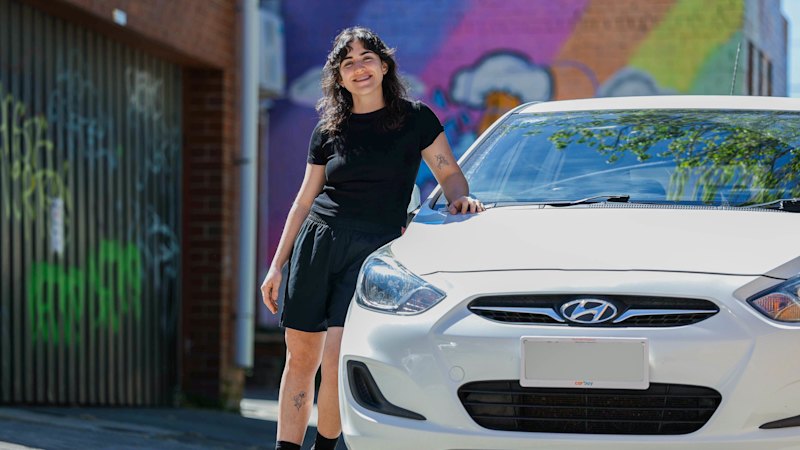
Melbourne personal trainer Jess Bricker is among those benefiting from the oversupply. asserted
Bricker → benefit → oversupply
The 30-year-old recently moved back to the city with her partner, Jonathan, after years of living overseas. asserted
old → move → years
One of the first things she did to restart their lives here was look for a car. asserted
she → do → car
As her job requires early morning shifts, Bricker wanted to find one before taking on more work. asserted
Bricker → require → work
As moving back home was costly and their combined incomes are still modest, a brand-new car was outside the couple’s budget. asserted
car → move → budget
Instead, they turned to the second-hand car market, and Bricker dedicated many days over the month-long process at dealerships and on websites, inspecting cars. asserted
Bricker → turn → cars
“We didn’t have a car, so then we needed to borrow [Jonathan’s] mum’s car whenever we went to go see a car,” she says. asserted
she → have → car
“There were just a lot more hurdles, and I started feeling fairly desperate.” asserted
I → be → ?
…and 27 more, not listed.

💬Give feedback
🕘History 🎫Support