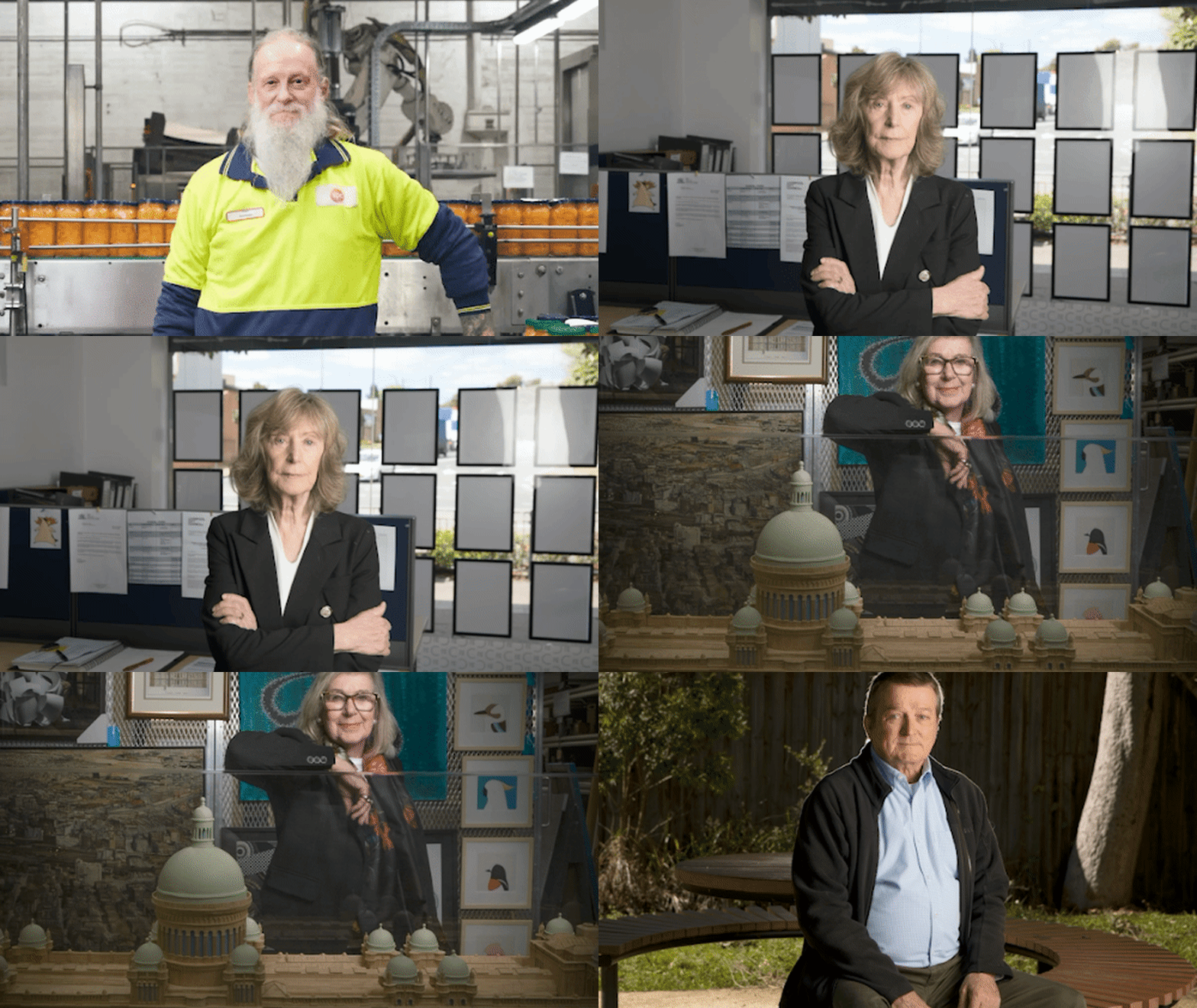
Theo Newbegin cuts a wiry silhouette striding between towers of peaches and pears in the echoing vastness of the SPC canning factory
in Victoria’s Shepparton.
asserted
Newbegin → cut → Shepparton
Newbegin’s weathered face and long, white beard may bear witness to his 67 years, but once he jumps behind the wheel of a forklift and whips around a labyrinth of palettes, readying them for loading onto a truck, the decades melt away.
uncertain
decades → bear → truck
His right knee might bark at him occasionally, but his lightning-fast reflexes put younger workers to shame.
uncertain
reflexes → bark → shame
“I don’t feel any different to how I was in my 40s,” he grins.
asserted
he → feel → 40s
“People ask if I go to the gym.”
asserted
I → ask → gym
Clocking in at 2.30pm for an eight-hour shift at the cannery is merely the second act of Newbegin’s working day.
asserted
Clocking → clock → day
He’s already hammered out a full morning of roofing – a trade he’s been toiling at since age 17.
asserted
he → hammer → age
Amid a tradie shortage, he’s in constant demand, particularly for his repair work on old-school hardwood rafters, which he says modern materials can’t match.
asserted
materials → ’ → rafters
“Fixing an old hardwood roof gives you a real sense of satisfaction,” he beams.
asserted
he → fix → satisfaction
You can bounce up and down on ’em.”
asserted
You → bounce → ’em
Between five kids, nine grandkids, and his wife Jenny – who’s still powering through full-time work as a medical receptionist at 65 – Newbegin appears to be hardwired for perpetual motion (“my dad worked ’til he was 75,” he shrugs).
asserted
he → power → motion
Forget fine dining, Pacific cruises or the latest high-tech baubles; the four motorbikes he dotes on like prized thoroughbreds are his single indulgence.
asserted
he → forget → thoroughbreds
Newbegin is part of a fast-growing club of older Australians delaying retirement well beyond the expected finishing line of 67.
asserted
Newbegin → grow → 67
Today, more than 760,000 Australians over 65 are in the workforce, the highest level since Australian Bureau of Statistics’ tracking began in 1995.
asserted
tracking → begin → 1995
“Twenty years ago, one in 10 men were working at age 70; today it’s one in four,” says Terry Rawnsley, director of planning and infrastructure economics at KPMG.
asserted
Rawnsley → work → KPMG
Over the two decades from 2003 to 2023, retirement rates among 65- to 69-year-old Australians plunged significantly, with women’s numbers dropping from 86 per cent to 66 per cent and men’s falling from 73 per cent to 61 per cent, according to the University of Melbourne’s most recent Household, Income and Labour Dynamics in Australia (HILDA) survey findings.
uncertain
men → plunge → findings
Why are Australians staying on the clock?
asserted
Australians → stay → clock
Although many remain in the workforce seeking purpose and social connection, the underlying driver for most is just to pay the bills.
asserted
driver → remain → bills
Rawnsley reckons something bigger is brewing – a shift in how we actually see retirement.
asserted
we → reckon → retirement
For Marion Wales, a 78-year-old dental nurse in Moss Vale in NSW, it’s the fact her superannuation coffers are running low, and she has an 81-year-old husband with limited mobility to support.
asserted
she → ’ → mobility
“I can’t retire now because the pension isn’t covering our bills, and we don’t have enough in the super kitty,” she says.
asserted
she → retire → kitty
“I also want to have a decent life.”
asserted
I → want → life
For Anne Drane, a property manager for a real estate agency in south-western Sydney’s Liverpool, working three days a week is necessary to cover soaring private health insurance premiums and medical costs for a lung condition.
asserted
working → work → condition
But she also loves her job, and completed a financial counselling certificate only four years ago.
asserted
she → love → certificate
“I like to keep busy, and also want to be able to afford to travel,” the 78-year-old enthuses.
asserted
old → like → ?
For Shane Scully, 67, renting in Sydney while raising two teenage daughters makes working a financial necessity.
asserted
working → rent → daughters
“I don’t have an option.
asserted
I → have → option
I need to keep working,” he says flatly.
asserted
he → need → ?
Yet, Scully, who designs outdoor classrooms and sensory gardens for public schools and special education units, finds his work deeply rewarding: “Turning a barren space into something that brings joy to the kids ... this makes it all worthwhile.”
asserted
it → design → kids
For 75-year-old Brisbane-based educator Margaret Harrington, teaching has been a passion for more than 45 years – and something she continues out of a deep love for the calling rather than financial necessity.
asserted
she → base → necessity
When she was made redundant from classroom teaching a decade ago, her students refused to let her go, telling her, “We know where you live and will come to you” – and she’s continuing to tutor privately from her home.
asserted
she → make → home
All of which has done nothing to dent the national sport of Boomer-bashing.
asserted
All → do → bashing
It kicked off a few years back when Gen Z provocateurs leveraged the catchphrase “OK, Boomer” to slap down anything they pinned as peak smugness by their elders.
asserted
they → kick → elders
Boomer-bashing has turned into a minor publishing industry in recent years: from highbrow US takedowns like A Generation of Sociopaths by Bruce Cannon Gibney, and OK Boomer, Let’s Talk: How My Generation Got Left Behind, by Jill Filipovic, to Australian Fiona Wright’s satirical novel Kill Your Boomers, published earlier this year.
asserted
Generation → turn → Boomers
Comedians and influencers alike have joined the pile-on, from Tom Ballard trying to turn a comedy festival crowd into a choir of Boomer-haters back in 2019 with “When the f--- are Baby Boomers going to die?” to US YouTuber Caleb Hammer griping to podcaster Joe Rogan in June that this generation “had the best housing market, college, jobs – they were set up for everything”.
asserted
they → join → everything
Boomers, so the resentment story goes, hit the historical jackpot: dirt-cheap houses, free uni degrees, careers so stable they’d bore – or bring – a young gig economy worker to tears, and plump super payouts.
asserted
they → go → tears
And to top it all off, these silver-haired fat cats retired early, slapped a “SKI” (spend the kids’ inheritance) sticker on their shiny new LandCruiser, and flipped the bird at the young-uns as they hit the open road.
asserted
they → top → road
Sure, for the top tier of older Baby Boomers, the 20 per cent who control most of the overall wealth of their generation, but there is a vast and frequently overlooked gulf between the haves and have-nots.
asserted
who → control → haves
The Baby Boomers most at risk of financial stress are the “forever renters”, those locked out of home ownership and battling rental increases of nearly 40 per cent in real terms since the early 2000s, according to HILDA.
uncertain
Boomers → lock → HILDA
While at least 66 per cent of retirees own their homes outright, HILDA reports, an increasing number of younger ones – so-called “Generation Jones” (those born between 1954 and 1965) – are more likely to be still shackled to a mortgage.
asserted
number → own → mortgage
…and 136 more, not listed.
 The Aporia