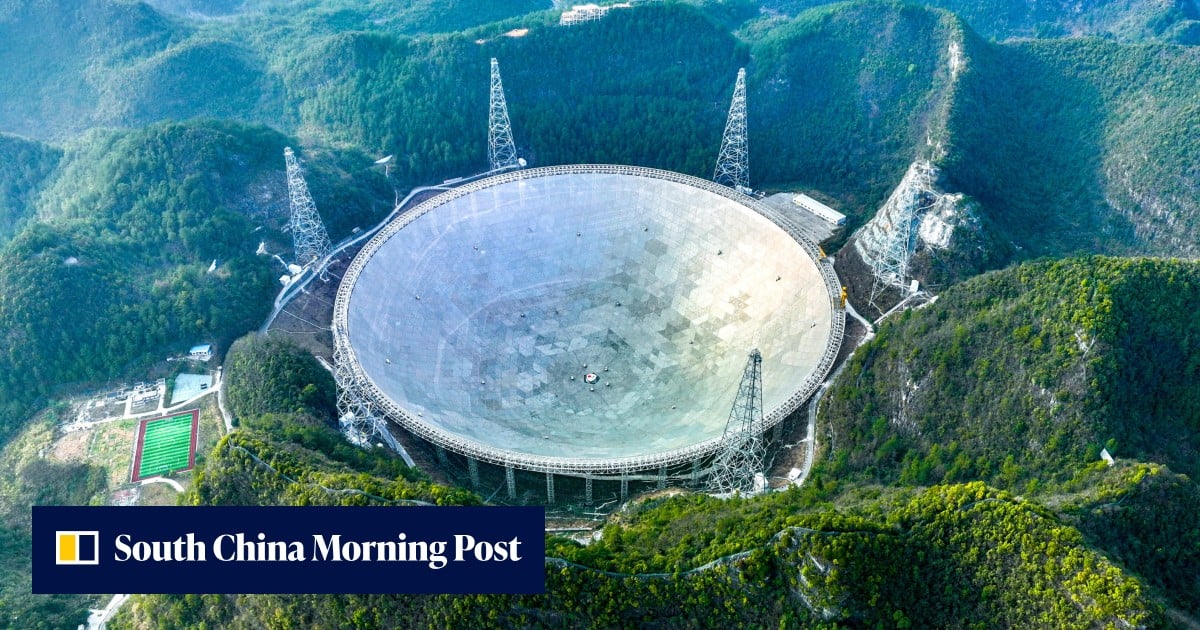
China's FAST telescope has mapped neutral hydrogen, a key cosmic gas involved in star formation, identifying more than 156,000 extragalactic sources. This survey offers astronomers an unprecedented dataset to study the universe's largest questions, such as galaxy evolution and structure of the cosmic web. Compared to the previous landmark ALFALFA survey conducted by Arecibo from 2005 to 2012, FAST covered three times more sky area and detected much smaller, fainter, and farther galaxies.
Written by the local model on 2026-09-13,
using this article's own text rather than the other coverage of the
same event (that is the story summary below).
Story summary
The FAST telescope in China has mapped neutral hydrogen, a key ingredient for star formation, identifying more than 156,000 extragalactic sources. This extensive survey provides an unprecedented dataset for astronomers globally to explore fundamental questions about the universe's evolution and galaxy dynamics. Unlike previous surveys like ALFALFA, which was conducted using Arecibo from 2005 to 2012, FAST covered three times as much sky and detected smaller, fainter, and more distant galaxies. Completed in 2016, FAST surpassed the former world's largest single-aperture radio telescope, Arecibo, which was operational until its collapse in 2020.
Written for “Cosmic Gas Mapping China” on 2026-09-14,
grounded in this article and the 0 other(s) covering the same event.
Why this leaning score
This article does not take a side on a contested political
question, so it has no leaning score. That is an
answer rather than a gap: a match report or a rescue can be warmly
or critically written without being left or right, and scoring it
anyway is how approval of a subject gets recorded as a political
position.
No political leaning scored for article 8500 · logged 2026-09-13
China’s FAST telescope maps neutral hydrogen, the cosmic gas for making stars
Survey identifies more than 156,000 extragalactic sources, offering an unprecedented pool for studying the universe’s biggest questions
The publicly available data gives astronomers worldwide an unprecedented pool of galaxies to investigate some of the universe’s biggest questions – from how the vast cosmic web took shape, to why some galaxies thrive while others fade away.
asserted
others → map → shape
Compared with ALFALFA – the landmark US survey carried out with Arecibo from 2005 to 2012 – FASHI covered about three times as much sky and detected galaxies that were much smaller, fainter and further away, a team led by researchers from the National Astronomical Observatories reported.
asserted
team → compare → Observatories
Completed in 1963, it remained the world’s largest single-aperture radio telescope until FAST overtook it in 2016, and was behind a string of major astronomical discoveries before its giant observing platform collapsed in 2020.
asserted
platform → complete → 2020