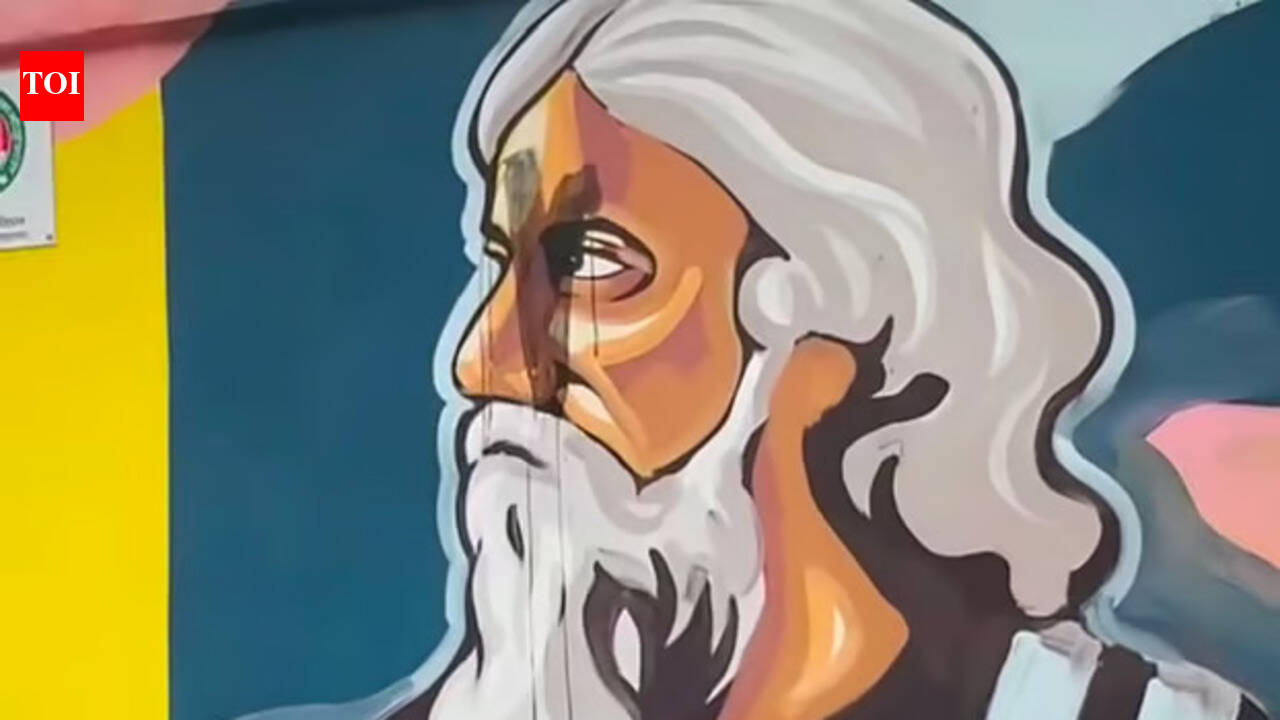
"Where the world has not been broken up into fragments by narrow domestic walls."
asserted
world → break → walls
More than a century after
Rabindranath Tagore penned these lines in
Gitanjali, Marzia Khandaker Rimi, a senior leader of Bangladesh's Rashtra Sanglap Forum, smeared black ink across his portrait in Dhaka, declaring that the poet was Indian and his image should be erased.
asserted
image → pen → Dhaka
Clearly, domestic as well as international walls exist, and going by the evidence, they may be hardening further, with prominent leaders of the July uprising expressing concern over growing Jamaat influence in the country.
uncertain
leaders → exist → country
The Rashtra Sanglap Forum emerged after Bangladesh's July 2024 uprising.
asserted
Forum → emerge → uprising
On October 10, Rimi joined others outside Bangladesh Shilpakala Academy to protest what she called "Indian aggression".
asserted
she → join → what
She also alleged that Tagore mistreated Muslims while managing his family's estates.
asserted
Tagore → allege → estates
Rimi was among four people subsequently arrested, including another leader of the forum, ANM Ayas.
asserted
Rimi → arrest → forum
The incident has reopened old faultlines over what Tagore means to Bangladesh.
asserted
Tagore → reopen → Bangladesh
On October 11, Nurul Haque Nur, Bangladesh's state minister for expatriates' welfare and overseas employment, described the defacement as a "communal Jamaati misdeed".
asserted
Nur → describe → misdeed
The prime minister's political assistant, Rashed Khan, went further.
asserted
assistant → go → ?
He accused Jamaat of orchestrating the defacement and alleged that an adviser to its chief had financed materials used by the protesters.
asserted
adviser → accuse → protesters
Bangladesh Jamaat-e-Islami assistant secretary general Ahsanul Mahboob Zubair demanded the withdrawal of the case and the immediate release of all four accused.
asserted
Zubair → demand → four
He described the incident leading to their arrest as trivial and alleged that sections of the administration were using such cases to harass forces associated with the July uprising.
asserted
sections → describe → uprising
At an October 14 court hearing, following a heated exchange, bail was rejected and the accused were sent to jail.
asserted
accused → follow → jail
The portrait that triggered the controversy was one of ten commissioned by Dhaka South City Corporation (DSCC) for a footpath beautification project.
asserted
that → trigger → project
The others included Kazi Nazrul Islam, Satyajit Ray, Ishwar Chandra Vidyasagar and Zainul Abedin, the celebrated Bangladeshi artist who had defended Tagore during the East Pakistan era.
asserted
who → include → era
On October 13, the corporation added portraits of Begum Rokeya Sakhawat Hossain, a pioneer of women's education, and poets Jibanananda Das and Jasimuddin.
asserted
corporation → add → education
It removed the portrait of singer and journalist Sanjib Choudhury.
asserted
It → remove → Choudhury
The attack itself was aimed at the man who wrote
Amar Sonar Bangla, Bangladesh's national anthem.
asserted
who → aim → man
Writer and journalist Amin Al Rashid, who researches the life and work of Jibanananda Das, sees the incident as part of a broader political development since the July 2024 uprising.
asserted
who → research → uprising
He points to what he describes as attacks on Bangladesh's Liberation War legacy, Sheikh Mujibur Rahman and the Constitution, alongside the growing influence of religious extremism.
asserted
he → point → extremism
"Turning a poet who died before India and Pakistan even came into existence into a villain in today's Bangladesh suggests a far-reaching political agenda," he told TOI.
uncertain
he → turn → TOI
Rashid questions whether the attack can be explained simply as opposition to India.
asserted
attack → question → India
Those involved, he notes, would themselves have sung Tagore's
Amar Sonar Bangla at school assemblies and studied his poems and stories.
asserted
themselves → involve → poems
Concerns about Bangladesh's political direction have also been voiced by Mahfuz Alam, a prominent leader of the July 2024 uprising and former adviser to Muhammad Yunus's interim government.
asserted
Concerns → voice → government
In a Facebook post on October 15, Alam warned that the country had boarded the train of far-right politics.
asserted
country → warn → politics
Alam also accused sections of secular civil society of aligning with Jamaat-e-Islami and its student wing, Islami Chhatra Shibir, in opposition to the BNP, warning that they would eventually pay a political price for it.
asserted
they → accuse → it
His remarks concerned Bangladesh's broader political trajectory rather than the Tagore incident specifically.
asserted
remarks → concern → incident
Not the first attack on a cultural symbol
The Dhaka incident was not the first time Tagore's image had been blackened in Bangladesh in recent years.
asserted
image → blacken → years
In April 2025, a mural of the poet at Kumarkhali in Kushtia district was found defaced with black paint.
asserted
mural → find → paint
It was subsequently restored by local authorities.
asserted
It → restore → authorities
Two months later, another controversy erupted at a site associated with Tagore.
asserted
controversy → erupt → Tagore
On June 10, 2025, a crowd stormed the Rabindra Kacharibari complex at Shahjadpur in Sirajganj district, damaging an auditorium, doors and windows.
asserted
crowd → storm → auditorium
A more direct attack on a cultural institution occurred in December 2025.
asserted
attack → occur → December
In the early hours of December 19, a mob stormed Chhayanaut's cultural complex in Dhaka's Dhanmondi, ransacking offices and classrooms, destroying musical instruments and books, and setting parts of the premises on fire.
asserted
mob → storm → fire
The attack occurred amid unrest following the death of political activist Sharif Osman Hadi.
asserted
attack → occur → Hadi
Some witnesses reported that attackers accused Chhayanaut of promoting Indian culture and argued that it had no place in Bangladesh.
asserted
it → report → Bangladesh
Chhayanaut, set up on Tagore’s centenary, was vandalised in Bangladesh (File Image)
The hostility towards Tagore has surfaced beyond Dhaka as well.
asserted
hostility → set → Dhaka
On October 11, a day after the Segunbagicha incident, Hasibul Islam Maruf, president of the Chhatra Dal unit at Bandherhat Abdul Malek Ukil Degree College in Noakhali, posted a photograph on Facebook showing Tagore's image beneath his feet.
asserted
Maruf → post → feet
The district leadership of Chhatra Dal, the student wing of the Bangladesh Nationalist Party, issued him a show-cause notice and expelled him from his organisational position on October 13.
asserted
leadership → issue → October
…and 67 more, not listed.
 The Aporia