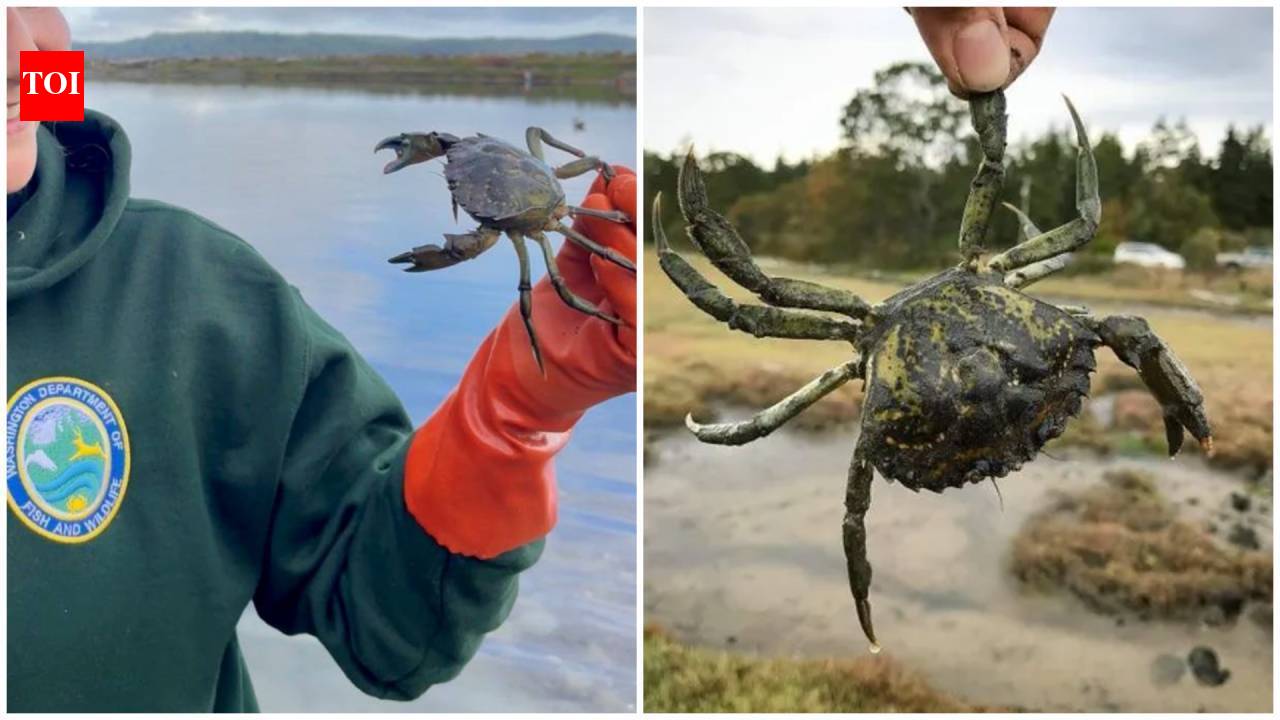
Washington captures record 2.16 million invasive green crabs, but experts warn invasion is far from over

Read the original at Times of India ↗
Cite

TOI World Desk. (2026, October 15). Washington captures record 2.16 million invasive green crabs, but experts warn invasion is far from over. Times of India. https://timesofindia.indiatimes.com/world/us/washington-captures-record-2-16-million-invasive-green-crabs-in-2025-26-first-detected-in-2016-the-species-threatens-marine-life-despite-8-million-in-funding-with-no-populations-eradicated/articleshow/134976963.cms

Dated from the outlet's own feed. Check the original for its byline.

Times of India · collected 2026-10-16 · by TOI World Desk

Quick Summary

Washington state captured a record 2.16 million invasive European green crabs from its waters during the fiscal year ending June 30, 2026, according to the Washington Department of Fish and Wildlife (WDFW). The Coastal Branch accounted for 2,133,725 crabs while the Salish Sea Branch removed another 24,827. Despite this significant effort, experts warn that established crab populations remain a threat to coastal ecosystems, with potential for further spread due to ongoing invasion and environmental factors like weather changes.
Written locally by qwen2.5:14b on 2026-10-16, using this article's own text rather than the other coverage of the same event (that is the story summary below).

AI analysis runs on qwen2.5:14b, locally

Story summary

Washington state removed more than 2.16 million invasive European green crabs from its marine waters during the 2026 fiscal year, marking a significant control effort but not eradicating the threat to coastal ecosystems. The Washington Department of Fish and Wildlife (WDFW) captured these crabs between July 1, 2025, and June 30, 2026. Specifically, 2,133,725 were caught by the Coastal Branch while another 24,827 were removed by the Salish Sea Branch.

Researchers warn that despite this record catch, established green crab populations have not been eradicated and the invasion could worsen, posing a significant risk to native marine life. The increase in captures is attributed to greater funding for removal efforts, weather changes, and continued population growth. While removing over two million crabs may have prevented tens to hundreds of billions of larvae from being released into Washington’s waters, experts caution that ongoing monitoring and sustained intervention are essential.


Written for “Invasive Green Crab Capture” on 2026-10-16, grounded in this article and the 0 other(s) covering the same event.
Why this leaning score
This article does not take a side on a contested political question, so it has no leaning score. That is an answer rather than a gap: a match report or a rescue can be warmly or critically written without being left or right, and scoring it anyway is how approval of a subject gets recorded as a political position.
No political leaning scored for article 84108 · logged 2026-10-16

Story

📰 Invasive Green Crab Capture
Environment · 1 article(s) covering the same event.

Compared with similar articles

Nothing to compare against. No article is close enough to this one for the pipeline to have linked or judged the pair.
How this article was measured signals, leaning charts, publisher record, byline, topics and claims

Signals How these are calculated →

Claims extracted
25
sentences that state something as happening or true
Uncertain
32%
8 of 25 hedged ("reportedly", "may", "according to")
Leaning
not political
takes no side on a contested political question
Publisher signals
59/100
Times of India's corrections and hedging, across everything collected from it. Not a measure of accuracy.
Outlets on this story
1
Environment
Same framing elsewhere
1
articles that frame the event the way this one does
Analyzed 2026-10-16 · how these are computed

How this is being covered How these are calculated →

Article leaning vs. publisher reliability
Source leaning vs. consistency

Publisher

Times of India · 2646 article(s) · 2 correction(s) detected
Running correction rate · 2 correction(s)

Who wrote this

TOI World Desk
990 article(s) here · 1 carrying a prediction
🔮 According to the Supreme Court of Queensland judgment in the Will of Clifford Stanley Perrin [2026] QSC 247, his handmade will named the scammer, whose purported name was Stella Helena Perrin, as executor and beneficiary.
🔮 Its identity was closely tied to hip-hop, an emerging cultural force that would go on to influence music, entertainment and global streetwear.
🔮 Her move to the United States helped place her at the centre of a changing music scene, but her influence would eventually extend far beyond any one city or genre.
🔮 Andy Corrie, 41, built the space himself as a personal retreat where he could relax after work and spend time away from his busy routine.
🔮 Ewbank’s estimated that around 200 copies may have been produced, with more than half distributed to guests.
🔮 Unable to find his grandmother’s car keys, Hudson decided to leave the house and look for someone who could assist.
🔮 Herpetologist Scott Ballard, who has studied the area, has said seeing around 20 snakes during a visit would already be a good day.
🔮 She explained that studying ocean acidification in a classroom is one thing, but the competition gave her a reason to design an experiment, collect real data and test whether her idea could withstand scrutiny.
🔮 However, after checking the property, Kemper claimed that sections of the walls she had expected to be cleaned remained untouched.
🔮 The initiative involves sharing images of people allegedly leaving waste on streets and other public spaces, with the council appealing to residents for information that could help enforcement teams identify those responsible.
Wire or desk byline, not an individual reporter.
Also by TOI World Desk
Nothing else under this byline is closely related to this article, so these are simply their most recent.
All 990 articles by TOI World Desk →

Topics

European KUOW WDFW Washington the Washington Department of Fish and Wildlife

Subjects

Washington GPE · 6× WDFW ORG · 3× the Washington Sea Grant Crab Team ORG · 2× Brian Turner PERSON · 1× Emily Grason PERSON · 1× European NORP · 1× Jay Inslee PERSON · 1× KUOW ORG · 1× Washington Department of Fish and Wildlife ORG · 1× the Washington Department of Fish and Wildlife ORG · 1×

Narrative

Although the removal of more than two million crabs represents a significant control effort, researchers caution that continued monitoring and sustained intervention will be necessary to limit the species' spread and protect Washington's coastal ecosystems.
framing: mixed · carried by 1 article(s) · first seen 2026-10-16
🔮 Despite the record catch, researchers warn that established populations have not been eradicated and the invasion could continue to worsen, putting native marine life at risk.

Claims (25 extracted, 8 hedged)

Washington state removed more than 2.16 million invasive European green crabs from its marine waters during the 2026 fiscal year, marking a major effort to control a species threatening coastal ecosystems. asserted
state → remove → ecosystems
According to the Washington Department of Fish and Wildlife (WDFW), the crabs were captured between July 1, 2025, and June 30, 2026. uncertain
crabs → accord → July
Despite the record catch, researchers warn that established populations have not been eradicated and the invasion could continue to worsen, putting native marine life at risk. uncertain
invasion → warn → risk
The WDFW report said the Coastal Branch accounted for 2,133,725 of the captured crabs, while the Salish Sea Branch removed another 24,827 during the fiscal year. Green crab catches reached record highs in multiple months during the period. asserted
catches → say → period
The department said the increase could be linked to greater funding for capture efforts, weather changes and continued growth in established populations. uncertain
increase → say → populations
Despite the scale of the removal campaign, Washington has yet to eradicate any of its established invasive green crab populations. asserted
Washington → have → populations
The department estimated that removing more than two million crabs may have prevented tens to hundreds of billions of green crab larvae from being released into state waters, potentially limiting further spread. uncertain
removing → estimate → spread
Researchers warn invasive crab population remains a concern The growing numbers have raised concerns among researchers monitoring the species. asserted
numbers → warn → species
In 2022, former Washington Governor Jay Inslee declared an emergency over the invasive green crab population, after which the state legislature allocated more than $8 million to address the problem. asserted
legislature → declare → problem
Researcher Brian Turner acknowledged the scale of the increase, telling KUOW that officials had “seen some pretty dramatic increases”. “It's not good news,” he said. asserted
he → acknowledge → increases
Researcher Emily Grason also warned that the invasion remains ongoing and could become more severe. “It's not hard to imagine the numbers could become worse. uncertain
numbers → warn → ?
We are still in the middle of an ongoing invasion that hasn't necessarily reached any sort of equilibrium,” she said. asserted
she → reach → equilibrium
How invasive green crabs threaten marine ecosystems asserted
crabs → threaten → ecosystems
First detected in Washington in 2016, invasive green crabs threaten clams, oysters and other marine life, prompting a continuing state removal effort. asserted
crabs → detect → effort
European green crabs are considered an invasive species because they can disrupt ecosystems where they become established. asserted
they → consider → ecosystems
According to the Washington Sea Grant Crab Team, the crabs can be accidentally transported to new habitats through marine vessels and seafood distribution. uncertain
crabs → accord → vessels
The first green crab was captured in Washington in 2016. asserted
crab → capture → 2016
Green crabs prey on clams, oysters, mussels, marine worms and small crustaceans. asserted
crabs → prey → clams
In environments where they have few natural predators, their feeding habits can put native marine species under pressure. asserted
habits → have → pressure
The species has already been blamed for reducing soft-shell clam populations in Maine. asserted
species → blame → Maine
Evidence also suggests that green crabs threaten aquatic plants, including eelgrass, which provides important habitat for marine life. uncertain
which → suggest → life
Early detection and monitoring remain key to controlling the invasion The Washington Sea Grant Crab Team identifies early detection, rapid response, monitoring and population suppression as key strategies for managing invasive green crabs. asserted
Team → remain → crabs
The species can have red, brown or orange colouring, according to WDFW. uncertain
species → have → WDFW
One identifying feature is the presence of five spines on either side of its eyes. asserted
feature → identify → eyes
Although the removal of more than two million crabs represents a significant control effort, researchers caution that continued monitoring and sustained intervention will be necessary to limit the species' spread and protect Washington's coastal ecosystems. asserted
monitoring → represent → ecosystems
💬Give feedback
🕘History 🎫Support