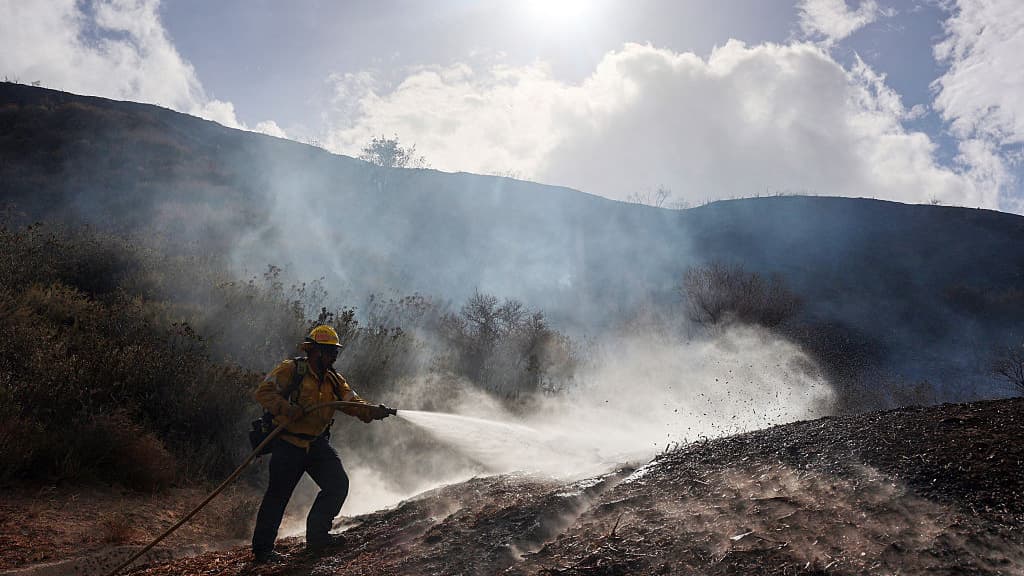
With the city enveloped in a cloak of haze, the urgency of tackling the climate crisis could hardly have been clearer as the four-day Global Tipping Points Conference 2026 drew to a close at Malaysia’s Sunway University on Thursday.
uncertain
Conference → envelop → Thursday
At the conference, speakers stressed the need for humanity to remain within planetary boundaries, or the “safe operating space”.
asserted
humanity → stress → boundaries
Crossing these boundaries could have catastrophic consequences, warned Professor Johan Rockström, director of the Potsdam Institute for Climate Impact Research and one of the conference organisers.
uncertain
Rockström → cross → organisers
He highlighted the dangers of triggering irreversible changes in major Earth systems.
asserted
He → highlight → systems
Some of the bulwarks have already been breached, manifesting themselves in the form of collapsed ice sheets, bleached corals, shrinking wildlife habitats and the slow death of rainforests.
asserted
Some → breach → rainforests
‘Tipping points’ conference brings together climate scientists, activists, and finance gurus; highlights success stories from around the world
All of this threatens food security, causes displacement, damages human health and destabilises economies.
asserted
All → bring → economies
With plenty of reasons to be pessimistic – social and political polarisation, rising inequality and poverty, and wars among them – the message was nevertheless one of urgency rather than despair.
asserted
message → rise → despair
“The science has matured, evidence is there…
asserted
evidence → mature → ?
that’s the natural step,” said Sultan Nazrin Shah of Perak.
asserted
Shah → ’ → Perak
Professor Timothy Lenton, chair for Climate Change and Earth System Science at the University of Exeter and another of the organisers, spoke about “positive tipping points”.
asserted
Lenton → speak → points
Lenton, who has studied tipping points since the 1990s, argued these could help societies move towards more sustainable futures.
uncertain
societies → study → futures
Citing Pakistan’s solar boom and Norway’s rapid adoption of electric vehicles, he pointed to transformative shifts that can happen within a relatively short period.
asserted
that → cite → period
But protecting ecosystems is as important as technologies, said Acehnese forest conservator Farwiza Farhan, while making a compelling case for the protection of the Leuser Ecosystem – a tropical rainforest reserve in Sumatra and one of the last places on Earth where tigers, elephants, rhinos and orangutans coexist in the wild.
asserted
tigers → protect → wild
Others turned to imagining the future.
asserted
Others → turn → future
Anab Jain, co-founder of London-based Superflux, described Mitigation of Shock, an immersive installation set in a fictional 2050.
asserted
Jain → base → 2050
Visitors enter an imagined apartment shaped by a future in which some of the most severe impacts of climate change have already occurred.
asserted
some → enter → change
More than 100,000 people have visited it since 2017, she said.
asserted
she → visit → 2017
Professor Jeffrey Sachs, director of the Center for Sustainable Development at Columbia University, broadened the discussion to social, economic and political tipping points.
asserted
Sachs → broaden → points
If these systems tipped in the wrong direction, he warned, they could trigger a “cascade of devastating consequences”.
uncertain
they → tip → consequences
Planetary changes and social, economic and political conditions are deeply interconnected, said Sachs, making cooperation essential to averting disaster.
asserted
cooperation → interconnect → disaster
He repeatedly pointed to poverty and inequality as forces that could deepen instability, but argued that all was not lost.
uncertain
all → point → instability
The tools for change – economic wellbeing, social inclusion, environmental sustainability, and peace and cooperation among nations – already exist, he said.
asserted
he → exist → nations
Discussions also covered deforestation, land-use change, governance failures and the rise of artificial intelligence.
asserted
Discussions → cover → intelligence
Turning tools into action, however, requires money, policy and political will.
asserted
Turning → turn → money
“But where’s the money?” many asked, urging encouragement for supportive policies and a pipeline of “bankable projects” that protect nature, so that economic incentives favour regeneration over extraction.
asserted
incentives → ’ → extraction
One such approach came from Dr Ralph Chami, founder of Blue Green Future, who outlined his concept of “regenerative GDP”, i.e. recognising the value of “living nature” and accounting for it on the balance sheet.
asserted
who → come → sheet
“Why kill the goose that lays the [golden] egg?” he asked, contrasting a living coral reef in the Maldives – which provides a habitat for fish and plays a role in the marine carbon cycle – with a bleached one that can threaten both tourism and fisheries.
asserted
that → kill → tourism
Dr Jemilah Mahmood, executive director of the Centre for Planetary Health at Sunway University, insisted on channelling youth energy.
asserted
Mahmood → insist → energy
“Give them space at policy [discussions], send them to COPs not as tokenism, but let them negotiate.
asserted
them → give → tokenism
It’s their future,” she said.
asserted
she → ’ → ?
As an example of what young people can achieve, Mahmood pointed to Pacific Island law students whose campaign helped bring climate change and human rights before the International Court of Justice (ICJ).
asserted
campaign → achieve → Justice
Their efforts contributed to a landmark advisory opinion in July 2025, clarifying states’ legal obligations on climate change.
asserted
efforts → contribute → change
Climate litigation and the role of legal action in holding governments accountable also featured in the wider conversation.
asserted
governments → hold → conversation
The highlight of the conference was definitely the success stories from around the world that offered the most tangible hope.
asserted
that → offer → hope
For example, Chinese urban planner Dong Wang, who specialises in sponge cities and ecological planning, shared a low-cost, low-maintenance and replicable project in the heart of Bangkok – the transformation of a former tobacco factory into the 102-acre Benjakitti Forest Park, to which more than 200 bird species have since returned.
asserted
species → specialise → which
Eva Gladek of Metabolic, who spoke about NetZeroCities, showed how 17 old houseboats in Amsterdam were retrofitted with clean technologies and transformed into energy-efficient offices and workspaces.
Mumbai-based Sheela Patel, director of the Society for the Promotion of Area Resource Centres, drew on five decades of work with people living in informal settlements to highlight another kind of urban resilience.
asserted
Patel → speak → resilience
Through the ‘Roof Over Our Heads’ campaign, women supported by young professionals are helping make homes more resilient to rain, strong winds and extreme heat.
asserted
homes → support → rain
Patel said the work has been documented and shared, with more than 100 labs established across 20 countries to help communities test and replicate solutions.
asserted
communities → say → solutions
Gladek, meanwhile, is helping 100 European cities work towards climate neutrality.
asserted
cities → help → neutrality
The thought-provoking conference had opened on a note of faith, with Sultan Nazrin Shah speaking of humanity’s responsibility to care for the planet, which he said “comes with privilege and obligation” but is “not a burden to be feared”.
asserted
he → provoke → privilege
…and 4 more, not listed.
 The Aporia