- Published
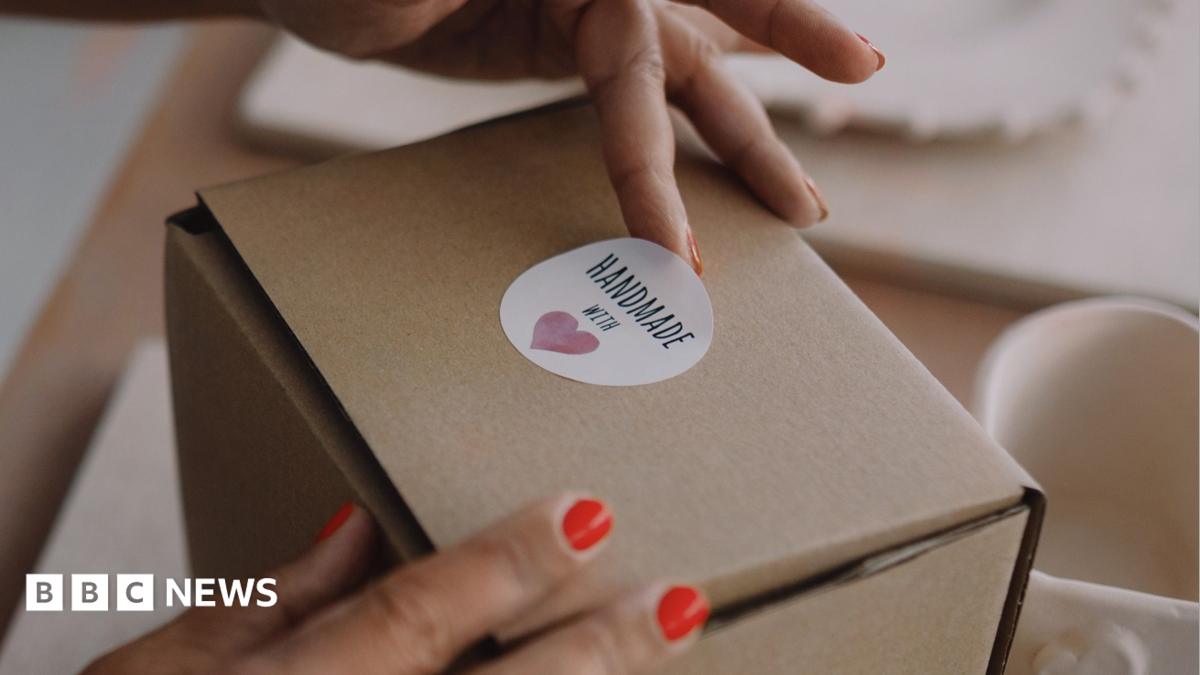
It's quite literally a sticking point.
While paper or cardboard packaging might on its own be recyclable, the presence of a label, a seal or a coating can negate that.
uncertain
presence → publish → that
That's because non-recyclable adhesives, or "stickies" as they are known as in the industry, can cause damage to recycling machinery, make the resulting batch of recycled paper inferior, or even cause a batch of paper to be recycled to be rejected, according to scientists, external at NC State University.
uncertain
batch → know → University
And that's a shame as paper is one of the most recycled materials in Europe - with around 74% of paper and board consumed in 2024 being recycled.
And European authorities are spurring firms to do better.
asserted
authorities → consume → firms
In August, a new Europe-wide packaging, external and packaging waste regulation (PPWR) kicks in ordering that all packaging should be minimum 70% recyclable by 2030, rising to 80% from 2038.
asserted
packaging → kick → 2038
In addition, German law will also, external require stricter reporting and licensing fees.
asserted
law → require → reporting
So, tackling stickies would be helpful.
asserted
tackling → tackle → stickies
One solution has been to develop water soluble adhesives, external.
asserted
solution → develop → adhesives
But what if you could skip the adhesive altogether?
uncertain
you → skip → adhesive
That's the idea that three firms from Germany - Fraunhofer, Herrmann Ultraschall, and Henkel - have come up with.
asserted
firms → come → Germany
It's no coincidence they are all German, as the country is known for its Packaging Valley, external, a hub for the packaging industry.
asserted
country → know → industry
Their efforts to innovate are partly a bid to satisfy ever tightening regulation around commercial recycling, and rising fines for those who fall foul.
asserted
who → innovate → those
With that in mind, German research organisation Fraunhofer established the PAPURE project in 2023 to develop a laser-based heating process that can seal paper packaging without an adhesive at all.
asserted
that → establish → adhesive
From September, when the project is set to officially close, Fraunhofer hopes to find an industry partner to take the technology to market.
asserted
Fraunhofer → set → market
Fraunhofer researchers exhibited their work at the Interpack packaging trade show in Dusseldorf in May, and are hopeful that the interest they attracted will come to fruition.
uncertain
they → exhibit → fruition
"There are not really many paper sealing technologies without any foreign materials, so it's a great technology and we feel it's likely that we can bring it to market," says researcher group leader Fabian Kayatz.
asserted
Kayatz → be → market
"If we are optimistic, we will have the first solution out in two years."
Also in 2023, engineering firm Hermann Ultraschall bought the rights to develop a patented ultrasonic paper sealing technology, a process which it likens to welding.
asserted
it → have → welding
"We are really actively at the moment in discussion with several really big players in the market with the focus of bringing this technology into mass production," says Michael Baumann, the company's head of business development packaging.
asserted
Baumann → bring → packaging
"One customer told me this is an innovation they have never seen before.
asserted
they → tell → me
Yet these seemingly simple solutions stem from complex technology, so naturally, there are challenges.
asserted
solutions → stem → technology
Firstly, it's not as simple as simply getting product manufacturers and packaging companies to swap out their old packaging for these new options.
asserted
manufacturers → get → options
It requires updating, and in some cases, completely replacing, existing machinery, which can be costly and time consuming.
asserted
which → require → machinery
"The packaging industry has existing machines which are all designed for glue materials.
asserted
which → have → materials
Some kind of redesign is probably necessary, and this is our biggest challenge," says Hermann Ultraschall's Baumann.
asserted
Baumann → say → redesign
Yet Volker Franke, also a research group leader at Fraunhofer, is confident that those existing machines can be modified by integrating the laser module that PAPURE has been developing.
asserted
PAPURE → exist → that
They both acknowledge that the production rate is also currently much slower than that for paper packaging that uses adhesives, but Franke says a key benefit PAPURE is selling is fully automated production, which he believes can continue to be developed for speed.
asserted
he → acknowledge → speed
The other issue is that the technologies don't work on all types of paper.
asserted
technologies → work → paper
"It's not possible to bond every paper material," Baumann confirms.
asserted
Baumann → bond → material
"But we are actively in discussion with paper manufacturers about how they can produce a raw material in a way that makes it easy to bond."
asserted
it → produce → way
PAPURE has also yet to find a way to apply their laser sealing technology to food-grade packaging, which needs a coating to protect the item.
asserted
which → have → item
This tends to be why plastic is often favoured for packaging food.
asserted
plastic → tend → food
But this is something Henkel, with both a consumer brand division, and adhesive technologies division, has cracked.
asserted
Henkel → crack → division
In February, Henkel announced the launch of the first cold seal solution that works with barrier coated paper, which is both recyclable and suitable for food products.
asserted
which → announce → products
Barrier paper can be a difficult surface to bond, and using heat isn't suitable for heat sensitive food products like ice cream or chocolate.
asserted
using → bond → cream
Hence the cold seal solution, in which enough pressure is applied for the barrier coated paper to be bonded against itself.
asserted
paper → apply → itself
Henkel's cold seal solution is already available for packaging manufacturers to apply to barrier coated paper.
asserted
manufacturers → apply → paper
It is already being used in snack and confectionery products, but Henkel could not say which ones.
uncertain
Henkel → use → products
Henkel had previously developed a heat seal solution for paper that is fully recyclable.
asserted
that → develop → paper
This has enabled Italian brand Regina, for example, to switch from plastic to paper packaging for its hygiene products like toilet roll, kitchen paper and napkins.
asserted
This → enable → roll
"Since paper is already very established in the recycling infrastructure, it's a very obvious solution when we think about how we can improve the sustainability and recyclability of our packaging," explains Dr Arianna Savini.
asserted
Savini → establish → packaging
You need to engage with all the players in the supply chain to enable this change.
asserted
You → need → change
…and 12 more, not listed.
 The Aporia