This article is brought to you by American Purpose, the magazine and community founded by Francis Fukuyama in 2020, which is proudly part of the Persuasion family.
asserted
which → bring → family
Poland is known as a bastion of European conservatism—and also as a country that, since 1989, has demonstrated rapid economic growth that is twice the average for OECD countries.
asserted
that → know → countries
From the outside, it might seem that these two things are interconnected.
uncertain
things → seem → outside
But as a naturalized citizen who has lived in Poland for over four years, I will try to show that policies based on conservative values not only weigh down Polish businesses, but also lead to consequences that even conservatives are unhappy with.
asserted
conservatives → live → that
On Sundays, millions of people around the world flock to shopping malls.
asserted
millions → flock → malls
Poland, where Sunday shopping has been gradually banned since 2018, stands apart from this cult of consumption.
asserted
shopping → ban → consumption
The law, supported by the Catholic Church, was initially promoted by the “Solidarity” trade union under the pretext that it would allow Polish women—who make up the majority of the retail workforce—to spend Sundays with their families.
asserted
who → support → families
The law did, however, provide for exceptions—of which retail chains took advantage, handing out parcels in addition to groceries, or hanging paintings above their beer refrigerators to turn their stalls into “galleries.”
asserted
chains → provide → galleries
Many of these loopholes were eventually closed, meaning the law took full effect—and it is now clear that all of its stated goals have failed.
asserted
all → close → goals
Sunday church attendance has fallen.
asserted
attendance → fall → ?
And although this decline fits into a broader secular trend and is partly linked to COVID-19, the Sunday shopping law may have played a significant role.
uncertain
law → fit → role
Cezary Kaźmierczak, head of the Union of Entrepreneurs and Employers, notes that for many, attending church was a nuanced ritual—people would first go to church and then, with a clear conscience, to the mall.
asserted
people → note → mall
Instead of church, however, Poles have chosen bread and circuses.
asserted
Poles → choose → bread
Now, Polish women are once again working on Sundays—only this time at movie theaters and food courts, wondering why the Adidas saleswoman gets to spend her Sunday with her family, while the McDonald’s saleswoman does not.
asserted
saleswoman → work → family
The law dealt the heaviest blow to small businesses.
asserted
law → deal → businesses
Large retail chains retooled their marketing strategies for Friday and Saturday, changing people’s shopping habits.
asserted
chains → retool → habits
Some small shops began to close, and their place was taken by franchise chains such as Żabka, whose stores can operate on Sundays because, technically, they are not owned by the chain but by the independent entrepreneurs who run them.
asserted
who → begin → them
This “independence” does not exempt entrepreneurs from Żabka’s strict corporate policies, but it does allow them to operate outside the labor code and work not only on Sundays but also up to seventeen hours a day.
asserted
them → exempt → Sundays
(In addition, a blank promissory note, which must be signed “for Żabka’s security,” can ultimately leave a franchisee $30,000 in debt, which is why critics call the franchise a form of modern slavery.
asserted
critics → sign → slavery
But the Polish government didn’t stop there.
asserted
government → stop → ?
Having “protected” Poles’ right to rest on Sundays, it has now taken on a larger problem—the protection of the nation.
asserted
it → protect → nation
While at the start of the war, 94% of Poles supported taking in Ukrainian refugees, by July 2026 52% opposed such a policy.
asserted
% → support → policy
Furthermore, in the first half of 2026, the number of hate crimes against Ukrainians rose by 30%.
asserted
number → rise → %
Ukrainians and Poles have their own Oliver Cromwell: Stepan Bandera, who fought for Ukrainian independence during World War Two, but was also implicated in the Volhynia massacre of 1943-44, in which 100,000 Poles were killed.
asserted
Poles → have → which
At the same time, Ukrainians view Bandera first and foremost as a fighter against Russia—which is particularly relevant in the context of the current conflict.
asserted
which → view → conflict
Some aren’t even aware that he has any connection to Poland (I myself spoke with a Ukrainian who didn’t understand why Poles get annoyed when Ukrainians sing the song “Our Father Is Bandera” in the streets).
asserted
Father → have → streets
Meanwhile, even those who are aware of the connection tend to downplay the accusations, arguing that there was violence on both sides and that the Volhynia massacre was carried out by Bandera’s supporters rather than the man himself, who at the time was imprisoned in a Nazi concentration camp.
asserted
who → tend → camp
However, they were magnified by the paleolibertarian Confederation Party, which had grown to be the third-largest political party in Poland by capitalizing on anti-immigration rhetoric.
asserted
which → magnify → rhetoric
In response, the Polish political center began to shift to the right, and as a result, Donald Tusk’s liberal government adopted the anti-immigrant strategy “Regain control. Ensure security,” under which the state excludes migrants arriving from certain countries.
asserted
state → begin → countries
As part of this strategy, in 2025 the government reduced the number of work permits for non-EU nationals (whose labor accounts for up to 10.7% of the Polish economy) by 22%.
asserted
labor → reduce → %
Experts believe that this strategy, which restricts the hiring of foreigners, prioritizes short-term political goals at the expense of the economy.
asserted
which → believe → economy
Poland doesn’t actually face a shortage of jobs being taken by migrants.
asserted
Poland → face → migrants
On the contrary: demographic decline in Poland is causing an acute labor shortage.
asserted
decline → cause → shortage
According to estimates by the Polish Economic Institute, if this shortfall is not offset—including through foreign workers—Poland could lose 2.1 million workers by 2035, resulting in a 6-8% decline in GDP due to losses in the industrial sector.
uncertain
Poland → accord → sector
To be fair, Polish conservatives are also trying to address the demographic problem.
asserted
conservatives → try → problem
But the methods they’ve chosen have had unexpected consequences.
asserted
they → choose → consequences
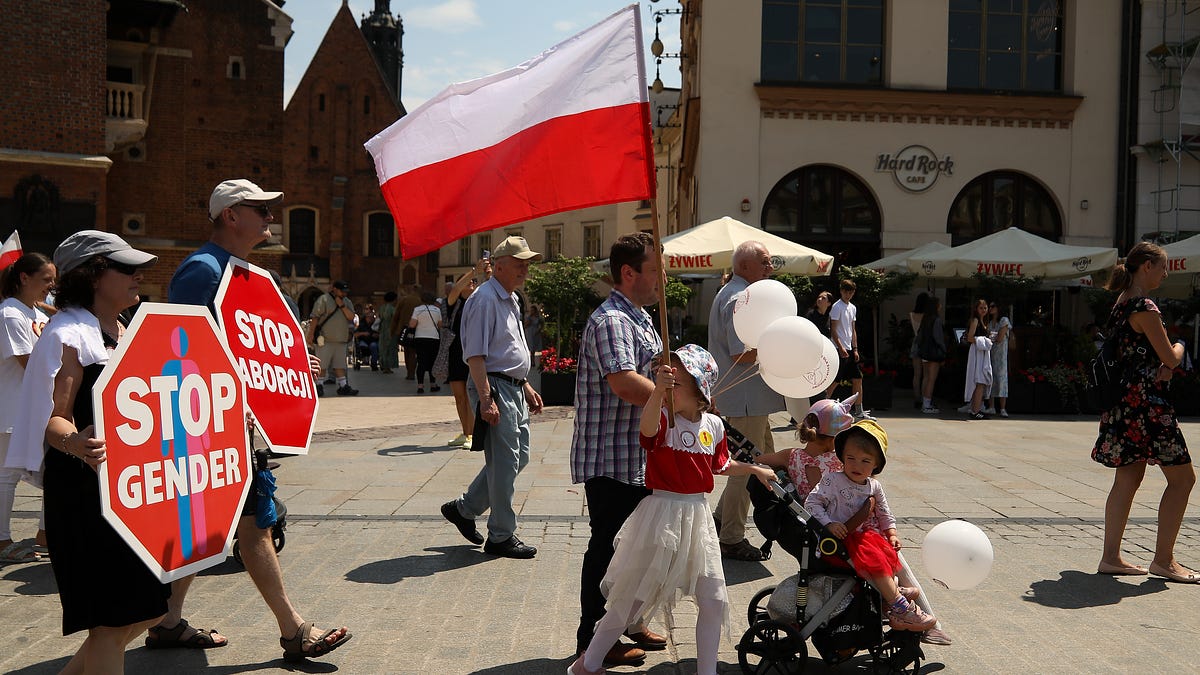
Poland has one of the strictest anti-abortion laws in Europe.
asserted
Poland → have → Europe
For example, in my native Belarus—often called Europe’s last dictatorship—you can go to prison for a comment on YouTube, yet abortion remains a standard medical procedure.)
asserted
abortion → call → YouTube
Unlike most European countries, the concept of “abortion on demand” does not exist in Poland.
asserted
concept → exist → Poland
Abortion in Poland is even banned when the fetus is terminally ill, forcing women to carry the child to term and give birth, knowing the child will suffer and die.
asserted
child → ban → birth
…and 16 more, not listed.
 The Aporia