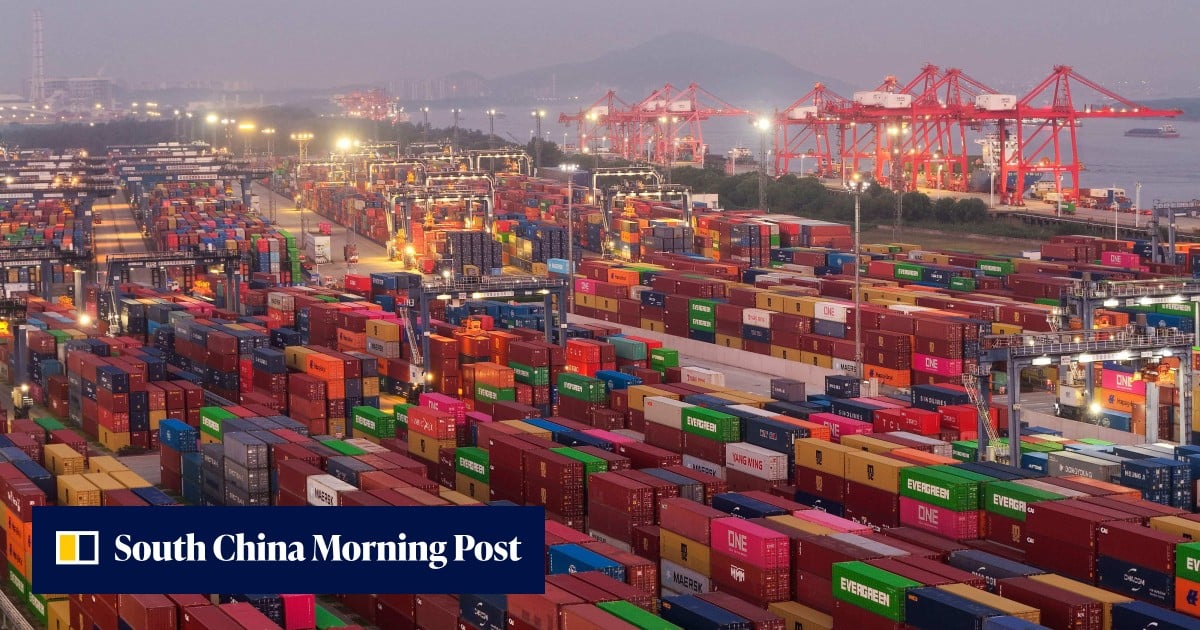
US-China decoupling could benefit other countries, China trade war game suggests

South China Morning Post · collected 2026-09-12 · by Dannie Peng
Read the original at South China Morning Post ↗

Summary

Chinese researchers have modeled a war game scenario that suggests US-China economic decoupling would hurt both superpowers but could temporarily benefit other countries. However, these gains are fragile; if those nations then reduce their own trade with China, they would experience losses. The study was published in the South China Journal of Economics by authors from the Guangzhou Geological Survey Institute and Beijing Normal University's Bay Area International Business School.
Written by the local model on 2026-09-12, using this article's own text rather than the other coverage of the same event (that is the story summary below).

Signals How these are calculated →

Claims extracted
5
claim-shaped sentences
Uncertain
40%
2 of 5 hedged
Leaning
not political
takes no side on a contested political question
Publisher trust
93.6
red-flag proxy, not a credibility rating
Outlets on this story
1
Economy/Business
Narrative spread
1
articles carrying this framing
Analyzed 2026-09-12 · how these are computed

AI analysis (generated at analysis time, not now)

Story summary

Chinese researchers from the Guangzhou Geological Survey Institute and the Bay Area International Business School at Beijing Normal University have modelled a scenario where complete economic decoupling between the US and China could temporarily benefit other nations. Published in the peer-reviewed South China Journal of Economics, the study found that such a drastic action would hurt both superpowers but provide short-term gains to others. However, these benefits are fragile; if those economies then reduce their own economic ties with China, they would quickly experience losses rather than gains. This underscores the interconnectedness and complexity of global trade dynamics.

Written for “US China Trade War Impact” on 2026-09-12, grounded in this article and the 0 other(s) covering the same event.
Why this leaning score
This article does not take a side on a contested political question, so it has no leaning score. That is an answer rather than a gap: a match report or a rescue can be warmly or critically written without being left or right, and scoring it anyway is how approval of a subject gets recorded as a political position.
No political leaning scored for article 8219 · logged 2026-09-12

Story

📰 US China Trade War Impact
Economy/Business · 1 article(s) covering the same event. This is the one the site leads with.

How this is being covered How these are calculated →

Article leaning vs. publisher reliability
Source leaning vs. consistency

Compared with similar articles

This article reads unscored and hedges 40% of its claims. Each row says how that neighbour differs.
Semafor
⚖️ Leans right 🔴 20% hedged 1 of 5 📰 publisher trust 96
“The articles discuss different aspects of US-China relations; one focuses on rhetoric ahead of a meeting while the other reports on a study about economic decoupling.”

Publisher

South China Morning Post · 207 article(s) · 0 correction(s) detected
No corrections detected for this publisher. That may mean careful reporting, or simply that nothing has been checked.

Who wrote this

Dannie Peng
1 article(s) here · 1 carrying a prediction
🔮 US-China decoupling could benefit other countries, China trade war game suggests The study suggests a complete severing of trade ties would hurt both superpowers while bringing temporary gains elsewhere
The only article under this byline in the corpus.

Topics

Beijing Normal University China Chinese the Bay Area International Business School the Guangzhou Geological Survey Institute

Subjects

China GPE · 4× Beijing Normal University ORG · 1× Chinese NORP · 1× South China Journal of Economics ORG · 1× the Bay Area International Business School ORG · 1× the Guangzhou Geological Survey Institute ORG · 1×

Narrative

The study, co-authored by researchers from the Guangzhou Geological Survey Institute and the Bay Area International Business School at Beijing Normal University, was published in the peer-reviewed South China Journal of Economics.
framing: mixed · carried by 1 article(s) · first seen 2026-09-12
🔮 US-China decoupling could benefit other countries, China trade war game suggests The study suggests a complete severing of trade ties would hurt both superpowers while bringing temporary gains elsewhere
2026-09-12 · South China Morning Post
US-China decoupling could benefit other countries, China trade war game suggests · mixed framing

Claims (5 extracted, 2 hedged)

US-China decoupling could benefit other countries, China trade war game suggests The study suggests a complete severing of trade ties would hurt both superpowers while bringing temporary gains elsewhere uncertain
severing → benefit → gains
Chinese researchers have modelled a war game scenario suggesting that a complete economic decoupling between the US and China could, unexpectedly, yield dividends for most other nations. uncertain
decoupling → model → nations
However, the simulations carried an important caveat: any spillover benefits would be fragile. asserted
benefits → carry → caveat
If those economies were subsequently to cut their own economic ties with China, their initial welfare gains would quickly turn into losses. asserted
gains → cut → losses
The study, co-authored by researchers from the Guangzhou Geological Survey Institute and the Bay Area International Business School at Beijing Normal University, was published in the peer-reviewed South China Journal of Economics. asserted
study → co → Economics
💬 Give feedback
🕘 History 🎫 Support