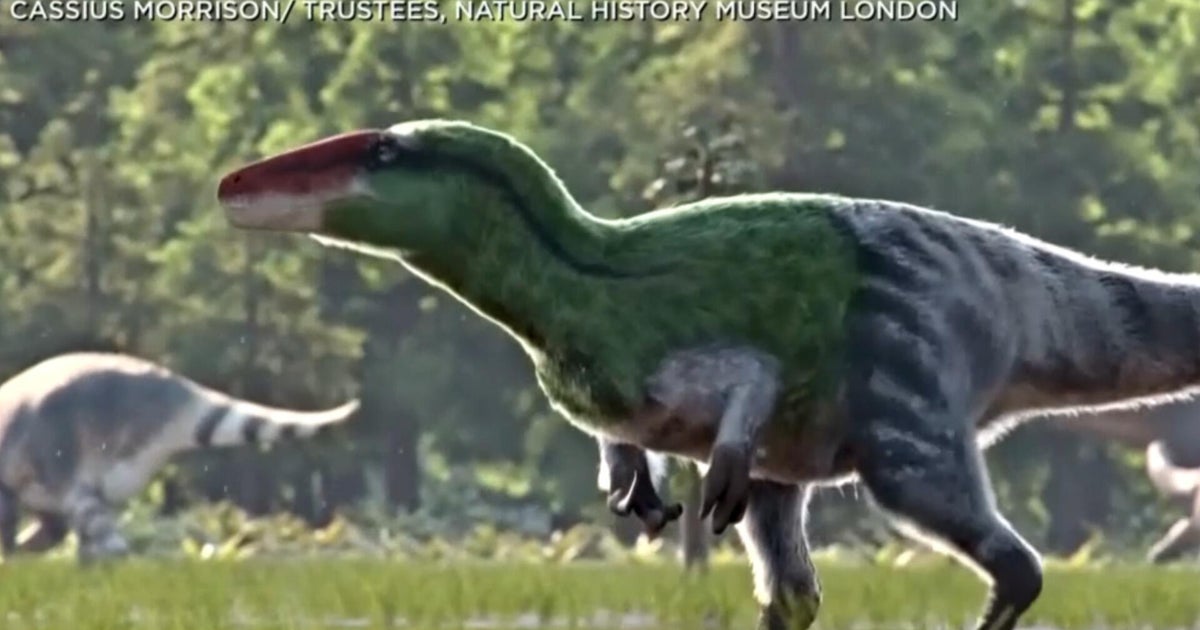
Animation depicts newly-discovered dinosaur species

Read the original at CBS News ↗
Cite

Animation depicts newly-discovered dinosaur species. (2026, October 15). CBS News. https://www.cbsnews.com/video/animation-depicts-newly-discovered-dinosaur-species/

Dated from the outlet's own feed. Check the original for its byline.

CBS News · collected 2026-10-15

Quick Summary

Scientists in the U.K. have identified a new dinosaur species called Invictibellatrix amberina from a fossil that was overlooked in a museum collection for almost a century. The two-legged carnivore is related to Tyrannosaurus rex and provides insights into dinosaurs previously unknown to paleontologists.
Written locally by qwen2.5:14b on 2026-10-15, using this article's own text rather than the other coverage of the same event (that is the story summary below).

AI analysis runs on qwen2.5:14b, locally

Story summary

A new species of dinosaur, Invictibellatrix amberina, has been discovered on the Isle of Wight after being overlooked for over a century. The fossil was initially collected by the Natural History Museum in London in 1924 and rediscovered recently. This long-clawed predator, about the size of a large tiger, lived in the UK during the early Cretaceous period around 120 million years ago. It is the first megaraptoran dinosaur found in Europe, a group closely related to tyrannosaurs like T. rex. Dr. Cassius Morrison from University College London, who led the research published in *Royal Society Open Science*, noted that while not an apex predator of its time, Invictibellatrix amberina would have been more dangerous to humans than a T. rex due to its optimal size for hunting human-sized prey.

Written for “New Dinosaur Species Discovered” on 2026-10-15, grounded in this article and the 1 other(s) covering the same event.

Story

📰 New Dinosaur Species Discovered
Science · 2 article(s) covering the same event. See how they differ ↓

Compared with similar articles

This article reads unscored and hedges 0% of its claims. Each row says how that neighbour differs.
Evening Standard
⚖️ leaning not scored 🔴 7% hedged 1 of 15 📰 publisher trust 67
“Both articles describe the discovery of a new dinosaur species from a fossil found on the Isle of Wight that was overlooked for over 100 years.”
How this article was measured signals, leaning charts, publisher record, byline, topics and claims

Signals How these are calculated →

Claims extracted
2
sentences that state something as happening or true
Uncertain
0%
0 of 2 hedged ("reportedly", "may", "according to")
Leaning
not political
takes no side on a contested political question
Publisher signals
66/100
CBS News's corrections and hedging, across everything collected from it. Not a measure of accuracy.
Outlets on this story
2
Science
Same framing elsewhere
1
articles that frame the event the way this one does
Analyzed 2026-10-15 · how these are computed

How this is being covered How these are calculated →

Article leaning vs. publisher reliability
Source leaning vs. consistency

Publisher

CBS News · 2894 article(s) · 6 correction(s) detected
Running correction rate · 6 correction(s)

Who wrote this

No reporter is named on this article.

Topics

London U.K. the Natural History Museum

Subjects

London GPE · 1× U.K. GPE · 1× the Natural History Museum ORG · 1×

Narrative

The fossil that led to the discovery sat in a drawer at the Natural History Museum in London for nearly 100 years, having first been obtained by the vaunted institution in 1924.
framing: assertive · carried by 1 article(s) · first seen 2026-10-15
2026-10-15 · CBS News
Animation depicts newly-discovered dinosaur species · assertive framing

Claims (2 extracted, 0 hedged)

Scientists in the U.K. have discovered a new dinosaur species, the Invictibellatrix amberina, a two-legged carnivore that was a cousin of the Tyrannosaurus rex. asserted
that → discover → rex
The fossil that led to the discovery sat in a drawer at the Natural History Museum in London for nearly 100 years, having first been obtained by the vaunted institution in 1924. asserted
that → lead → 1924
💬Give feedback
🕘History 🎫Support