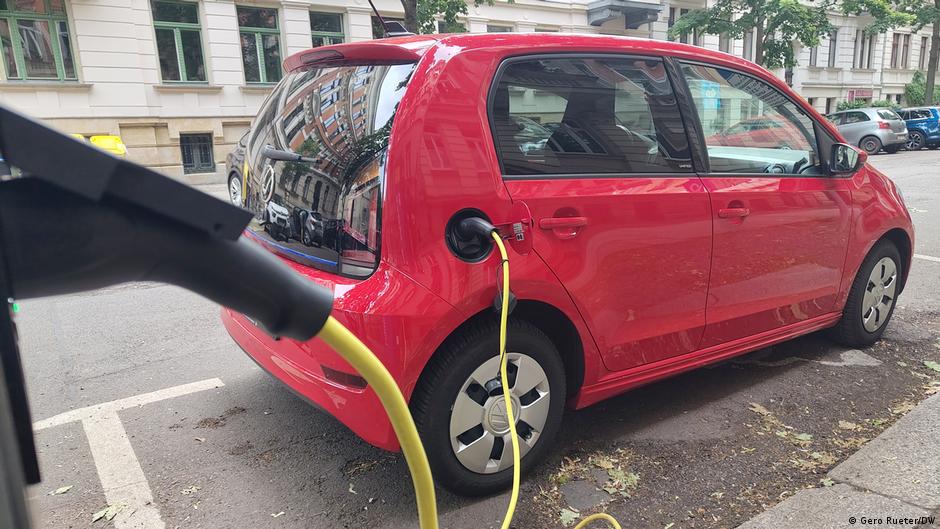
"The EU's car lie" — Germany's Bild tabloid newspaper didn't mince words when it reported on what it called the European Union's "dangerous" claim that electric vehicles were carbon neutral.
uncertain
vehicles → mince → what
Writing on social media, he called for an end to "the EU's phaseout of internal combustion engines" set for 2035.
asserted
he → write → 2035
Stepping away from the phaseout, he said, would now be backed by "science."
asserted
he → step → science
Söder and Bild were reacting to a new report by the Technical University of Munich (TUM), which outlined what it considered to be a major flaw in the EU's climate strategy: the fact that its vehicle emissions regulation only focuses on CO2 emissions from exhaust gases and that battery-electric vehicles are considered "climate-neutral."
asserted
vehicles → react → gases
The report stated that battery-electric vehicles reduce carbon emissions by only "41% on average" over combustion engine vehicles, with the EU regulation failing to take into account emissions generated by other factors like manufacturing and electricity mix.
asserted
regulation → state → manufacturing
Gas-powered vehicles were at a disadvantage, the report concluded, suggesting emissions should be counted over a vehicle's entire life cycle, from the materials used to build a car to the fuel that makes it run.
asserted
it → power → fuel
Credit could be given for the use of green steel, for instance, or recovering raw materials through recycling.
uncertain
Credit → give → recycling
It highlighted several major car manufacturers that support this approach, including BMW, Audi and Volkswagen — all major institutional donors at TUM.
asserted
that → highlight → TUM
Georg Bieker, who researches the environmental impact of electric and gas-powered cars at the US-based International Council on Clean Transportation (ICCT) think tank, said TUM's analysis didn't offer any new insights.
asserted
analysis → research → insights
He, and other climate and mobility experts, pointed out that the importance of life-cycle assessments was already well known.
asserted
importance → point → assessments
Bieker co-authored a 2025 study examining the global warming potential of passenger cars sold in the EU which took into account their entire life cycle, from the production of the vehicle to its fuel consumption and maintenance.
asserted
which → co → consumption
It found that the emissions generated by battery-electric vehicles are on average 73% lower than gasoline cars, and up to 78% when using only renewable electricity.
asserted
emissions → find → electricity
Similar studies, including from the EU and the International Energy Agency, came up with emissions reductions of between 60%-66%.
asserted
studies → include → 60%-66
The Germany Environment Ministry said modern vehicles could even achieve reductions of up to 80%.
uncertain
vehicles → say → %
Hybrid vehicles, meanwhile, which combine a combustion engine with an electric motor and battery charged by the car's brakes and an internal generator, generate fewer emissions than traditional cars, but still don't match fully electric vehicles.
asserted
which → combine → vehicles
Bieker said the full EV advantage will only grow as production and operation becomes less carbon intensive.
asserted
production → say → ?
Even today, he added, production emissions for gasoline internal combustion vehicles only account for around 13% of the total climate impact; most of the emissions come from the tailpipe.
asserted
most → add → tailpipe
Batteries have a high environmental cost
Bieker confirmed batteries were still one of the main environmental challenges facing electric cars.
asserted
batteries → have → cars
The mining of key resources like cobalt and lithium has been linked to habitat destruction and water depletion; mining 1 ton of lithium, enough for around 125 EVs, requires some 2 million liters of water.
asserted
mining → link → water
Bieker's ICCT study found that while battery-electric vehicles had an estimated 40% higher production emissions than gas-powered vehicles due to battery production, these additional emissions were offset after driving about 17,000 kilometers (10,500 miles), or in one or two years.
asserted
emissions → find → years
And, Bieker pointed out, most of those batteries could eventually be recycled — unlike the gasoline burned in a combustion engine.
uncertain
most → point → engine
"We see a trend of emissions decreasing for battery production," Bieker told DW, pointing out that technology was still being developed.
asserted
technology → see → DW
The production of lithium-iron phosphate (LFP) batteries, for example, generates fewer emissions than the nickel manganese cobalt variety.
asserted
production → generate → variety
LFPs are increasingly becoming the battery of choice for the industry — they're generally safer, last longer and are cheaper to manufacture.
asserted
they → become → industry
Bieker said batteries were also increasingly being produced in Europe in larger, more efficient factories, which also helps reduce emissions generated by importing them from abroad.
asserted
which → say → them
Though Europe still ranks second behind China when it comes to battery cell manufacturing, the European Commission has committed to boosting the sector with financial support, including a recent €1.5 billion in interest-free loans.
asserted
Commission → rank → loans
The other major factor contributing to EV emissions is the electricity mix — how the power charging the batteries is actually generated.
asserted
power → contribute → batteries
While electric cars don't produce emissions during driving, they can generate them indirectly when charged using electricity produced by burning fossil fuels like coal and gas.
asserted
they → produce → coal
But the rapid expansion of renewable energy in recent years — especially solar, including a growing popularity of home installations — is increasingly tipping the scale in favor of EVs.
asserted
expansion → include → EVs
"Europe's electricity grid is currently more than 70% decarbonized and expected to be almost fully decarbonized by 2040," said Gabrielle Clark, a policy officer at European trade federation Eurelectric focusing on energy, climate and sustainability.
asserted
Clark → decarbonize → energy
"As the production of green steel and battery recycling capacity also ramps up as expected, this will only strengthen the case even more.
asserted
this → ramp → case
Clark said it wasn't necessary to replace the EU's current tailpipe emissions regulation, which plans to phase out combustion engines entirely by 2035, with more complex regulations and green accounting rules.
asserted
which → say → regulations
"Whether assessed through [life-cycle assessment] or tailpipe emissions, [battery-electric vehicles] are always the preferred technology for carbon emission reductions in the road transport sector," she told DW in an email.
asserted
she → assess → email
"Their replacement of [internal combustion engine] vehicles must be accelerated, not delayed.
asserted
replacement → accelerate → vehicles
"
Rising fuel prices, climate concerns push EV growth
Bieker said that in the end the market will decide, not policy.
asserted
market → rise → end
"The future will be electric, no matter what European policymakers or German carmakers think," he said, highlighting the global growth of EV sales in recent years, especially in China and Southeast Asia.
asserted
he → think → China
EVs are also taking off in Europe.
asserted
EVs → take → Europe
In Germany, for example, a new survey by research firm SBD Automotive and Here Technologies showed that 54% of respondents were more likely to consider buying an electric car as their next vehicle, citing technology advances, rising fuel prices and environmental concerns.
asserted
% → show → advances
"We cannot win the race by ignoring it," said Bieker.
asserted
Bieker → win → it
"[For climate,] for competitiveness and economic development, we need to double down on electrification and not slow it down."
Edited by: Tamsin Walker
asserted
we → need → Walker
 The Aporia