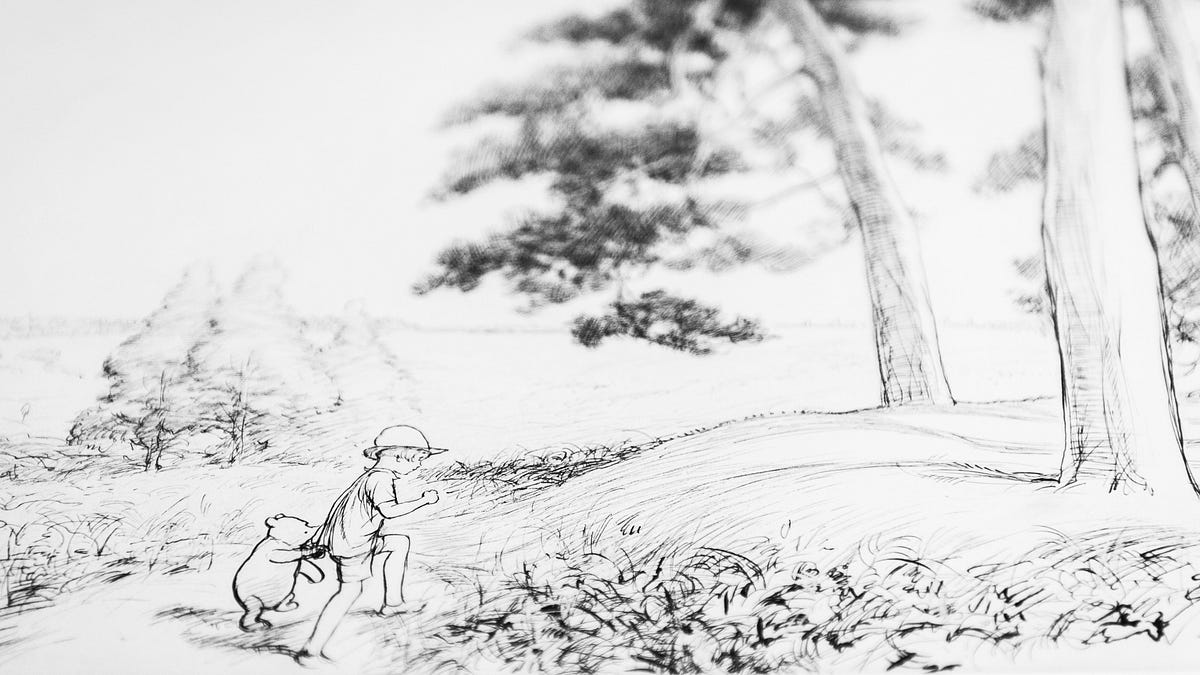
Winnie-the-Pooh’s Most Important Lesson

Read the original at The Free Press ↗
Cite

Katz, J. (2026, October 14). Winnie-the-Pooh’s Most Important Lesson. The Free Press. https://www.thefp.com/p/winnie-the-poohs-important-lesson-heffalumps

Dated from the outlet's own feed. Check the original for its byline.

The Free Press · collected 2026-10-14 · by Joshua Katz

Quick Summary

Today marks the centennial of A.A. Milne’s book Winnie-the-Pooh, though the character first appeared in a short story published on Christmas Eve 1925 and was inspired by a stuffed bear given to Christopher Robin Milne in 1921. The article reflects on the enduring impact of the books through personal anecdotes about receiving them as gifts at age three and now sharing them with a daughter, emphasizing one specific passage that resonates deeply with the author.
Written locally by qwen2.5:14b on 2026-10-14, using this article's own text rather than the other coverage of the same event (that is the story summary below).

AI analysis runs on qwen2.5:14b, locally

Story summary

Winnie-the-Pooh's original book by A.A. Milne was published on October 14, 1926, marking its centennial anniversary. However, the character first appeared in a short story titled "The Wrong Sort of Bees" in London’s Evening News on Christmas Eve 1925. The inspiration for Winnie-the-Pooh came from a stuffed bear given to Christopher Robin Milne by his mother from Harrods in 1921, shortly after the term "teddy bears" began circulating. This year, many are celebrating the enduring legacy of the beloved character and its impact on children's literature.

Written for “Winnie The Pooh Lessons” on 2026-10-14, grounded in this article and the 0 other(s) covering the same event.

Story

📰 Winnie The Pooh Lessons
Entertainment · 1 article(s) covering the same event.

Compared with similar articles

Nothing to compare against. No article is close enough to this one for the pipeline to have linked or judged the pair.
How this article was measured signals, leaning charts, publisher record, byline, topics and claims

Signals How these are calculated →

Claims extracted
11
sentences that state something as happening or true
Uncertain
0%
0 of 11 hedged ("reportedly", "may", "according to")
Leaning
not political
takes no side on a contested political question
Publisher signals
96/100
The Free Press's corrections and hedging, across everything collected from it. Not a measure of accuracy.
Outlets on this story
1
Entertainment
Same framing elsewhere
1
articles that frame the event the way this one does
Analyzed 2026-10-14 · how these are computed

How this is being covered How these are calculated →

Article leaning vs. publisher reliability
Source leaning vs. consistency

Publisher

The Free Press · 294 article(s) · 0 correction(s) detected
No corrections detected for this publisher. That may mean careful reporting, or simply that nothing has been checked.

Who wrote this

Joshua Katz
1 article(s) here · 1 carrying a prediction
🔮 And perhaps Winnie-the-Pooh would never have had a birthday at all had a very young Christopher Robin Milne not received a stuffed bear from Harrods from his mother in 1921, only a little over a decade after people began speaking about “teddy bears.”
2026-10-14 · assertive framing · Winnie-the-Pooh’s Most Important Lesson
The only article under this byline in the corpus.

Topics

Evening News Harrods London Punch

Subjects

Milne PERSON · 2× A.A. Milne’s PERSON · 1× Christopher Robin Milne PERSON · 1× E.H. Shepard PERSON · 1× Edward Bear PERSON · 1× Evening News ORG · 1× J.H. Dowd PERSON · 1× London GPE · 1× Punch ORG · 1× Shepard PERSON · 1×

Narrative

I know this because my parents, in an experiment in delayed gratification, bought the four-part boxed set of the Pooh books (Winnie-the-Pooh, The House at Pooh Corner, When We Were Very Young, and Now We Are Six) and gave me one a year until finally I was 6.
framing: assertive · carried by 1 article(s) · first seen 2026-10-14
🔮 And perhaps Winnie-the-Pooh would never have had a birthday at all had a very young Christopher Robin Milne not received a stuffed bear from Harrods from his mother in 1921, only a little over a decade after people began speaking about “teddy bears.”
2026-10-14 · The Free Press
Winnie-the-Pooh’s Most Important Lesson · assertive framing

Claims (11 extracted, 0 hedged)

Winnie-the-Pooh turns 100 today. asserted
Pooh → turn → 100
Actually, that’s not quite true. asserted
that → ’ → ?
Yes, A.A. Milne’s beloved book Winnie-the-Pooh, with equally beloved illustrations by E.H. Shepard, was first published on October 14, 1926. asserted
book → publish → October
But the eponymous bear first appeared by name in a short story—illustrated by J.H. Dowd rather than Shepard—that Milne then expanded into the first chapter of what quickly became and has remained a classic of children’s literature. asserted
what → appear → literature
That story, “The Wrong Sort of Bees,” came out in London’s Evening News on Christmas Eve 1925; the previous year, Milne had written a poem for Punch that features Edward Bear, who, even in a brief appearance, is recognizably Winnie-the-Pooh’s prototype. asserted
who → come → appearance
And perhaps Winnie-the-Pooh would never have had a birthday at all had a very young Christopher Robin Milne not received a stuffed bear from Harrods from his mother in 1921, only a little over a decade after people began speaking about “teddy bears.” asserted
people → have → bears
I imagine that Winnie-the-Pooh was read to me before I had a copy of my own, but I know for sure that I first leafed through the pages myself on my third birthday. asserted
I → imagine → birthday
I know this because my parents, in an experiment in delayed gratification, bought the four-part boxed set of the Pooh books (Winnie-the-Pooh, The House at Pooh Corner, When We Were Very Young, and Now We Are Six) and gave me one a year until finally I was 6. asserted
I → know → one
It hardly makes me special that I loved the books then and love them still now, both for myself and for my 3-year-old daughter. asserted
I → make → daughter
But one passage in particular has stuck with me. asserted
passage → stick → me
I recite it to myself often: asserted
I → recite → myself
💬Give feedback
🕘History 🎫Support