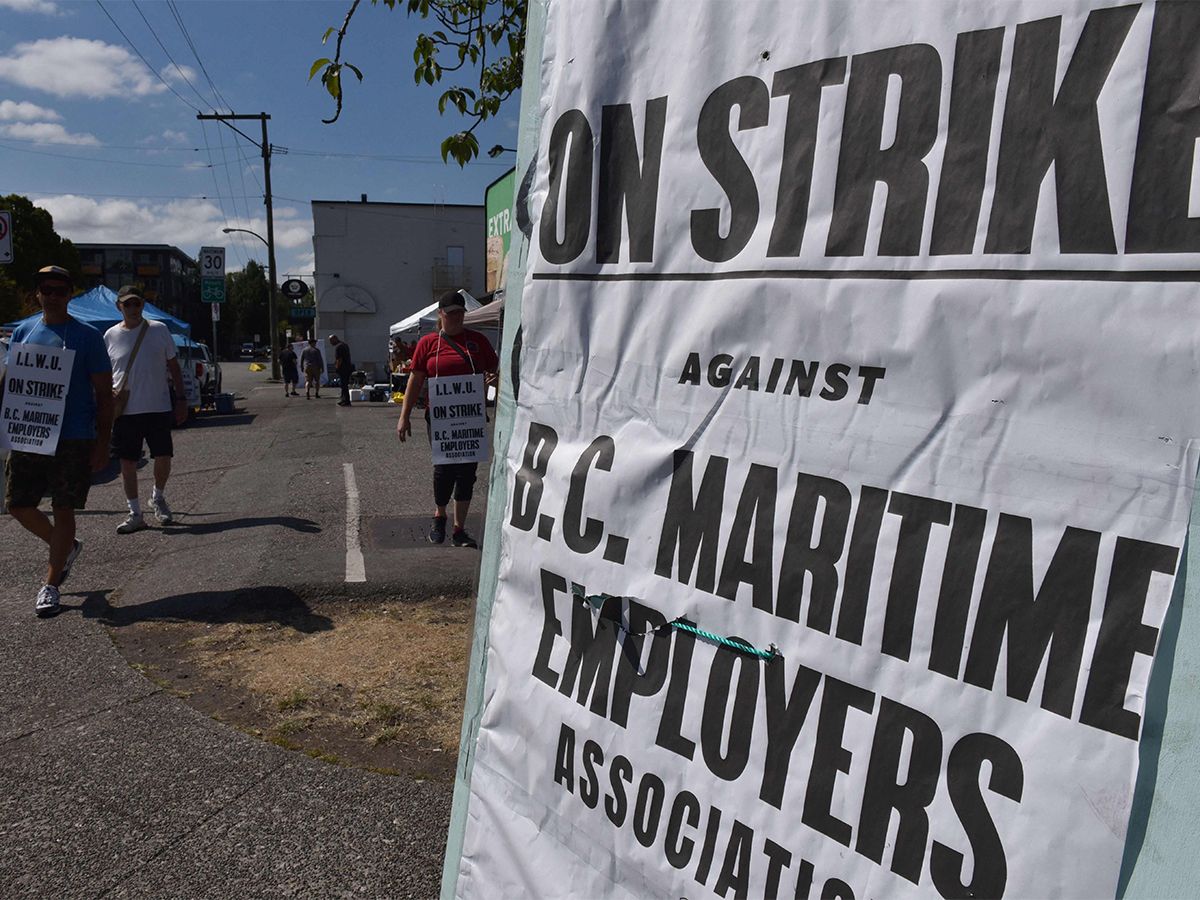
Opinion: Canada Labour Code changes are not an attack on workers’ rights

Read the original at National Post ↗
Cite

Special to National Post. (2026, October 14). Opinion: Canada Labour Code changes are not an attack on workers’ rights. National Post. https://nationalpost.com/opinion/canada-labour-code-changes-are-not-an-attack-on-workers-rights

Dated from the outlet's own feed. Check the original for its byline.

National Post · collected 2026-10-14 · by Special to National Post

Quick Summary

This opinion piece argues that recent changes proposed in the Building Canada Strong Act are not an attack on workers' rights but rather sensible solutions aimed at addressing persistent labour disputes in critical supply chain industries. The author claims these disruptions, such as those in airlines, ports, and rail services, harm the national economy and millions of Canadians who are not directly involved. Bill C-39, according to the article, enhances support for negotiation processes by extending conciliation periods and introducing a Special Mediator role to aid resolution efforts before potentially invoking binding arbitration if necessary.
Written locally by qwen2.5:14b on 2026-10-14, using this article's own text rather than the other coverage of the same event (that is the story summary below).

AI analysis runs on qwen2.5:14b, locally

Story summary

The National Post published an opinion piece on October 14, 2026, arguing that recent changes to the Canada Labour Code, particularly Bill C-39 or the Building Canada Strong Act, do not attack workers' rights but instead offer solutions to persistent labour disputes in critical sectors like airlines, ports, and railways. The article asserts that these disruptions threaten the national economy and affect millions of Canadians. According to the piece, the legislation aims to address an emerging pattern where labour pressure impacts not just the involved parties but also broader economic stability.

Written for “Canada Labour Code Changes” on 2026-10-14, grounded in this article and the 0 other(s) covering the same event.
Why this leaning score
The article's own words the score was based on. Each is quoted verbatim and was checked against the article text before being stored, so you can find it in the original.
Reading Leans strongly right (beta estimate) Confidence high 1 quote(s) discarded as not found in the article
Leaning: leans strongly right for article 79533 (high confidence, 4 verified quotes) · logged 2026-10-14

Story

📰 Canada Labour Code Changes
Politics · 1 article(s) covering the same event.

Compared with similar articles

Nothing to compare against. No article is close enough to this one for the pipeline to have linked or judged the pair.
How this article was measured signals, leaning charts, publisher record, byline, topics and claims

Signals How these are calculated →

Claims extracted
26
sentences that state something as happening or true
Uncertain
19%
5 of 26 hedged ("reportedly", "may", "according to")
Leaning
Leans strongly right
of the writing, not the subject · beta estimate
Publisher signals
60/100
National Post's corrections and hedging, across everything collected from it. Not a measure of accuracy.
Outlets on this story
1
Politics
Same framing elsewhere
1
articles that frame the event the way this one does
Analyzed 2026-10-14 · how these are computed

How this is being covered How these are calculated →

Article leaning vs. publisher reliability
Source leaning vs. consistency

Publisher

National Post · 869 article(s) · 2 correction(s) detected
Running correction rate · 2 correction(s)

Who wrote this

Special to National Post
86 article(s) here · 1 carrying a prediction
🔮 Recommended Videos Not only does Bill C-39 stand on a solid constitutional footing, we believe it could in fact — under certain circumstances — go further to protect the national interest.
🔮 But if early polls are to be trusted, it seems like Lorne Doerkson’s hastily assembled coalition of the willing is poised to potentially rise like a phoenix from the ashes and form government.
🔮 The first is the new restriction barring states or investors which are not members of the North Atlantic Treaty Organization (NATO), or NATO partners or European Union members from controlling, significantly influencing or accessing non-public information unless the parties are that the “activities of such states or investors would not constitute a threat to national security or public order.”
🔮 If the investigation establishes that the passengers were targeted because they were Israeli or Jewish, their identity will not be some incidental detail.
🔮 The new research will examine the longer-term impact of trauma and the needs that remain unmet.
🔮 Riesenhuber, along with Patrick Cox, an assistant professor of psychology at Lehigh University, led a study published this year in the Journal of Cognitive Neuroscience that tested whether practice could make a new task automatic.
🔮 Today, Quebecers will be called to the polls to elect their next government.
🔮 The university subsequently announced that the event could not proceed as planned, citing “significant safety and operational concerns” — not illegality.
🔮 The sharpest decline occurred between 2016 and 2021, which may have been pandemic driven.
🔮 In that same news conference, Premier Eby announced a $15-million commitment to attract medical professionals from the United States, meaning the cost of the election will keep rising if the NDP is returned to power on high spending promises.
Also by Special to National Post
Nothing else under this byline is closely related to this article, so these are simply their most recent.
All 86 articles by Special to National Post →

Topics

Bill C-39 stand Building Canada Strong Act Canadians Liberal the Canada Labour Code

Subjects

Canadians NORP · 4× Canada GPE · 1× Canadian NORP · 1× Liberal NORP · 1× the Supreme Court of Canada ORG · 1×

Narrative

These disruptions have played out in a manner our labour model never envisaged: where pressure doesn’t just target the parties involved, instead it puts the national economy, especially when it impacts critical sectors of our economy, in the crosshairs and leaves millions of Canadians to pay the price.
framing: assertive · carried by 1 article(s) · first seen 2026-10-14
🔮 Recommended Videos Not only does Bill C-39 stand on a solid constitutional footing, we believe it could in fact — under certain circumstances — go further to protect the national interest.
2026-10-14 · National Post
Opinion: Canada Labour Code changes are not an attack on workers’ rights · assertive framing

Claims (26 extracted, 5 hedged)

If Canadians focused solely on recent commentary from union leaders and their lawyers, they’d be forgiven for thinking the current Liberal government has been engaged in a long battle against workers’ rights, culminating in a final charge against the right to strike. asserted
government → focus → right
It’s time to set the record straight. asserted
It → ’ → record
The recently released Building Canada Strong Act does nothing to diminish hard-fought rights. asserted
Act → release → rights
It offers sensible solutions to a persistent problem of labour disputes in certain critical supply chain industries. asserted
It → offer → industries
Recommended Videos Not only does Bill C-39 stand on a solid constitutional footing, we believe it could in fact — under certain circumstances — go further to protect the national interest. uncertain
it → stand → interest
The legislation responds to a concerning pattern in collective bargaining that has exploded in the past few years — exemplified by recent airline, port and rail stoppages. asserted
that → respond → stoppages
These disruptions have played out in a manner our labour model never envisaged: where pressure doesn’t just target the parties involved, instead it puts the national economy, especially when it impacts critical sectors of our economy, in the crosshairs and leaves millions of Canadians to pay the price. asserted
it → play → price
The right to strike was recognized by the Supreme Court of Canada in a landmark 2015 decision. asserted
right → strike → decision
As courts have confirmed since that date, however, this right is far from absolute. asserted
right → confirm → date
There are circumstances where governments may reasonably intervene in work stoppages, including to protect the national interest. uncertain
governments → be → interest
It also bears remembering why strikes and lockouts exist in our labour relations system. asserted
strikes → bear → system
They are tools to make a negotiated agreement more likely: the economic pressure they create pushes both sides toward compromise. asserted
they → make → compromise
When it no longer brings the parties closer to a deal and simply inflicts harm on Canadians who have no seat at the table, it has stopped serving its purpose. asserted
it → bring → purpose
In fact, the Canada Labour Code already recognizes that some sectors are so critical to the national interest that work stoppages there cannot be tolerated. asserted
stoppages → recognize → interest
It includes a number of restrictions on strikes and lockouts — including a total prohibition related to longshoring services in Canadian ports that are critical to Canada’s grain trade. asserted
that → include → trade
Bill C-39 also significantly strengthens the support available to the parties at the bargaining table. asserted
C-39 → strengthen → table
It extends the conciliation period from 60 to 90 days and introduces a Special Mediator to the bargaining process, whose role will be to assist the parties to find a resolution and, if not possible, issue a report to the Minister of Labour recommending next steps. asserted
parties → extend → steps
With this report in hand and, upon receipt of a comprehensive National Interest assessment, the minister will have the authority under Section 107 of the Canada Labour Code to end a current work stoppage by sending the parties to a process of independent third-party binding arbitration. asserted
minister → have → arbitration
Let us be clear — there is nothing unconstitutional about any of this. asserted
us → let → this
In fact, the minister could even go one step further and still remain compliant with the Canadian Charter of Rights and Freedoms. uncertain
minister → go → Rights
As many industry associations and employers have argued, the minister could act pre-emptively in the most severe cases, invoking a Section 107 referral before a consequential work stoppage begins. uncertain
stoppage → argue → referral
If the parties have had extended conciliation, the help of a Special Mediator and every other tool the new law provides, and still cannot reach a deal, they likely never will. asserted
they → extend → deal
A strike or lockout at that point would no longer serve its purpose; it would only impose costs on farmers, manufacturers, travellers and workers across the country. asserted
it → serve → country
In those circumstances, and only in sectors where the national interest is truly at stake, the minister could exercise the discretion the law provides to prevent the stoppage before it starts and send the outstanding issues to fair and neutral binding arbitration. uncertain
it → exercise → arbitration
Canadians would be wise to not believe the hype. asserted
Canadians → believe → hype
It recognizes current law and affirms the vital importance of labour stability and its connection to reliable supply chains, increased exports, and greater economic diversification required to protect Canadian sovereignty in a rapidly changing world. asserted
It → recognize → world

💬Give feedback
🕘History 🎫Support