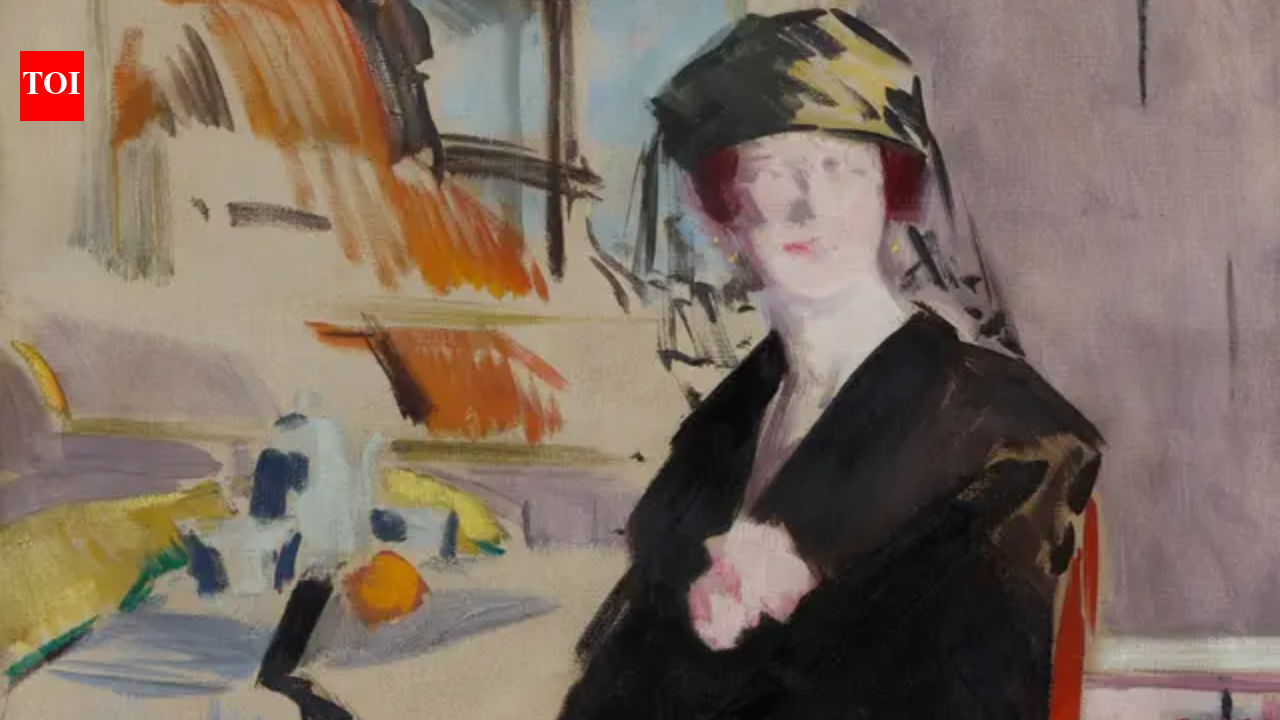
A painting bought for less than $100 at a thrift store in White Plains, New York, in 1966 has been sold for £189,200 at auction after experts identified it as a work by Scottish artist Francis Campbell Boileau Cadell.
asserted
experts → buy → Cadell
According to Edinburgh auction house Lyon & Turnbull, the painting, titled 'Interior: The Lady in Black', remained in art teacher Helene Plotkin’s home for nearly six decades before her son’s investigation helped uncover its identity.
uncertain
investigation → accord → identity
The final price, including the buyer’s premium, was reported by the auction house and art-market publication Artnet News.
asserted
price → include → house
Plotkin, who had an academic background in art history and studio practice, was drawn to the painting’s composition and use of colour when she encountered it while shopping in 1966.
asserted
she → have → 1966
The work depicted an elegantly dressed woman seated in a red chair against a richly decorated interior.
asserted
work → depict → interior
However, its signature was difficult to read, and its label identified it as 'Portrait of Miss Don Wauchope'.
asserted
label → read → Wauchope
Unaware of its true provenance, Plotkin bought the picture and displayed it in her living room for years.
asserted
Plotkin → buy → years
The painting stayed with the family through decades of ordinary domestic life.
asserted
painting → stay → life
Its significance came to light only after Plotkin’s son, Barry, began researching it in 2025, according to Artnet News.
uncertain
son → come → News
He used Google’s artificial intelligence assistant Gemini to examine a photograph of the work.
asserted
He → use → work
The tool helped him decipher the signature and suggested that he investigate a label on the back of the canvas.
uncertain
he → help → canvas
That clue led the family to historical auction records.
asserted
clue → lead → records
The painting had been sold at Christie’s in London on March 18, 1966, for £21, under the incorrect title 'Portrait of Miss Don Wauchope'.
asserted
painting → sell → Wauchope
The record established an earlier point in the artwork’s history, although it remains unclear how the painting moved from the auction market to a thrift store in New York within months.
uncertain
painting → establish → months
The family then approached Lyon & Turnbull, whose specialists assessed the painting and confirmed its attribution to Cadell.
asserted
specialists → approach → Cadell
The identification also corrected the name of the woman shown in the work: she was May Easter, one of the artist’s models, rather than Bethia Hamilton Don Wauchope.
uncertain
she → correct → Wauchope
The auction house consequently gave the painting its present title, 'Interior: The Lady in Black'.
asserted
house → give → Black
Cadell (1883–1937) was one of the Scottish Colourists, a group of four painters associated with bold colour and modern approaches to composition.
asserted
Cadell → associate → composition
The group also included Samuel John Peploe, John Duncan Fergusson and George Leslie Hunter.
asserted
group → include → Peploe
Cadell was particularly known for paintings of Edinburgh interiors, portraits and still lifes.
asserted
Cadell → know → interiors
According to Lyon & Turnbull’s specialist analysis, 'Interior: The Lady in Black' was created during the 1920s, at the height of Cadell’s career.
uncertain
Interior → accord → career
It depicts his north-facing studio at 6 Ainslie Place in Edinburgh’s Georgian New Town, with a view towards Fife.
asserted
It → depict → Fife
The artist bought the property in 1920, and its stylishly decorated rooms became recurring subjects in his work.
asserted
rooms → buy → work
The painting brings together several features associated with Cadell’s interiors: lilac walls, a polished black floor, mirrors, an ornate Louis XV-style armchair and a blue-and-white coffee set.
asserted
painting → bring → interiors
A closed black fan tied with ribbon rests on a white tablecloth.
asserted
fan → tie → tablecloth
Easter sits at the centre of the composition, wearing black clothing accented by a pink rose at her neckline.
asserted
Easter → sit → neckline
Her red hair and golden headwear add contrasting colour to the scene.
asserted
hair → add → scene
The vivid red chair is another defining element.
asserted
chair → define → ?
Lyon & Turnbull notes that Cadell used similar chairs as striking focal points in other works, and that fellow Scottish Colourist Peploe also incorporated the motif into some of his paintings.
asserted
Peploe → note → paintings
Cadell’s brushwork shifts between clear detail and simplified forms, using areas of bright colour to guide the viewer’s eye through the room.
asserted
brushwork → shift → room
Lyon & Turnbull included the painting in its Scottish Paintings & Sculpture auction in Edinburgh on June 4, 2026.
asserted
Lyon → include → June
It sold for £189,200, including the buyer’s premium, within its pre-sale estimate of £150,000 to £200,000.
asserted
It → sell → 200,000
Artnet News reported the price as approximately $254,000.
asserted
News → report → 254,000
The sale represents a striking change in the painting’s fortunes.
asserted
sale → represent → fortunes
In 1966, Christie’s sold it for £21; six decades later, it fetched nearly £190,000.
asserted
it → sell → 190,000
The discovery depended on the combination of historical records, technology and specialist art expertise.
asserted
discovery → depend → records
AI helped the family identify a potentially significant signature, but the attribution was confirmed by auction-house specialists rather than by the tool alone.
asserted
attribution → help → tool
The painting’s earlier auction history also helped establish its provenance, while the revised identification of Easter clarified the subject.
asserted
identification → help → subject
 The Aporia