-
Click here to listen to this article -
The reporter may have misheard the comment, or maybe the person being quoted actually said it, or something odd happened in the editing process.
For the record:
4:45 p.m. Sept. 9, 2026A previous version of the story misspelled the name of the curator of a new exhibit at the California Museum in Sacramento.
uncertain
version → click → Sacramento
Whatever: This is what appeared in the Feb. 20, 1985, edition of the Oakland Tribune, quoting a UC Berkeley professor about a protest against immigration sweeps in the Bay Area.
asserted
what → appear → Area
“This probably won’t stop the Iron Ass [federal government] from making raids in the Eastbay.”
asserted
This → stop → Eastbay
“Iron Ass” is how someone might hear the acronym INS, the Immigration and Naturalization Service, the forerunner to ICE.
uncertain
someone → hear → ICE
And now, 40 years on, it fits right into the kind of angry, derisory language many Americans use for the present-day hammer-handed operations of federal immigration officers, around the country, especially here in California.
asserted
Americans → fit → California
California has always been — and that’s a couple of centuries of “always” — at the fulcrum of the immigration-deportation seesaw in the U.S., with national policies yo-yoing between kicking workers out and inviting them in.
asserted
policies → ’ → them
Consider the foreign-born who joined the Gold Rush, the Chinese railroad workers, and still and always the Latino population along the long, wide international border.
asserted
who → consider → border
That underlies the name of a new exhibition at the California Museum in Sacramento, “Help Wanted/Leave Now!” about the “revolving door” of programs and practices that have alternately enticed and expelled workers, legal and undocumented.
asserted
that → underlie → workers
The U.S. border with Mexico represents a political borderline but it cannot sever many decades of complicated history and culture.
asserted
it → represent → history
And it’s left us with endless paradoxes and contradictions of who belongs where, with the U.S. government shifting to and fro on deciding and enforcing that, depending on the American economy, and American politics.
asserted
government → leave → economy
“We have historically recruited foreign workers who set down roots, become members of the community, and then, when there’s an economic downturn or it becomes politically expedient, it’s kind of a revolving door.”
asserted
it → recruit → community
The endless argument is that undocumented immigrants, who work for less because of their needs and their vulnerability, take jobs that Americans will, or that Americans won’t do.
asserted
Americans → work → that
Something else Americans won’t do: pay higher prices for food, 90 years ago or now.
asserted
Americans → do → food
Last year, the Kansas City Federal Reserve bank, one of 12 regional Feds, noted on its website, “Historically, the supply of U.S.-born farm workers has not been sufficient to meet demand for farm jobs at the going wage rate, contributing to a largely foreign-born workforce.”
asserted
supply → note → workforce
Even the H-2A legal process for hiring seasonal foreign workers “would likely be more expensive than employing undocumented workers.”
asserted
process → hire → workers
Body camera footage and forensically recovered texts, which provide a window into the mindset of agents who conducted raids throughout the L.A. area, were detailed in a 37-page motion for a preliminary injunction filed Monday.
asserted
who → recover → injunction
A 1924 immigration law that created the Border Patrol also revealingly put it under the control of the federal labor department.
asserted
that → create → department
Cheaper Mexican workers had been welcomed during World War I, and were still coming north more casually back then, even as a U.S. labor group was beginning to agitate for organizing American migrant farmworkers.
asserted
group → welcome → farmworkers
But when the 1929 market crash and the Depression knifed the American economy, the blame for unemployment in the Southwest and California in particular fell on these Mexicans, and the government’s “Mexican Repatriation” program sent hundreds of thousands back to Mexico, some voluntarily, some not, and some numbers of them American citizens.
asserted
numbers → knife → them
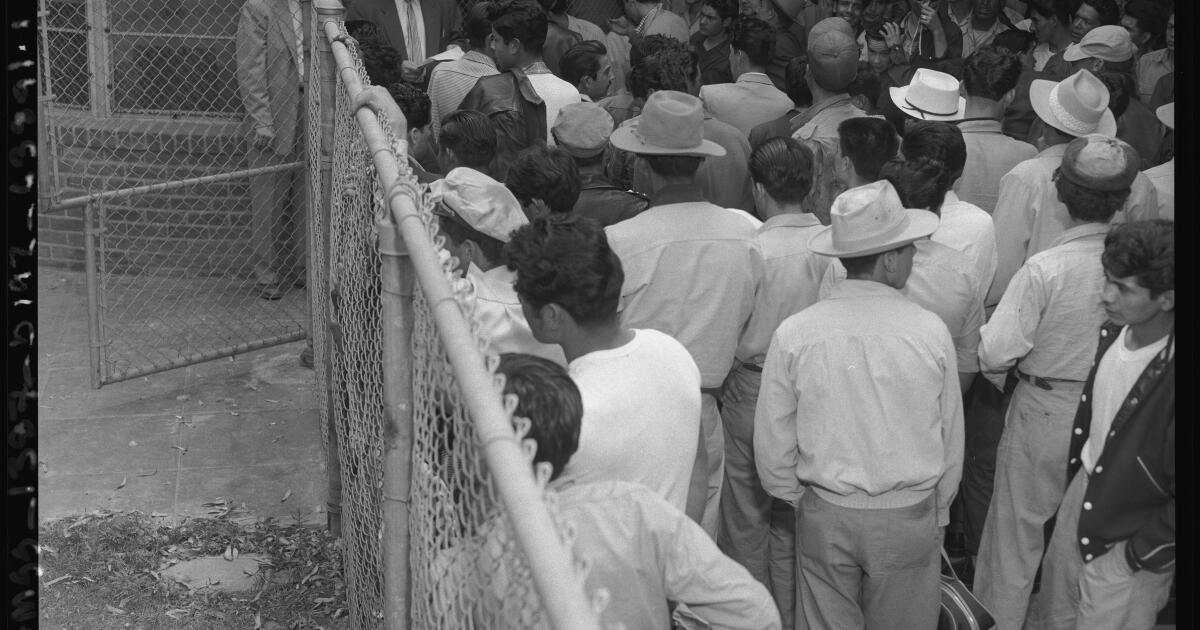
Once, border migration patterns resembled a loop: Thousands of laborers, mostly men, commuted here once or twice a year from Mexico to jobs in the fields, then on to other jobs once harvests were over.
asserted
harvests → resemble → jobs
Then they’d take their earnings home to Mexico as breadwinners and comparatively rich men, and stay until the next year’s season.
asserted
they → take → season
But as U.S. policies over decades squeezed the border shut on this back-and-forth commuting, some workers chose to stay on the side of the border where they could find work, and a number brought their families north to settle, legally or otherwise.
And then that pendulum swung again.
uncertain
pendulum → squeeze → families
In 1942, Americans by the millions left their peacetime jobs for the war and wartime industries, and the “bracero” program — from “brazo,” the Spanish word for “arm” — filled in the gaps in the domestic workforce with contracts for employers of Mexican workers, usually in agriculture or on railroads.
asserted
program → leave → railroads
Under the program, the U.S. screened Mexicans for aptitude for the work, and for attitude.
asserted
U.S. → screen → attitude
Manwaring shared with me the notes of Henry P. Anderson, a historian and farm labor organizer, who took a guided tour of a Calexico bracero processing center in 1958:
asserted
who → share → 1958
“Those deemed expendable were described one at a time: this one is too tall, he is too ‘cocky,’ that one a ‘loafer,’ another ‘lazy and irresponsible,’ he’s a ‘smart aleck,’ this one a ‘ladykiller’ and not ‘peon’ enough.
asserted
one → deem → time
On the other hand the ‘right man,’ according to the guide, was ‘built right.
uncertain
man → accord → guide
He’s a farm worker, you can tell that … he hasn’t got any big ideas.
asserted
he → ’ → ideas
He’s got the right attitude.
asserted
He → get → attitude
He’s humble, not fresh and cocky.
asserted
He → ’ → ?
He’s an Indian type, probably from Jalisco or Guanajuato.’
asserted
He → ’ → Jalisco
Through the bracero program’s 22-year span, as many as 4 million workers came in and presumably went home — though not always; a generation of families came here, or were born here, and stayed.
asserted
generation → come → families
About 15 years after it ended, a former Texas labor commissioner and ranking Labor Department official overseeing the program went public.
asserted
commissioner → end → program
He characterized wages for braceros as unconscionably low, the food substandard and the housing prison-like.
asserted
food → characterize → braceros
The bracero program was definitely created by the farmer who needed to make a dollar.”
asserted
who → create → dollar
And then America’s policy yo-yoed again: In 1953, even as the bracero program was still operating, the federal government launched “Operation Wetback,” to rid the country of undocumented immigrants.
asserted
government → yoe → immigrants
With its heavy-handed “sweeps” of labor camps and factories, American citizens were indiscriminately caught up in the operations, just as ICE is doing now.
asserted
ICE → catch → operations
Consider the breezy tone of a 1931 story in the Los Angeles Evening Citizen News, reporting on 1,200 Mexicans deported from L.A. County in a day, with the casual note that “virtually none of them” was “an undesirable alien — many are American citizens.”
asserted
many → consider → them
“L.A. was really ground zero for these raids during Operation Wetback and the Mexican deportation,” said Manwaring.
asserted
Manwaring → say → Wetback
Those 1,200 deportees were among at least 50,000 deported from L.A. County in five months of 1931 — as much as a third of the county’s Mexican and Mexican American population.
asserted
deportees → deport → population
…and 44 more, not listed.
 The Aporia