World's oldest shipwreck found off coast of Turkey

Read the original at BBC News ↗
BBC News · collected 2026-10-14 · by Kevin Church, Alison Francis, Rebecca Morelle

Quick Summary

Archaeologists have discovered the world's oldest known shipwreck off the coast of Kekova Island near Antalya, Turkey. The wreck dates back 4,400 to 4,700 years and includes more than 30 ceramic storage pots called amphorae, along with three large stone anchors. Prof Hakan Öniz led the expedition that found the ship, which was about 10 meters long and used for trade in the Early Bronze Age, coinciding with the construction of the Great Pyramid. Some of the jars still contain residue from their cargo, possibly olive oil, wine, or tree resins, providing insights into ancient Mediterranean trade routes.
Written locally by qwen2.5:14b on 2026-10-14, using this article's own text rather than the other coverage of the same event (that is the story summary below).

AI analysis runs on qwen2.5:14b, locally

Story summary

Archaeologists have discovered what is believed to be the world's oldest shipwreck off the coast of Turkey, near Kekova Island in Antalya. The wreck dates back between 4,400 and 4,700 years, placing it in the Early Bronze Age, around the time when the Great Pyramid was being constructed.

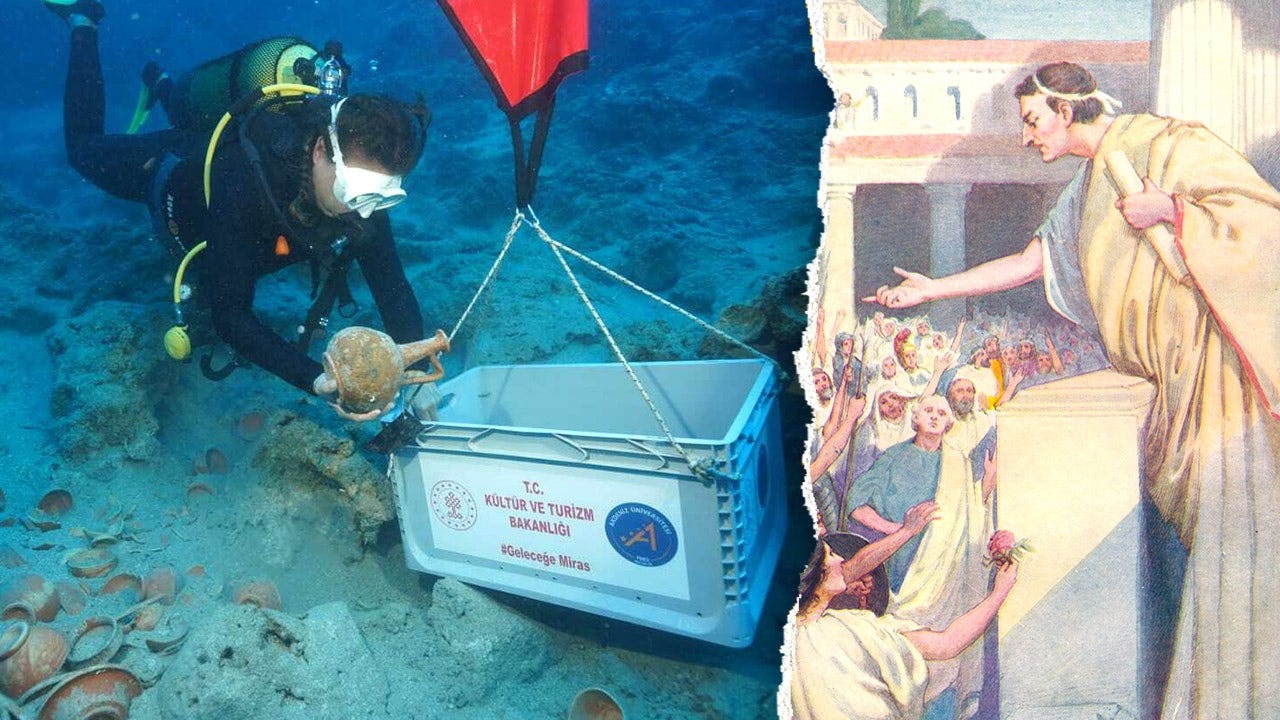
Professor Hakan Öniz from Akdeniz University, leading an expedition with the Mediterranean Archaeology Association, made the discovery. Despite the absence of wooden remains, over 30 ceramic storage pots (amphorae) were found on the sea floor, some still containing traces of their original cargo. The ship is estimated to have been about 10 meters in length and was likely a trade vessel navigating the Mediterranean Sea.

The artifacts are spread across an underwater slope just 30 meters below the surface and include three large stone anchors. Since no organic materials survived, radiocarbon dating could not be used to confirm its age; however, other archaeological evidence supports this estimate. This discovery provides unique insights into ancient maritime trade practices of that era.

Written for “Oldest Shipwreck Found Off Turkey Coast” on 2026-10-14, grounded in this article and the 0 other(s) covering the same event.

Story

📰 Oldest Shipwreck Found Off Turkey Coast
Science · 1 article(s) covering the same event.

Compared with similar articles

This article reads unscored and hedges 9% of its claims. Each row says how that neighbour differs.
Fox News
⚖️ leaning not scored 🔴 13% hedged 3 of 23 📰 publisher trust 70
“The articles describe two different shipwrecks found off the coast of Turkey, with different ages and contents.”

Cite this article

Church, K., Francis, A., & Morelle, R. (2026, October 14). World's oldest shipwreck found off coast of Turkey. BBC News. https://www.bbc.co.uk/news/articles/c6gr80rk1yyko?at_medium=RSS&at_campaign=rss

Dated from the outlet's own feed. Check the original for its byline.

How this article was measured signals, leaning charts, publisher record, byline, topics and claims

Signals How these are calculated →

Claims extracted
32
sentences that state something as happening or true
Uncertain
9%
3 of 32 hedged ("reportedly", "may", "according to")
Leaning
not political
takes no side on a contested political question
Publisher signals
72/100
BBC News's corrections and hedging, across everything collected from it. Not a measure of accuracy.
Outlets on this story
1
Science
Same framing elsewhere
1
articles that frame the event the way this one does
Analyzed 2026-10-14 · how these are computed

How this is being covered How these are calculated →

Article leaning vs. publisher reliability
Source leaning vs. consistency

Publisher

BBC News · 3302 article(s) · 3 correction(s) detected
Running correction rate · 3 correction(s)

Who wrote this

Kevin Church
2 article(s) here · 1 carrying a prediction
🔮 The fact that none of the ship's wood remained meant techniques like radiocarbon dating - which measures a form of carbon in organic materials - could not be used to determine its age.
2026-10-14 · assertive framing · World's oldest shipwreck found off coast of Turkey
🔮 - Published Researchers are using AI to create a vast digital museum of millions of specimens from collections across the UK that they say could "supercharge" our understanding of the natural world.
Also by Kevin Church
Nothing else under this byline is closely related to this article, so these are simply their most recent.
Alison Francis
1 article(s) here · 1 carrying a prediction
🔮 The fact that none of the ship's wood remained meant techniques like radiocarbon dating - which measures a form of carbon in organic materials - could not be used to determine its age.
2026-10-14 · assertive framing · World's oldest shipwreck found off coast of Turkey
The only article under this byline in the corpus.
Rebecca Morelle
1 article(s) here · 1 carrying a prediction
🔮 The fact that none of the ship's wood remained meant techniques like radiocarbon dating - which measures a form of carbon in organic materials - could not be used to determine its age.
2026-10-14 · assertive framing · World's oldest shipwreck found off coast of Turkey
The only article under this byline in the corpus.

Topics

Akdeniz University Antalya Egypt Mediterranean Archaeology Association Turkey

Subjects

Turkey GPE · 4× Kekova PERSON · 2× Öniz PERSON · 2× Akdeniz University ORG · 1× Antalya GPE · 1× Egypt GPE · 1× Hakan Öniz PERSON · 1× Karin Sowada PERSON · 1× Macquarie University ORG · 1× Mediterranean Archaeology Association ORG · 1×

Narrative

The ship's wooden structure has not survived, but the ceramic storage pots it was carrying were lying on the sea floor and, remarkably, some still contain traces of what they held inside. The archaeologists who found the ship say it was about 10m in length and was a trade vessel carrying cargo across the Mediterranean Sea.
framing: assertive · carried by 1 article(s) · first seen 2026-10-14
🔮 The fact that none of the ship's wood remained meant techniques like radiocarbon dating - which measures a form of carbon in organic materials - could not be used to determine its age.
2026-10-14 · BBC News
World's oldest shipwreck found off coast of Turkey · assertive framing

Claims (32 extracted, 3 hedged)

- Published The world's oldest shipwreck has been discovered off the coast of Turkey, archaeologists say. asserted
archaeologists → publish → Turkey
They have dated it to between 4,400 and 4,700 years old, which is the Early Bronze Age, and is around the same time that the Great Pyramid was being built. asserted
Pyramid → date → time
The ship's wooden structure has not survived, but the ceramic storage pots it was carrying were lying on the sea floor and, remarkably, some still contain traces of what they held inside. The archaeologists who found the ship say it was about 10m in length and was a trade vessel carrying cargo across the Mediterranean Sea. asserted
it → survive → Sea
"The shipwreck is a time capsule at the bottom of the sea," said Prof Hakan Öniz, from Akdeniz University in Turkey, who led the Mediterranean Archaeology Association expedition. asserted
who → say → expedition
The artefacts lie scattered across an underwater slope, just 30m beneath the waves. asserted
artefacts → lie → waves
Three large stone anchors were found, as well as more than 30 ceramic storage pots, called amphorae. asserted
anchors → find → pots
The fact that none of the ship's wood remained meant techniques like radiocarbon dating - which measures a form of carbon in organic materials - could not be used to determine its age. uncertain
which → remain → age
Instead, archaeologists analysed the shape of the amphorae. asserted
archaeologists → analyse → amphorae
Because pottery styles have changed over time, differerent styles are linked to particular periods. asserted
styles → change → periods
Öniz said this design matched other amphorae unearthed in Egypt and the Middle East that were known to be 4,400-4,700 years old. asserted
that → say → Egypt
"Comparing the decoration techniques… we can definitely say our wreck is Early Bronze Age. asserted
wreck → compare → techniques
Divers from the expedition brought the pots up to the surface, where they are now being carefully conserved after so many thousands of years underwater. asserted
they → bring → years
Dr Karin Sowada, an archaeologist from Macquarie University, Australia, examined the amphorae after they were recovered. asserted
they → examine → amphorae
Some were intact and she was surprised to see they still contained a viscous, glossy residue. asserted
they → see → residue
"I looked inside and nearly fainted. asserted
I → look → ?
I could not believe how much [residue] was visible. uncertain
residue → believe → ?
a lot of this material was still remaining," she said. asserted
she → remain → material
The team is now working to find out exactly what was being carried in the amphorae. asserted
what → work → amphorae
"It could be olive oil, it could be wine, it could be tree resins," Sowada said. uncertain
Sowada → say → ?
I mean, these jars are huge - they're not things that you just ship away and then never see again. asserted
you → mean → that
People would have emptied these jars on arrival and potentially used them for many, many, many years." The wreck and its cargo are also shedding light on trade in the ancient world. asserted
wreck → empty → world
The archaeologists say the ship started its voyage from somewhere along the eastern coast of the Mediterranean. asserted
ship → say → Mediterranean
They believe is it was taking goods to either the ancient city of Troy, in what is now north-western Turkey, or to the Minoan people in Crete. asserted
what → believe → Crete
Travelling by sea was fraught with danger, particularly around Kekova Island, where the strong currents and winds have claimed many ships. asserted
currents → travel → ships
There are hundreds of wrecks in the area, and the Mediterranean Archaelogy Association specialises in finding and studying them. asserted
Association → be → them
Öniz says that when he is diving on the wreck his first thoughts are about the lives of the people who were connected to this vessel. asserted
who → say → vessel
"We are the first humans who [have] touched these objects after 5,000 years. asserted
who → touch → years
We are always thinking of the sailors... the producers of the amphora and the person who carried the amphora on their shoulders to the ship, and the women who were waiting for their husbands, and they unfortunately couldn't go back." asserted
they → think → husbands
The Kekova discovery now tops the list of the world's oldest shipwrecks. asserted
discovery → top → shipwrecks
Previously, the record holder was a wreck off the coast of Dokos, an island in southern Greece, which dates to about 4,200 years ago. asserted
which → date → Greece
The oldest known shipwreck where some of the wood is still preserved was found in the Black Sea off the coast of Bulgaria. asserted
some → know → Bulgaria
It dates to about 2,400 years ago. asserted
It → date → ?

💬Give feedback
🕘History 🎫Support