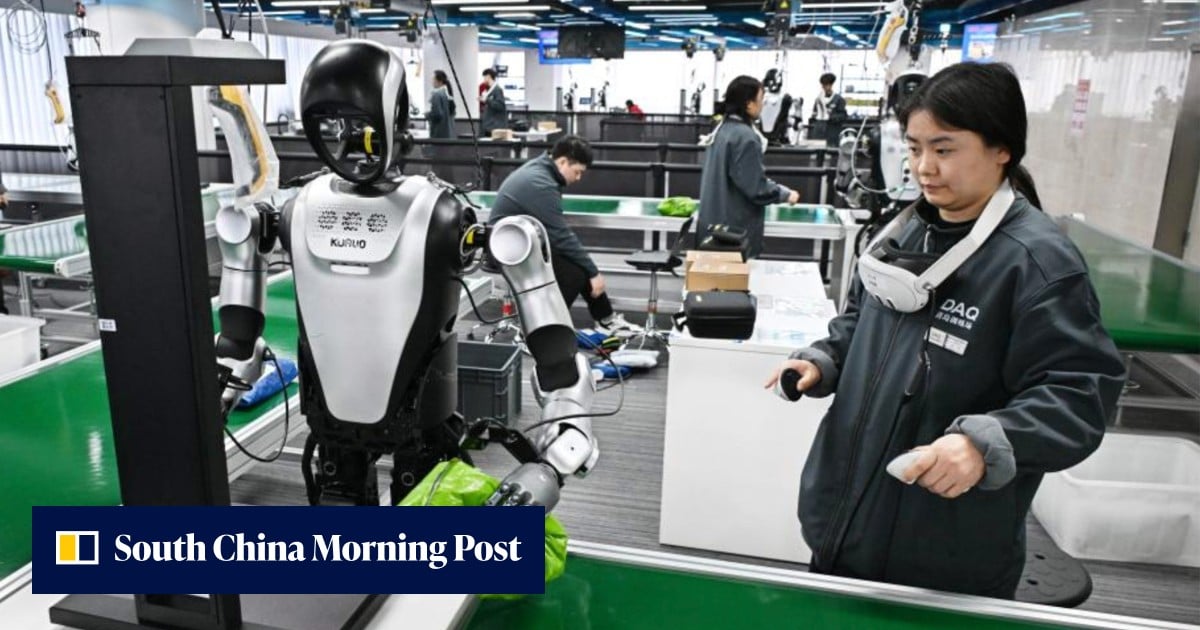
IN China, people are being paid to fold clothes, wipe tables, and open microwave doors.
asserted
people → pay → doors
Wearing virtual reality headsets and exoskeletons, they repeat the movements hundreds of times so humanoid robots can learn them.
asserted
robots → wear → them
Across China, similar centres have people performing other painfully ordinary tasks.
asserted
centres → have → tasks
The work looks mundane, but it produces precious data.
asserted
it → look → data
It may seem like an odd way to begin a story about geopolitics, but like this piece, it offers important clues about who is better placed to ‘win’ the AI race — China or the US?
uncertain
who → seem → race
The winner will have a much larger say in the next world order.
asserted
winner → have → order
Donald Trump insists America must win the AI race, a contest his administration has likened to the Cold War’s ‘space race’.
asserted
administration → insist → race
The analogy is attractive, but Michael Kratsios, Trump’s science adviser, later conceded the obvious problem.
asserted
Kratsios → concede → problem
Unlike the race to the moon, this one has no finish line.
asserted
one → have → line
On the conventional scoreboard, the US remains formidable.
asserted
US → remain → scoreboard
Stanford’s 2026 AI Index counts 59 notable American models in 2025 against China’s 35.
asserted
Index → count → 35
US private AI investment exceeded China’s 23 times over, though this understates Chinese spending through government funds.
asserted
this → exceed → funds
Yet the report says the model performance gap has “effectively closed”, as of March 2026, the leading US model was ahead by just 2.7 per cent.
asserted
model → say → cent
Pakistan does not need to win the AI race.
asserted
Pakistan → need → race
It needs to win from AI.
asserted
It → need → AI
China may be building its advantage by pushing AI into the physical economy.
uncertain
China → build → economy
In March, the US China Economic and Security Review Commission ‘warned’ of a reinforcing loop in China.
asserted
Commission → warn → China
Cheap, open models spread into factories, logistics, and robotics.
asserted
models → spread → factories
Their use generates specialised real-world data, which then improves the models.
asserted
which → generate → models
That could create an advantage proprietary American systems may struggle to match, even if they remain stronger on benchmarks.
uncertain
they → create → benchmarks
Most importantly, China had classified data as a factor of production in 2020.
asserted
China → classify → 2020
Factories are paid for access to workers wearing cameras and sensors, while others earn money performing household tasks to train robots.
asserted
others → pay → robots
On the flip side, America’s AI boom grew out of an internet economy built on years of accumulated online content and behavioural data, where major platforms are accused of “vast surveillance” by the FTC, with users having little control over their data’s use.
asserted
users → grow → use
I am not suggesting China has a better privacy regime.
asserted
China → suggest → regime
It does not.
asserted
It → do → ?
The point is that China is producing, pricing, and feeding data back into industry, building an ecosystem that could give it an immense edge over the US.
uncertain
that → produce → US
And it already has the machinery.
asserted
it → have → machinery
China had more than two million industrial robots operating by 2024 and installed 354,000 in 2025 alone.
asserted
China → have → 2025
According to the International Federation of Robotics, China accounted for 59pc of new industrial robot installations worldwide in 2025.
uncertain
China → accord → 2025
The real advantage may, therefore, be the ecosystem itself, ie, factories produce robots, robots produce data, data improves AI, and AI improves factories.
uncertain
AI → produce → factories
Then comes energy, as I argued earlier in these pages.
asserted
I → come → pages
The International Energy Agency (IEA) expects data centre electricity use to nearly double to 950 terawatt-hours by 2030.
asserted
use → expect → 2030
Whoever can expand reliable, affordable power fastest will have an edge in building the AI ecosystem.
asserted
expand → expand → ecosystem
In the US, data centres are expected to account for nearly half of electricity demand growth to the end of the decade, while natural gas supplies more than 40pc of their electricity.
asserted
gas → expect → electricity
Grid delays are pushing developers towards on-site gas generation.
asserted
delays → push → generation
But the IEA says ensuring reliable supply requires generating capacity 30pc to 70pc above demand, while turbine shortages may undermine hopes of getting power faster.
uncertain
shortages → say → power
To its advantage, China accounts for around 85pc of global solar supply chain production capacity and 80pc of lithium-ion battery capacity.
asserted
China → account → capacity
It added nearly 500 gigawatts of renewable capacity in 2025 alone.
asserted
It → add → 2025
The idea isn’t to romanticise the figurative ‘Chinese model’, considering they still use coal to supply nearly 70pc of the electricity used by Chinese data centres.
asserted
they → romanticise → centres
China manufactures much of the machinery needed to generate and store the next unit of electricity.
asserted
China → manufacture → electricity
…and 20 more, not listed.
 The Aporia