When it comes to train travel, inventive spirits have never let challenging terrain get in the way.
asserted
terrain → come → way
Mountains have been scaled, valleys crossed and cities traversed – even if that means the creation of a railway that appears to be hanging upside down.
asserted
that → scale → railway
Just look at Argentina, which now has a train that can transport you through the Andes utilising the power of the sun alone.
asserted
that → look → sun
Ecuador, meanwhile, has one that seems to defy logic as it zigzags up an almost impossibly steep slope; in Cambodia, strange contraptions made of bamboo are used to ferry passengers along ancient tracks first laid by the French.
asserted
contraptions → have → French
There are scenic trains, spectacular trains, luxurious trains – and then there are some that are, well, almost beyond description.
asserted
that → be → description
Here’s our selection of the 10 most intriguing on Earth, each more weird and wonderful than the last.
asserted
each → ’ → last
Here comes the sun – or rather, the train powered by the sun, a futuristic venture bringing new life and energy to an ancient route through the sacred Quebrada de Humahuaca region in the Andes.
asserted
sun → come → Andes
The solar-powered two-carriage train is the first of its kind in South America and a genuine trail-blazer.
asserted
train → power → America
It runs along a 42-kilometre route connecting remote indigenous communities in the Jujuy province of Argentina and is powered by lithium batteries that are charged by solar panels.
asserted
that → run → panels
Sustainable, slow-paced and scenic, the train launched in 2024 and has recently added wine and dark skies-themed journeys.
asserted
train → launch → journeys
A ticket covering all six stations on the line costs $US45 ($65); trensolar.com.ar; dexotic.com
Gondola Carril Ferrobus, Chile
Less state-of-the-art, but incredibly inventive nonetheless, is the Ferrobus in South America, a hybrid train-bus option found in mountainous regions of Bolivia, Chile and Colombia.
asserted
Ferrobus → cover → Bolivia
This form of transport involves the use of old bus bodies furnished with steel wheels that run on train tracks.
asserted
that → involve → tracks
Popular in remote spots, these journeys can be hairy – but certainly tick the what-an-experience box.
asserted
journeys → tick → box
A tourist-friendly choice is Chile’s Gondola Carril which climbs a 34-kilometre stretch of track north of Santiago.
asserted
which → climb → Santiago
Los Andes to Rio Blanco return costs 50,000 Chilean pesos ($74); trendelrecuerdo.cl/gondola
DMV Road-Rail hybrid, Japan
In Japan (where else?) the Ferrobus concept is taken further with the DMV, an extraordinary Dual-Mode Vehicle able to operate on ordinary asphalt roads – and regular railway tracks.
asserted
concept → cost → roads
Operated by Asa Coast Railway on the island of Shikoku, the service connects rural coastal towns along a route of 48 kilometres, six of which are train tracks.
asserted
six → operate → which
At the crucial moment of transition, the front rubber tyres are lifted off the ground as steel rail wheels are lowered.
asserted
wheels → lift → ground
The whole process takes 15 seconds.
asserted
process → take → seconds
Tickets from ¥200-2400 ($2-$22); asatetu.com/en
POKEMON with YOU Train, Japan
Technological prowess aside, Japan is also famed for being ever so slightly… eccentric.
asserted
Japan → fame → Train
Testament to which is this vibrantly decorated train that’s a consummate celebration of the Pokemon character, Pikachu.
asserted
that → decorate → character
Yellow on the outside, the train – from floor to walls to curtains – is packed with visual references to this much-loved anime icon.
asserted
train → pack → icon
Passengers can sit and smile at it all, though younger ones may prefer to head for the Pikachu-themed playroom.
uncertain
ones → sit → playroom
The train operates in Tohoku.
asserted
train → operate → Tohoku
The two-hour trip from Ichinoseki to Kesennuma costs ¥1700 ($15); jreast.co.jp/en
‘Flying Train’, Germany
Another region traditionally lauded for its technological know-how, Germany is home to the extraordinary Wuppertaler Schwebebahn, a train literally suspended from an elevated monorail running for 13 kilometres through the city.
asserted
Germany → cost → city
It looks like something from a sci-fi film, though it was actually opened in 1901 and serves both as a vital public transport artery and a prime tourist attraction.
asserted
it → look → artery
A 24-hour ticket costs €7.60 ($12), from station machines; schwebebahn.de/en
Optics Valley Photon (Skyrail), China
Train innovation superpower China has its own version of Wuppertal’s suspended train, though this one also has a transparent floor so travellers can admire the views of city and countryside directly beneath them in and around Wuhan in Hubei province.
asserted
travellers → cost → province
To add to the frisson, the train is driverless.
asserted
train → add → frisson
A similar, newer train operates in Chengdu in Sichuan.
asserted
train → operate → Sichuan
A single ride on the monorail costs ¥30 ($6.45); crecg.com
Schwyz-Stoos funicular, Switzerland
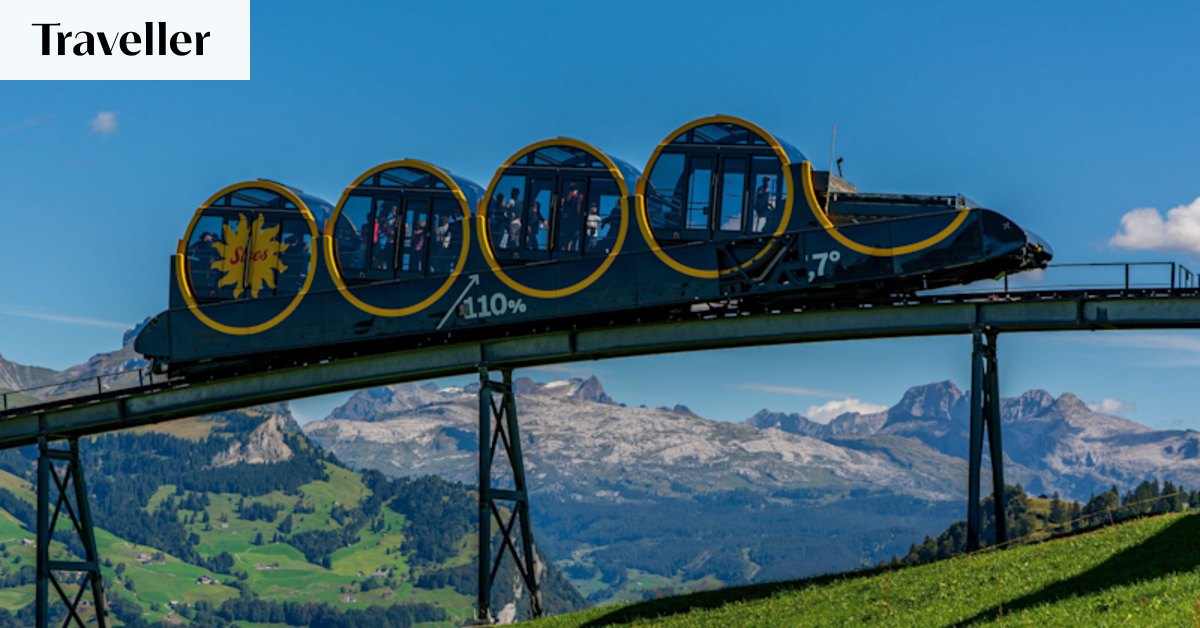
Train carriages do not generally resemble beer barrels – those attached to the Schwyz-Stoos funicular, however, do.
asserted
those → cost → funicular
This is because as the train ascends almost 750 metres at gradients of up to 110 per cent – the steepest in the world – and the barrel-like carriages rotate, thereby keeping passengers upright.
asserted
carriages → ascend → passengers
It is a remarkable feat of engineering marvelled by all who use it and much prized by the residents of the isolated mountain community of Stoos which it serves.
asserted
it → marvel → which
A round-trip costs CHF23.20 ($40), purchasable at Schwyz station; stoos.ch/en
Devil’s Nose (Nariz del Diablo), Ecuador
After a temporary closure following a landslide, the Devil’s Nose train in Ecuador is once again astonishing passengers with an ascent up what looks like a vertical wall of rock between Alausi and Sibambe in the Andes.
asserted
what → cost → Andes
The climb – more than 500 metres over some 11 kilometres – is achieved through a remarkable zigzag system which enables the train to move upwards in a jagged motion facing first forwards and then backwards and repeating several times.
asserted
which → achieve → motion
Stunning views, but nerves of steel required.
asserted
nerves → require → steel
A round-trip costs $US30 ($43), from Alausí station; trenecuador.org/en
Bamboo Train (Norry), Cambodia
The extraordinary-looking contraptions running along a number of tracks in Cambodia prove once again that necessity is the mother of invention.
asserted
necessity → cost → invention
With many lines badly damaged in the country’s civil war, creative spirits found a way of using stretches that were still good with improvised vehicles comprising a wooden frame, scrap metal and bamboo slats powered by motorbike, lawnmower, or tractor engines.
asserted
that → damage → engines
The platforms accommodate four people and travel at up to 50km/h.
asserted
platforms → accommodate → km/h
A five-kilometre round-trip from Ou Dambong Village south of Battambang costs $US5 ($7); available on location
The Gulflander, Australia
Related Article
Trains normally connect places people want to visit.
asserted
people → cost → places
The Gulflander, affectionately known as “the train that goes from nowhere to nowhere”, is a 151-kilometre stretch of track completely cut off from the rest of the Australian rail network.
asserted
that → know → network
Built during the 1800s to serve a gold rush that never happened, it runs between the tiny towns of Normanton and Croydon on a five-hour journey offering a unique railway experience through crocodile-inhabited wetlands and vast expanses of Queensland Outback.
asserted
it → build → Outback
…and 2 more, not listed.
 The Aporia