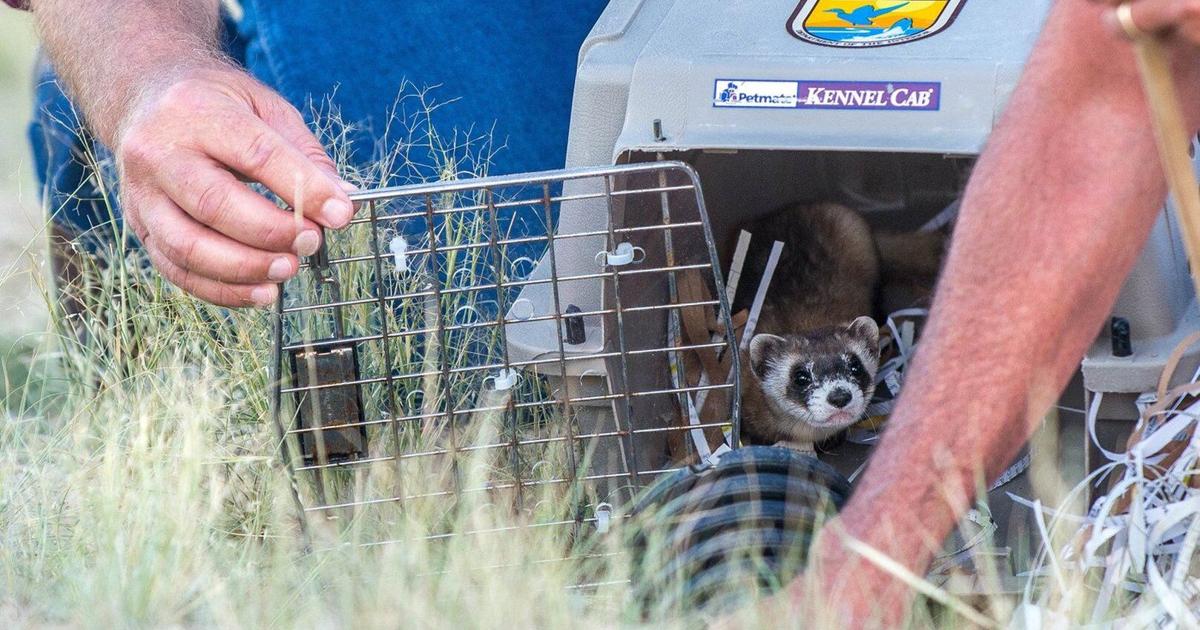
Wyoming wildlife managers are reporting that no black-footed ferrets are being detected in the cradle of the species’ conservation: the Absaroka Range foothills outside of Meeteetse, where the ferrets were saved after presumed extinction in the 1980s.
asserted
ferrets → report → 1980s
A tough combination of plague and drought — both big issues for the embattled western species — are suspected causes of a population collapse in the Meeteetse area, where wildlife managers returned ferrets to the wild in 2016 after a three-decade-long absence.
asserted
managers → suspect → absence
It’s not assured that the reintroduced population is completely gone, but it’s not looking promising, Wyoming Game and Fish Department small carnivore biologist Andy Gygli said.
asserted
Gygli → assure → ?
“We spent a couple hundred hours of effort surveying 4,000 to 5,000 acres of the Meeteetse reintroduction area,” Gygli said.
asserted
Gygli → spend → area
“We didn’t see any ferrets.”
asserted
We → see → ferrets
Sylvatic plague flared in the region in 2018 and 2019, and ferret numbers plunged to just one confirmed animal in 2020.
asserted
numbers → flare → 2020
Subsequent releases of captive-raised ferrets, including 18 animals in 2022, helped the small population temporarily recover, but plague struck again in 2023.
asserted
plague → raise → 2023
By 2025, spotlighting surveyors again detected just a single ferret.
asserted
surveyors → spotlight → ferret
Ferrets bottoming out and potentially disappearing struck Meeteetse rancher Allen Hogg as a big letdown.
asserted
Ferrets → bottom → letdown
“I’m really disappointed, of course,” Hogg told WyoFile.
asserted
Hogg → ’m → WyoFile
“They might be gone.
uncertain
They → go → ?
But just because they didn’t find them doesn’t mean they’re not there, either.
asserted
they → find → them
I’m not saying all hope is lost.”
asserted
hope → say → ?
The Meeteetse rancher’s family name became synonymous with black-footed ferrets 45 years ago, when a blue heeler owned by his parents brought a dead weasel-like critter home.
asserted
heeler → become → critter
Subsequently, biologists found more than 100 other black-footed ferrets — presumed extinct for the two years prior — on and near the family ranch.
asserted
biologists → find → ranch
The exact cause of the ferrets’ absence during the surveys is unknown, but recently drought in the Bighorn Basin walloped their primary prey species, prairie dogs.
asserted
drought → wallop → species
“We’ve heard a lot about deer, elk, pronghorn and cattle having hard times,” Gygli said.
asserted
Gygli → hear → times
“It’s the same with our other herbivores.
asserted
It → ’ → herbivores
Prairie dogs also have to eat, and lack of (vegetation) coverage can result in low recruitment, which can result in downstream effects.
asserted
which → have → effects
They, too, haven’t had enough to eat.
asserted
They → have → enough
Indirectly, drought caused the numbers of rare mustelids in the world’s largest wild black-footed ferret population, in South Dakota’s Conata Basin/Badlands, to plummet from 250 to 70 animals between 2024 and 2025, according to biologist and ferret expert Travis Livieri, who studies that population.
uncertain
who → cause → population
“In my 30 years of doing this, I’ve never seen (drought) this bad, where prairie dogs failed to reproduce at a high rate,” Livieri said.
asserted
Livieri → do → rate
“The prairie dogs don’t do well, the ferrets won’t do well.”
asserted
ferrets → do → ?
Prairie dogs in the Meeteetse area also continue to struggle, Gygli said.
asserted
Gygli → continue → area
After the 2023 bout of sylvatic plague, Game and Fish surveys mapped prairie dog colonies and found only 3,800 acres in active use — down from the 6,000-plus acres that were mapped around the time of the 2016 reintroduction.
asserted
that → map → reintroduction
The habitat conditions were bad enough for black-footed ferrets this summer that Gygli diverted 10 captive-raised animals that were going to be released in Meeteetse to the Shirley Basin, site of a rare ferret reintroduction success story.
asserted
that → divert → story
His rationale was that keeping ferrets out of the reintroduction area would relieve predation pressure on prairie dogs, helping them recover — and ultimately again support ferrets.
asserted
them → keep → ferrets
“There are prairie dogs there,” Gygli said.
asserted
Gygli → be → ?
“They just need some time and some good conditions to come back.
asserted
They → need → time
Rodents reproduce.
asserted
Rodents → reproduce → ?
That’s part of their strategy — they reproduce really quick.”
asserted
they → ’ → strategy
Wildlife managers are also assisting the recovery with prophylactic insecticide treatments to kill fleas and guard against plague.
asserted
managers → assist → plague
On average, they treat roughly 4,000 acres annually — a roughly $100,000 expense, with the lion’s share covered by the Bureau of Land Management, Gygli said.
asserted
Gygli → treat → Management
For now, the Meeteetse reintroduction area might stay free of ferrets intentionally.
uncertain
area → stay → ferrets
The last time that happened, in 1986, there were wildly different circumstances.
asserted
that → happen → 1986
It was a rescue mission to save the species.
asserted
It → save → species
Although the federal and state wildlife officials found 124 black-footed ferrets after Shep the ranch dog’s remarkable rediscovery, the population plummeted in 1985 from a combination of plague and canine distemper.
asserted
population → find → plague
Retired Game and Fish Nongame Wildlife Supervisor Bob Oakleaf was on the front lines at the time, and he helped develop a contingency plan that outlined when wildlife officials should step in and whisk the remaining animals from the wild.
asserted
officials → develop → wild
Taking every last ferret into captivity from their only stronghold was a controversial decision, he recalled.
asserted
he → take → stronghold
“There was a lot of blockage in the Game and Fish,” Oakleaf told WyoFile.
asserted
Oakleaf → be → WyoFile
…and 21 more, not listed.
 The Aporia