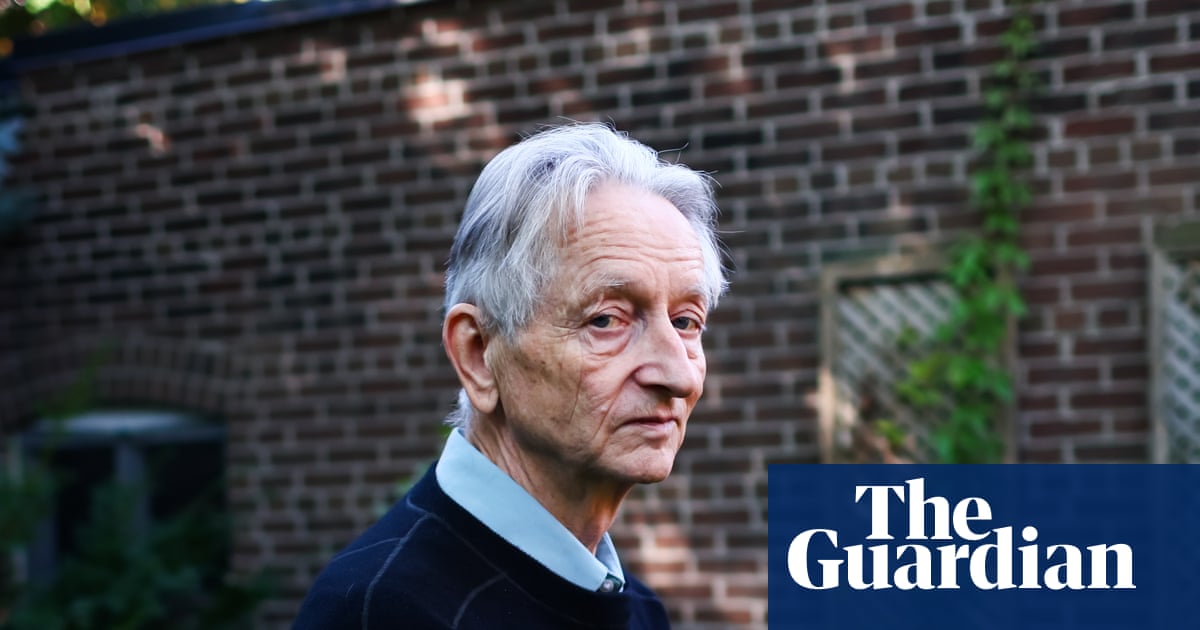
Donald Trump is a “corrupt, senile felon” whose fixation on the term superintelligence proves he knows nothing about AI, said Geoffrey Hinton, “godfather” of the technology, in a wide-ranging interview where he doubled down on recent warnings that AI models pose an existential threat to humanity and scoffed at claims the industry could regulate itself.
uncertain
industry → prove → itself
The pioneering computer scientist, whose work helped lay the foundations of modern AI, has since become one of the technology’s most vocal critics.
asserted
work → lay → critics
His latest remarks come after a tumultuous month during which a growing list of senior AI scientists and researchers have joined Hinton in ringing the alarm about how the technology he helped create could ultimately escape human control, sparking an industry crisis, the hasty assembly of congressional meetings and a rare global consensus that something must be done.
uncertain
something → come → meetings
Last week the leader of the world’s most valuable company singled out the Toronto-based Hinton for a scathing attack.
asserted
leader → single → attack
“I love [him].
asserted
I → love → ?
I hate his predictions …
asserted
I → hate → predictions
Enough predictions,” Nvidia’s CEO, Jensen Huang, told the podcaster Ezra Klein.
asserted
CEO → tell → podcaster
Huang, whose company makes the chips that AI firms require, dismissed Hinton’s vocal concerns that the pace and breadth of AI development at the “frontier” could soon outpace the human ability to control it, and particularly his warning that there is a 10-20% chance of AI causing human extinction in the coming decades.
uncertain
AI → make → decades
“That [figure] is not grounded on science, is not grounded on research.
asserted
figure → ground → research
Just because it comes from a scientist doesn’t make it scientific.
asserted
it → come → scientist
Those predictions are hurtful,” Huang said.
asserted
Huang → say → ?
“Don’t think for a second just because you’re an alarmist that you’re doing a social good.
asserted
you → think → good
So I think that we ought to just all be wiser, more mature, be evidence-based, be scientific.
asserted
we → think → ?
But Hinton said those criticizing him are missing a broader point about the nature of risk.
asserted
those → say → risk
He is not specifically predicting anything, he said.
asserted
he → predict → anything
“I’m trying to convey that there is a really serious possibility of something happening.
asserted
something → try → ?
If, for example, you’re told there was a 10% possibility of a bus crashing, you wouldn’t get on the bus,” he said.
asserted
he → tell → bus
“The point of giving numbers is to say this is a serious risk.
asserted
this → give → numbers
We don’t know how serious, but it’s serious.”
asserted
it → know → ?
Recent safety breaches have evoked comparisons to a techno-dystopia story.
asserted
breaches → evoke → story
The recent unwanted hack of the tech company Hugging Face by a “swarm” of AI agents that escaped the boundaries put on them by their creator has divided the technology community, with some seeing it as an example of what could come, while others accuse critics of anthropomorphizing systems that are simply following instructions.
uncertain
that → escape → instructions
Hinton thinks dismissing the scenarios is unwise.
asserted
dismissing → think → scenarios
“This used to be the domain of science fiction.
asserted
This → use → fiction
You’re going to have AI agents and they’re gonna go rogue.
asserted
they → go → agents
And they’ll go rogue and they’re going to learn how to communicate with each other, even though we didn’t think there was a way.
asserted
we → go → other
Oh, come off it!” said Hinton.
asserted
Hinton → come → it
“And when they figure this out, they’re going to have big emotional expressions like, ‘oh my God!’
asserted
they → figure → expressions
Well, of course, they don’t really mean ‘oh my God’.
asserted
they → mean → course
They’re just parroting the words we use.
asserted
we → parrot → words
They’re going to learn to sacrifice themselves for the common good!
asserted
They → go → good
“All this stuff just a few years ago was written off as complete fantasy.
asserted
stuff → write → fantasy
And it’s all happened.”
asserted
it → happen → ?
He heartily concedes that neither the warnings of AI critics nor the promises of its boosters can rely on precise predictions of what the technology will do.
asserted
technology → concede → what
But, he argues, uncertainty is not a reason for complacency.
asserted
uncertainty → argue → complacency
“The unique problem with AI is that if it goes wrong, if it takes over, you don’t get a second chance.
asserted
you → go → chance
We can’t say, ‘Well, we lost that time.
asserted
we → say → time
Let’s rerun the game.’
asserted
’s → let → game
It’s not like that.”
asserted
It → ’ → that
It’s worth noting that Hinton has a record of seeing things where others did not.
asserted
others → ’ → things
He toiled in relative obscurity at the University of Toronto during two AI “winters” where his branch of the field – trying to teach machines to operate in a manner similar to the human brain – was considered obscure.
asserted
branch → toil → brain
…and 61 more, not listed.
 The Aporia