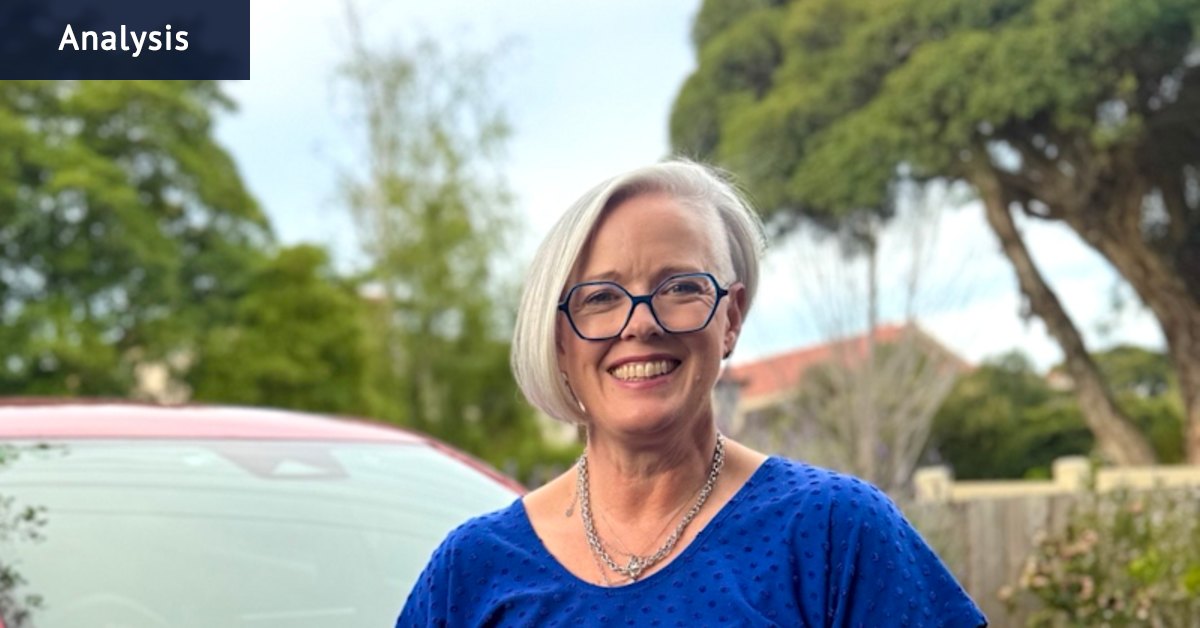
When my old Toyota Corolla was written off after being hit, I found myself scrolling through numerous car sales websites trying to find a replacement.
asserted
myself → write → replacement
It would take two years to finally find one that I could afford.
uncertain
I → take → that
I settled on a 2018 Honda Jazz: basic for my needs and driveable.
asserted
I → settle → needs
I did consider buying an EV but the upfront costs were too high and, frankly, there weren’t any affordable second-hand EVs.
asserted
costs → consider → EV
Now, with more second-hand EVs on the market, and with skyrocketing petrol prices, I have wondered if an EV would have been the better option.
asserted
EV → skyrocket → prices
After trading in her 21-year-old BMW for her EV MG4 two years ago, Imogen Lamport said she will never go back to an internal combustion engine (ICE) vehicle.
asserted
she → trade → vehicle
‘It takes 20 minutes to charge – enough time for me to go inside, use a toilet, buy a drink and a snack, and walk back to my car.
asserted
me → take → car
Lamport paid $40,000 for her EV, which she said was an average price at the time for what was available.
asserted
what → pay → time
“I decided to go EV.
asserted
I → decide → ?
There’s no fumes or noise, and because we have solar panels it’s mostly free to run.
asserted
it → ’ → panels
I recently had my first two-year service and it cost $270.”
asserted
it → have → 270
Another reason for the change was the rising costs of servicing, petrol and maintenance.
asserted
reason → rise → servicing
“I paid around $10k more than an equivalent ICE car but from my calculations it would only take two years to make up the difference.
asserted
it → pay → difference
After my old running costs it’s so much lower now, so it was worth it.”
asserted
it → ’ → costs
Lamport drives mostly around Melbourne.
asserted
Lamport → drive → Melbourne
At home she has installed a 7kW charger in the garage for faster charging, and charges the car once a week.
asserted
she → instal → car
The only long drives are to Canberra to visit her elderly parents.
asserted
drives → visit → parents
On these trips she stops twice after fully charging the car before leaving home.
asserted
she → stop → home
“I visit my elderly parents fairly frequently; my car has a smaller battery, which is perfect for city driving.
asserted
which → visit → driving
It takes me an hour longer depending on where I stop and the speed of the charger.”
asserted
I → take → charger
Her husband Adam recently purchased an EV Zeekr 7X, making the trip to Canberra easier.
asserted
trip → purchase → Canberra
“Now, I only need to stop once,” says Imogen Lamport.
asserted
Lamport → need → ?
“It takes 20 minutes to charge – enough time for me to go inside, use a toilet, buy a drink and a snack, and walk back to my car.
asserted
me → take → car
Almost the same time as I used to take to purchase petrol to get to Canberra.”
asserted
I → use → Canberra
She believes her EV has saved her close to $8000 in the past two years.
asserted
EV → believe → years
“I rarely have to use the public charging network and even then, if I’d had to, it would still have saved me $5000 as the maintenance costs with my BMW, along with petrol, was around $5000 a year.
asserted
costs → use → petrol
“I’d never go back to an ICE car.
asserted
I → go → car
EVs are much nicer to drive, along with being more environmentally friendly and quiet.
asserted
EVs → drive → ?
Even when I do have to use public chargers, it costs me less than half of what I used to pay in petrol.”
asserted
I → have → petrol
A study conducted on behalf of the Electric Vehicle Council found that driving an ICE vehicle with petrol at $2 per litre costs an average of $22.20 per 100 kilometres of driving, rising to $27.75 at $2.50 and $33.30 at $3 per litre.
asserted
driving → conduct → litre
Battery-EV owners charging at 6pm, considered peak period, pay an average of $5.90 per 100 kilometres, dropping to $1.20 for midday charging.
asserted
owners → charge → charging
According to the council, an EV owner could save an average of $3000 a year based on lower charging costs, compared with fuel and fewer parts, which means less maintenance.
uncertain
which → accord → maintenance
Insurance a kicker
While savings are found in running costs, be prepared to pay more insurance.
asserted
savings → find → insurance
In 2026 a comparison test by consumer group Choice found EV cars are generally more expensive to insure.
asserted
cars → find → Choice
Electric vehicle owners pay about 40 per cent, or $843 a year, more than petrol car owners.
asserted
owners → pay → owners
Geelys are the cheapest EVs to insure, with an average cost of $1622 for a new car, and Tesla the most expensive, at an average cost of $2985.
asserted
Tesla → insure → 2985
Milestone EV sales ahead of petrol
The council announced a significant milestone in August 2026: for the first time, battery electric vehicles (BEVs) overtook every other fuel type in Australia’s new car market.
asserted
vehicles → announce → market
BEVs accounted for 25.6 per cent of all new vehicle sales, ahead of petrol at 24.4 per cent and diesel at 22.3 per cent.
asserted
BEVs → account → cent
Combined BEV and plug-in hybrid (PHEV) sales held a 36 per cent share of the new car market.
asserted
sales → plug → market
The Tesla Model Y remained Australia’s best-selling new vehicle, while BYD Australia and New Zealand and Tesla ranked second and third among manufacturers behind Toyota.
asserted
Australia → remain → Toyota
…and 5 more, not listed.
 The Aporia