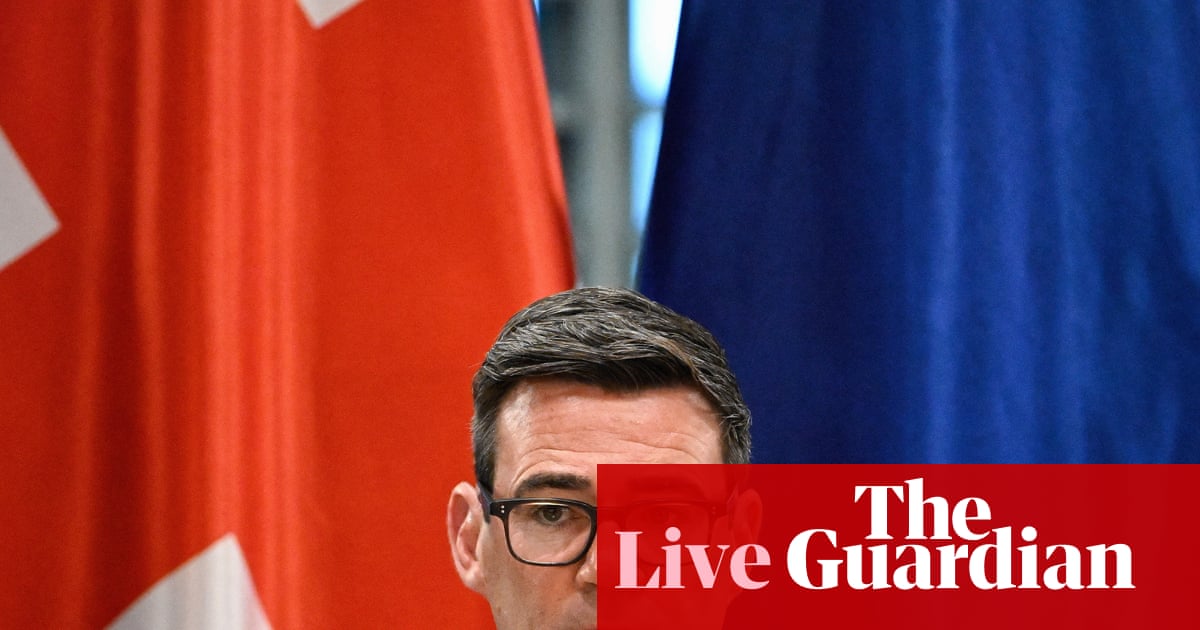
Why the prime minister wants to talk about Brexit again

Read the original at BBC News ↗
BBC News · collected 2026-10-13 · by Chris Mason

Quick Summary

Andy Burnham, the current prime minister, has recently revived discussions about Brexit, arguing that it has caused more harm than good for Britain. Despite previous assurances to stay away from certain EU arrangements like the customs union, he now seeks to "deepen" the UK’s relationship with the EU at an upcoming summit in Brussels. This shift comes as Burnham contemplates including a referendum on leaving or remaining in the European Union in Labour's next election manifesto, while critics argue that voters have already made their decision and deserve political support for it.
Written locally by qwen2.5:14b on 2026-10-13, using this article's own text rather than the other coverage of the same event (that is the story summary below).

AI analysis runs on qwen2.5:14b, locally

Story summary

The Brexit debate has resurfaced in Westminster after years of intense focus on the issue. This began with the Conservative Party's promise in its 2015 manifesto to hold a referendum on EU membership by the end of 2017. Prime Minister David Cameron then negotiated with the European Union for better terms, leading to a referendum held on 23 June 2016 where voters decided to leave the EU. After two general elections in 2017 and 2019, it was only after the tenures of Prime Ministers Theresa May and Boris Johnson that Britain officially left the EU at midnight on 31 January 2020. Despite ongoing tensions, there has been a collective desire to move past Brexit-related discussions since then, reflecting public sentiment for new topics in political discourse.

Written for “Brexit Talks Renewed” on 2026-10-13, grounded in this article and the 0 other(s) covering the same event.
Why this leaning score
The model judged this article politically coded and scored it -0.45, but 2 quote(s) could not be found in the article and the other 1 are attributed speech rather than the article's own narration, so the score is not published.
Written under an earlier scoring contract, which gave a paragraph rather than checkable quotes. Re-analysing this article replaces it.
Leaning score withheld for article 75514: no verified evidence · logged 2026-10-13

Signals How these are calculated →

Claims extracted
41
claim-shaped sentences
Uncertain
15%
6 of 41 hedged
Leaning
withheld
no quote in the article backed the model's score
Correction & hedging signals
72.2
corrections and hedging in what we collected; not a measure of accuracy
Outlets on this story
1
Politics
Narrative spread
1
articles carrying this framing
Analyzed 2026-10-13 · how these are computed

Story

📰 Brexit Talks Renewed
Politics · 1 article(s) covering the same event.

How this is being covered How these are calculated →

Article leaning vs. publisher reliability
Source leaning vs. consistency

Compared with similar articles

This article reads unscored and hedges 15% of its claims. Each row says how that neighbour differs.
BBC News
⚖️ leaning not scored 🔴 5% hedged 1 of 21 📰 publisher trust 72
“The articles discuss different time periods and contexts related to Brexit, with Article A focusing on recent comments by French finance minister Roland Lescure and UK Prime Minister Andy Burnham in 2026, while Article B provides a historical overview of the Brexit process up until 2016.”
Daily Mail
⚖️ leaning not scored 🔴 20% hedged 4 of 20 📰 publisher trust 64
“Article A reports on a French minister's urging for Andy Burnham to reconsider Brexit and PM's visit to Germany, while Article B discusses the historical context of the Brexit debate and its impact over time.”
The Guardian
⚖️ leaning not scored 🔴 20% hedged 3 of 15 📰 publisher trust 68
“The articles discuss different time periods and events related to Brexit rather than a single specific incident.”
Daily Mail
⚖️ leaning not scored 🔴 7% hedged 5 of 75 📰 publisher trust 64
“The articles discuss different time periods and events related to Tony Blair's rise to power in 1997 versus the Brexit process starting from 2015 onwards.”
Daily Mail
⚖️ leaning not scored 🔴 5% hedged 2 of 41 📰 publisher trust 64
“The articles discuss different time periods and contexts related to David Cameron's experiences with Brexit; one is about his birthday celebrations impacted by Brexit a decade later, while the other discusses the initial stages of the Brexit debate and referendum.”
Daily Mail
⚖️ leaning not scored 🔴 0% hedged 0 of 18 📰 publisher trust 64
“Article A discusses Andy Burnham's claim about Russian interference in the Brexit referendum and hints at a push to rejoin the EU. Article B is a general commentary on the history of the Brexit debate, not focusing on any specific recent event involving Burnham.”
Evening Standard
⚖️ Leans left 🔴 5% hedged 1 of 22 📰 publisher trust 66
“The articles discuss different aspects of Brexit and its aftermath over several years rather than a single specific incident on the same day.”
BBC News
⚖️ Leans strongly left 🔴 17% hedged 3 of 18 📰 publisher trust 72
“Article A describes a statement by PM Andy Burnham to the Commons about closer EU ties, while Article B is a retrospective look at the Brexit debate over several years.”
Evening Standard
⚖️ Leans left 🔴 40% hedged 2 of 5 📰 publisher trust 66
“Article A discusses Burnham's call for a closer EU relationship during a Labour conference speech, while Article B is a broader commentary on the Brexit debate over time.”
The Guardian
⚖️ Leans left 🔴 3% hedged 1 of 34 📰 publisher trust 68
“The articles discuss different periods and contexts related to Brexit and UK politics.”

Publisher

BBC News · 3200 article(s) · 3 correction(s) detected
Running correction rate · 3 correction(s)
2026-10-06
Five reasons India's stock market is sinking even when its economy is growing
2026-10-03
Tennessee prison chief to resign after Christa Pike's failed execution, governor says
2026-09-21
Watch: BBC tracks down abusive teacher secretly released early

Who wrote this

Chris Mason
15 article(s) here · 1 carrying a prediction
🔮 And that, you will remember, was merely the start, as years of wrangling began.
2026-10-13 · assertive framing · Why the prime minister wants to talk about Brexit again
🔮 - Published The prime minister is expected to tell the Commons later it would be a "dereliction of duty" to turn down a closer relationship with the European Union - if one can be negotiated with Brussels.
🔮 She arrived in the UK as a child refugee from Somalia in the 1990s, grew up locally in Camden, became a councillor four years ago, the council leader in May and is now Sir Keir Starmer's successor as the MP.
2026-10-09 · assertive framing · Polanski faces greatest crisis of his leadership so far
🔮 Reform UK, for instance, claim it is a "tax cut for multi-millionaires" and that their plan to cut income tax for millions by raising the threshold at which most people start paying it will benefit far more people.
🔮 - Published Kemi Badenoch has said she would rather have another general election than do a deal with Reform UK to secure power, if no party wins the next election.
🔮 The man who was the mayor of Greater Manchester a matter of months ago is now the prime minister, and so finds himself caught up in it all at a local level, a national level and a diplomatic level.
🔮 Speaking at the White House on Monday, Trump said: "I will tell you, I would have said, 'don't let them have bail'.
🔮 The funeral will take place in a few days' time.
🔮 The pitch from Andy Burnham is that "hope comes from honesty," there needs to be "less drift and more direction" and there needs to be a willingness to say "the things politicians usually avoid."
🔮 Prime Minister Andy Burnham, a mayor a matter of months ago, sat next to the most powerful man in the world.
Also by Chris Mason
Nothing else under this byline is closely related to this article, so these are simply their most recent.
All 15 articles by Chris Mason →

Topics

Brexit Brussels Labour Westminster the European Union

Subjects

Brussels GPE · 3× the European Union ORG · 3× Andy Burnham PERSON · 2× Commons ORG · 2× Conservative NORP · 2× David Cameron PERSON · 2× Labour ORG · 2× Boris Johnson PERSON · 1× Theresa May PERSON · 1× Westminster ORG · 1×

Narrative

The former Prime Minister Boris Johnson added that he had asked the same question as Andy Burnham did when he became Foreign Secretary, external "and they replied that there was no evidence of any successful interference in the 2016 referendum, by Russia or any other power".
framing: assertive · carried by 1 article(s) · first seen 2026-10-13
🔮 And that, you will remember, was merely the start, as years of wrangling began.
2026-10-13 · BBC News
Why the prime minister wants to talk about Brexit again · assertive framing

Claims (41 extracted, 6 hedged)

- Published The Brexit debate is back. asserted
debate → publish → ?
For years, it felt like the only thing Westminster talked about. asserted
Westminster → feel → thing
I have had a ringside seat at it all, from the Conservative election victory in 2015, with the party's promise in its manifesto that year to offer "a straight in-out referendum on our membership of the European Union by the end of 2017." asserted
I → have → 2017
Then there was the then Prime Minister David Cameron's negotiation with the European Union to try to secure what he saw as a better deal and then the referendum itself on Thursday, 23 June 2016. asserted
he → be → Thursday
And that, you will remember, was merely the start, as years of wrangling began. asserted
years → remember → wrangling
Two general elections came and went in 2017 and 2019 and it took the two prime ministers after David Cameron, first Theresa May and then Boris Johnson, before the UK left the European Union at 23:00 on Friday, 31 January 2020. uncertain
UK → come → Friday
Political parties picked up that vibe and while their long standing instincts on the EU were there to see if you scratched the surface, there was minimal desire to extemporise about them any time soon. asserted
you → pick → them
With the arrival of Andy Burnham as prime minister, that has changed, despite what he said just a few months before he arrived in Downing Street. asserted
he → change → Street
He has been happy to repeatedly lean into an argument claiming that it is time to "face up to the reality that Brexit has done more harm than good" and "the status quo is not good enough for Britain." asserted
quo → lean → Britain
First he made this case at the Labour Party Conference last month and now he has made it again in the House of Commons. asserted
he → make → Commons
Burnham is attempting to make a two-pronged case. asserted
Burnham → attempt → case
First, in the short term, he wants to "deepen" the UK's relationship with the EU at a summit in Brussels at the end of next month. asserted
he → want → month
He insists such a deepening would be within the promise made by Labour at the last general election that the UK would say no to the customs union, the single market and freedom of movement. asserted
UK → insist → movement
Which brings us onto the second element of his case, in the medium term. asserted
Which → bring → term
What might Labour promise in its next general election manifesto? uncertain
Labour → promise → manifesto
The prime minister told me a fortnight ago the manifesto could promise an in-out referendum. uncertain
manifesto → tell → referendum
In the Commons, he sought to reassure you, whatever your view on Brexit. asserted
view → seek → Brexit
"This country in the next decade needs to know where it's going. asserted
it → need → decade
There are no assumptions here, and as I said, the British public will be the boss of whatever is decided," he said. asserted
he → be → ?
Hang on, say critics, it was decided by voters a decade ago. asserted
it → hang → voters
"They weighed the arguments and made a decision. asserted
They → weigh → decision
The least they are owed is politicians willing to defend it," argues Lord Frost, external, a former Brexit minister and chief Brexit negotiator in the Telegraph. asserted
Frost → owe → Telegraph
The focus of the next five weeks, ahead of a UK-EU Summit in Brussels on Friday 20 November, is what Downing Street sees as short term wins on youth mobility, food and drink, and energy. asserted
Street → see → mobility
Andy Burnham hopes to make an argument that what he will portray as a sensible, pragmatic deepening of the relationship with Brussels can help cut illegal immigration and boost economic growth. asserted
portray → hop → growth
He sought to goad the Conservative leader Kemi Badenoch for seeking to oppose a plan he thinks can contribute to growth. asserted
he → seek → growth
She argued it risked regurgitating yesterday's arguments with little prospect of success. asserted
it → argue → success
And, strikingly, his attempt at goading his opponents went further still. asserted
attempt → goad → opponents
He told The Rest Is Politics podcast that upon arriving in Downing Street, he had asked if there was Russian interference in the Brexit referendum. asserted
he → tell → referendum
"I've had a clear answer that, yes, there was," he claimed, without saying who provided that clear answer or what the evidence for that suggested clarity was. uncertain
evidence → have → clarity
In the Commons, his language appeared a little softer. asserted
language → appear → Commons
He told MPs it was "inconceivable" to think that Russia did not try to interfere. asserted
Russia → tell → MPs
A double negative deployed this time, about alleged attempts at interference. asserted
negative → deploy → interference
His political opponents were already pouncing. asserted
opponents → pounce → ?
The Reform UK leader Nigel Farage was blunt – calling the prime minister "a liar." asserted
leader → call → minister
The former Prime Minister Boris Johnson added that he had asked the same question as Andy Burnham did when he became Foreign Secretary, external "and they replied that there was no evidence of any successful interference in the 2016 referendum, by Russia or any other power". asserted
they → add → Russia
And so a debate resumes about the difference between attempted interference, interference and successful interference. asserted
debate → resume → interference
But the key point is this: for the first time since the UK left the European Union, we now have a prime minister who is willing to unflinchingly debate Brexit: whether it is working, how it is working, how to improve it, and if it's proved to be a failure. asserted
it → leave → it
In so doing he hopes he can tap into public sentiment which opinion polls suggest a perception among a majority that leaving the European Union hasn't turned out how many might have hoped., uncertain
many → do → Union
On top of this, he hopes to lure pro Europeans broadly on the Left who may recently have supported the Liberal Democrats, the Green parties of both England and Wales and Scotland, the Scottish National Party and Plaid Cymru towards Labour. uncertain
who → hop → Labour
And as for where all of this leads – well, good question. asserted
all → lead → this
…and 1 more, not listed.

💬Give feedback
🕘History 🎫Support